Intellectual property arrangements
Draft report
You were invited to examine the draft report and to make written submissions by 3 June 2016.
Please note: This draft report is for research purposes only. For final outcomes of this inquiry refer to the inquiry report.
Download the overview
 Overview (PDF - 555 Kb)
 Overview (Word/Zip - 359 Kb)
Download the draft report
Key Points
Key points
All chapter key points and recommendations
- All chapter key points and recommendations (PDF - 362 Kb)
- All chapter key points and recommendations (Word/Zip - 187 Kb)
 All chapter key points and recommendations (Word/Zip - 187 Kb)
Main key points
- Intellectual property (IP) arrangements need to balance the interests of rights holders with users. IP arrangements should:
- encourage investment in IP that would not otherwise occur
- provide the minimum incentives necessary to encourage that investment
- resist impeding follow-on innovation, competition and access to goods and services.
- Improvements are needed so Australia's copyright and patent arrangements function effectively and efficiently.
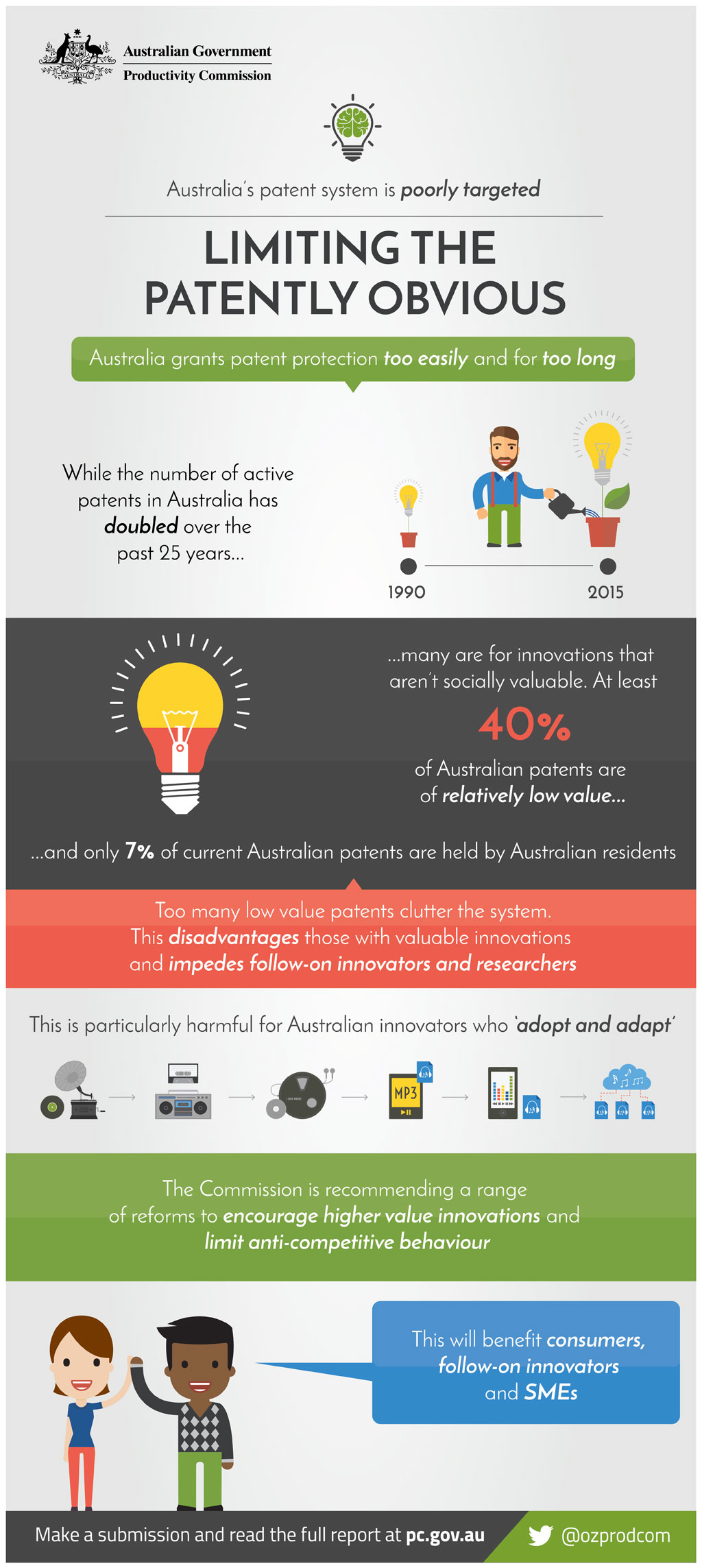
- Australia's patent system grants protection too easily, allowing a proliferation of low-quality patents, frustrating the efforts of follow-on innovators, stymieing competition and raising costs to the community. To raise the quality of patents, the Australian Government should:
- increase the degree of invention required to receive a patent, abolish the innovation patent, redesign extensions of term for pharmaceutical patents, limit business method and software patents, and use patent fees more effectively.
- Australia's copyright system has progressively expanded and protects works longer than necessary to encourage creative endeavour, with consumers bearing the cost.
- A new system of user rights, including the introduction of a broad, principles-based fair ;use exception, is needed to help address this imbalance.
- Better use of digital data and more accessible content are the key to reducing online copyright infringement, rather than increasing enforcement efforts or penalties.
- While Australia's enforcement system works relatively well for large rights holders, reforms can improve outcomes for small- and medium-sized enterprises.
- Recent Commission-initiated reforms of the Federal Court, with an emphasis on lower costs and informal alternatives, should improve enforcement outcomes and replicate many of the benefits a dedicated IP court would offer.
- Changes to the Federal Circuit Court are one option for improving dispute resolution options for small- and medium-sized enterprises.
- Commercial transactions involving IP rights should be subject to competition law. The current exemption under the Competition and Consumer Act is based on outdated views and should be repealed.
- Improving IP governance arrangements would help promote a coherent and integrated approach to IP policy development and implementation.
- Multilateral and bilateral trade agreements are the primary determinant of Australia's IP ;arrangements. These agreements substantially constrain domestic IP policy flexibility.
- An overly generous system of IP rights is particularly costly for Australia — a significant net importer of IP, with a growing trade deficit in IP-intensive goods and services.
- The Australian Government should focus its international IP engagement on encouraging more balanced policy arrangements for patents and copyright, and reducing transaction and administrative costs for parties seeking IP ;rights in multiple jurisdictions.
- Improving the evidence base and analysis that informs international engagement (especially trade agreements with IP provisions) would help the Australian Government avoid entering agreements that run counter to Australia's interest.