Expenditure on children in the Northern Territory
Draft report
Please note: This draft report is for research purposes only. For final outcomes of this study refer to the study report.
Download the overview
 Overview (PDF - 925 Kb)
 Overview (Word - 551 Kb)
Download the draft report
Key Points
- Children in the Northern Territory are four times more likely than Australian children overall to come into contact with the child protection system, and face higher rates of socioeconomic disadvantage. To help address this, the Commonwealth and NT Governments commit significant funds to children and family services. In 2018-19, they collectively spent about $538 million, through 9 funding agencies, more than 700 grants, to over 500 service providers.
- Despite these significant resources, the Commonwealth and NT Governments continue to make funding decisions in relative isolation. This has led to fragmentation, inefficiencies in service delivery, and significant overlap in expenditure effort.
- There is inadequate coordination between and within both governments, with each often unaware of what the other is funding and of what is being delivered on the ground.
- It is unclear how the merits of activities for one place are weighed against the merits of activities in another, with the risk of inequitable funding flows driven by the capacity of service providers to apply for funding, rather than by needs and priorities of communities.
- The current approach to funding service providers is largely short term and output focused. This creates uncertainty and inhibits the ability of providers to build capacity, develop trust, and design and deliver culturally appropriate services over the long term.
- There is immense goodwill, positive reforms and pockets of good practice, but a fundamental shift in approach is needed — one that is underpinned by a stronger commitment to transparency and collaboration between governments, service providers and communities. This would help to ensure that governments are collectively accountable for achieving their shared objective — of keeping children and young people safe and well.
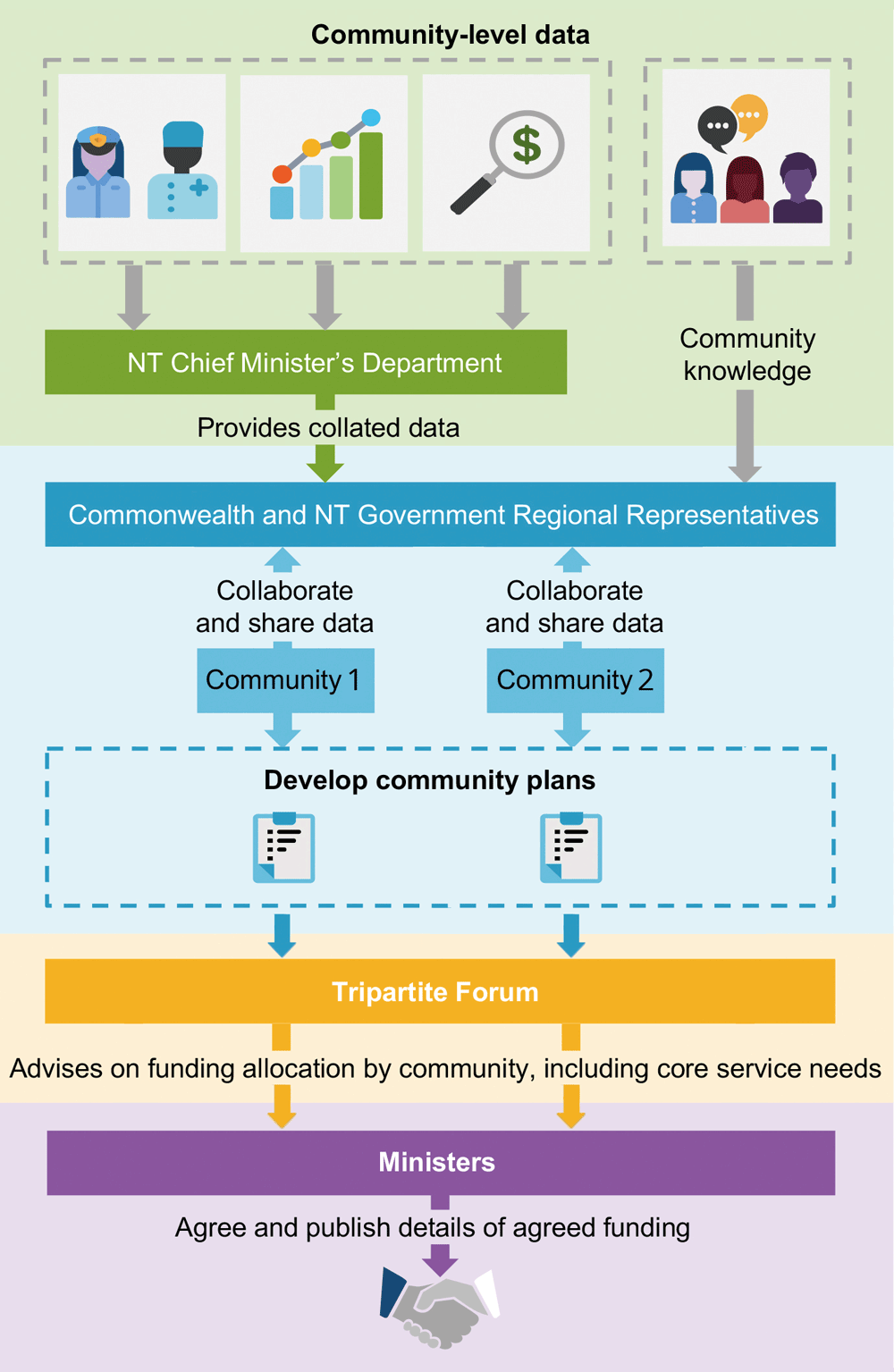
- A formal process — of agreed funding and selected funds pooling — should be established between the Commonwealth and NT Governments. This would involve both governments agreeing on what children and family services each will fund (and where they will pool funds) based on the service needs and priorities identified in community plans.
- Community plans should be developed that provide a snapshot of the strengths and needs of children and families in the community and give community voice about which children and family services they would like to retain, change or replace.
- Governments should transition to longer term contracts (a minimum of seven years) that cover the full costs of service provision and take into account the capacity of providers to deliver outcomes, particularly for Aboriginal communities. This should be supported by a relational approach to contracting, where regional government staff and providers engage in regular collaborative reviews with users on service outcomes and continuous improvement.
- Better use of data and public reporting of progress against outcomes for children and families at the community level is also needed. And both governments need to significantly improve their record keeping for the services they fund, and create and maintain a public services list.
- Stronger supporting institutions will be required. The role of the Children and Families Tripartite Forum should be strengthened to include the provision of advice to governments on funding arrangements. And both governments should ensure that their regional networks have the skills, capacity and authority to collaborate to develop community plans and undertake relational contracting.
- Implementing these reforms will be challenging and will require leadership and long term commitment from governments. The development of a joint funding framework between the Commonwealth and NT Governments would formalise and bolster the reforms proposed in this report. External oversight of the reforms by the NT Children’s Commissioner would also help to embed incentives for implementing the reforms.