
Transforming government organisations

The National Agreement on Closing the Gap (2020) commits all governments to a different way of working with Aboriginal and Torres Strait Islander people through four Priority Reform areas.
Priority Reform Three, transforming government organisations, is about making all government institutions accountable for Closing the Gap, culturally safe, and responsive to the needs of Aboriginal and Torres Strait Islander people.
Many government organisations are already transforming. Read on for stories and learnings on how.
Download the guidance and case studies
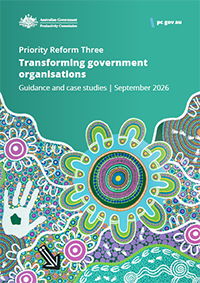
 Transforming government organisations (PDF 22.8 MB)
 Transforming government organisations (DOCX 50.9 MB)
Start your transformation journey
Read stories of government transformation
Hear from senior leaders in the public service
In conversation with Gordon de Brouwer, Australian Public Service Commissioner
Our first ‘in conversation’ interview between our Chair Danielle Wood and Gordon de Brouwer, explores the role of the public service to represent the nation, how to put people and business at the centre of what government does, and what that means for how governments work with Aboriginal and Torres Strait Islander people, organisations and communities. The conversation focuses on building First Nations leadership in the APS, moving from stakeholder management to engagement and partnership, and having the courage to embrace reforms that enable community partnership to improve policy and service delivery.
Gordon de Brouwer: Unless we have Aboriginal and Torres Strait Islander people in positions of authority and clearly in positions of authority, we don't get the right policy and the right service delivery.
We're not going to communities and saying, this is the solution you have to have. It's actually listening and engaging on the solutions that communities see as relevant to them.
Danielle Wood: Hi, everyone. Thanks for joining us.
I'm Danielle Wood, Chair of the Productivity Commission, and I am joined today by Dr Gordon de Brouwer, Commissioner of the Australian Public Service Commission.
Gordon has had a long career in the Commonwealth Public Service and a history of making significant reforms.
Welcome, Commissioner.
During this conversation, we are going to explore a current area of focus for the APSC, transforming government organisations in line with Priority Reform Three under the National Agreement on Closing the Gap.
As many of you will know, the National Agreement on Closing the Gap sets out four priority areas to change the way governments work with First Nations Australians.
Priority Reform Three calls on governments to change their approach to decision making to ensure that Aboriginal and Torres Strait Islander knowledge, experiences and perspectives are reflected in all decisions.
One aspect of this is having more Aboriginal and Torres Strait Islander people in the public service.
Over the past two years, the APSC has been running the SES100 initiative, a targeted effort to recruit and support 100 First Nations SES across the public service.
And I'm very pleased to say that this goal was achieved earlier this year.
Commissioner, congratulations on that fantastic achievement.
I'm really interested to hear from your perspective what having this cohort of First Nations Australians in our senior leadership in the public service will mean and how you think that will shift the way that we go about making decisions within the public service.
Gordon de Brouwer: Thanks, Danielle, and really nice to be here on Ngunnawal country.
I think it's a wonderful thing, the SES100, the fact that over a year and a half, we went from 54 First Nations SES to 100 First Nations SES at the end of 2024 and we're in a second round now for both Band 1 and Band 2 First Nations SES. It's a merit-based process, so it's based on merit, but it's done in a culturally proper way that suits First Nations people.
I think it's, the impact is really, I think, profound. We have a requirement under the Public Service Act that the public service represents the nation and you can only understand the nation if the public service comes from the nation. And that's as much as it is for culturally and linguistic diverse Australians, as it is also for First Nations Australians.
So unless we have Aboriginal and Torres Strait Islander people in positions of authority and clearly in positions of authority, we don't get the right policy and the right service delivery. So people get better policy as a result because of the different sort of experience that people bring and the insight that they have.
But it also means that we can relate much better to communities, because communities can see them, they can see them in us, and they don't treat the public service as being alien then to communities.
So I think it gives you better policy, better service delivery, and that's good for Australians, and it’s also a statutory duty.
Danielle Wood: So we've got to the 100, which is fantastic. Where to next for this initiative?
Gordon de Brouwer: So it's very much on the employment side and Priority Reform Three isn't just employment, but it's got other dimensions around, especially how you relate to the community.
But what it means on employment is that we've got a scope for a lot more First Nations employees in the service.
And also for recruitment, it means that people can see themselves. It's really big. It really matters. When people say that they can't see themselves in the senior ranks of an organisation, they don't stay and they don't participate and they don't feel like they can contribute. When they can see themselves, they do. And you can see that with all the different groups when they talk about, ‘am I in the service, can I be seen?’
So we want more of that. We've got things lined up already in play for leadership and talent development both at the executive level, but also for Band 1 and Band 2 First Nations.
We run quite a systematic talent development program to make people be the best public servant that they can be, to do the job the best they can and we have special First Nations programs that do that. So that's to bring in, but also to keep and grow that talent.
Danielle Wood: Priority Reform Three is broader than employment. It's about sort of fundamentally changing the way that we work to bring First Nations experiences into decision making. That kind of change is big, it takes time, it's hard.
What do you see when you look across the service in terms of how quickly we're adapting and do you see sort of pockets of good practice in responding to that challenge?
Gordon de Brouwer: I think there are some great areas of excellence, including in health and other dimensions.
More generally, there's a change underway. It's probably framed more generally of how does a public servant engage with the public on a matter?
And we used to talk about stakeholder management, which was really a way of controlling people. You go and tell them what government is doing, and management means a form of control. We then talked about stakeholder engagement, a bit more open. Here we're going to tell you what we're doing, and we'll listen to what you think.
But the really more advanced forms of engagement are through co-design and partnership with communities, where you bring the apparatus of the state to support communities in their own decision making. Not us telling them what to do, but actually communities saying to government, this is how you can help us achieve our objectives.
That's front and foremost with First Nations. When you think around the nature of the closing the gap agenda and the problems or the issues that have arisen, it's that lack of self-determination and control over those matters that affect people.
This nature of the shift of talking from engagement to partnership is big. And on the First Nations side, we've just put out, just released a Playbook on partnership with First Nations. Really, how do you engage and partner with First Nations? It's got some very practical guidance around that.
And that's something that we're seeing across secretaries and across departments, really strong interest in.
So there's something around how public servants do their job, and it's very particularised then in the First Nations space. And that can be a game changer.
We're not going to communities and saying, this is the solution you have to have. It's actually listening and engaging on the solutions that communities see as relevant to them. It's quite a big shift.
Danielle Wood: So it's when you engage in the process as well as how you engage.
Gordon de Brouwer: Yes, yeah, exactly. And both. And early in understanding.
And it's not the idea of us to go out and just tell people what kind of policy is for them. It's actually how do they determine their lives? And again, bring that power of the state and the funding, the approaches, the insight to support local communities or regional communities in that.
Danielle Wood: And that Playbook is something that's available for everyone working in the APS that might be grappling with these issues?
Gordon de Brouwer: It is, and it's on the APSC website. It's an internal facing document, so it's designed to help public servants do it, but we've made it, it's publicly available so that people can see what we're doing as well.
Danielle Wood: I mean, given some of the challenges that you're talking about, you know, it is clear that we need courageous leadership and advocacy to keep that momentum going.
You know, love to hear about how you think about this in your role as APS Commissioner in kind of pushing that transformational reform that sort of public service is undergoing.
Gordon de Brouwer: Well, I think that one, even just the idea of partnership is a courageous thing.
="" p="">
But it takes courage to do it. Because sometimes you've got to take a risk. You've got to say what matters to you and we're in constrained resources, so we may not be able to do it. Maybe we know that there may be ways that people want that maybe the government doesn't like, or they've got their own preferences. So that's part of bringing that together. That takes courage, but that's a good thing for public servants to have that courage.
It also means understanding the community and people in their terms, on their terms, rather than just expecting them to be like us, which is again why diversity matters, because the ‘us’, if it's a diverse group, then actually we understand the community much better and we're trusted more.
So that's a challenge though too, that it's a more a collective or a group sort of interaction. Again, it means giving up control and that means letting people exercise power over their own lives. And that's not always easy.
Danielle Wood: I think that's a fantastic call to action, be bold, give up control, have a look at the Playbook.
Commissioner de Brouwer, thank you so much for sharing your insights and reflections with us today. You know, changing the systems and cultures in the public service is a long journey, but your leadership, I think, has really set the tone for the service.
We very much appreciate your time and look forward to seeing how transformation aligned with the priority reforms continues to shape the APS. Thank you.
Gordon de Brouwer: Thank you very much.
In conversation with Katherine Jones PSM, Secretary of the Attorney-General’s Department
In our second episode, Katherine Jones discusses implementing Priority Reform Three of Closing the Gap with our Chair Danielle Wood, focusing on agency-wide reform, cultural safety led by First Nations staff, and boosting First Nations employment. Katherine also highlights co-design lessons including active listening, supporting community priorities, and long-term engagement.
Danielle Wood: Hi, I'm Danielle Wood, Productivity Commission Chair, and I am joined today by Katherine Jones, Secretary of the Attorney-General’s Department and Chair of the Indigenous Champions Network.
Today we're going to be talking about Katherine's efforts to implement Priority Reform Three of the National Agreement on Closing the Gap. Thank you for being with us, Secretary.
Katherine Jones: Thanks for having me.
Danielle Wood: As many of you will know, the National Agreement on Closing the Gap sets out four Priority Reforms to change the way that governments work with First Nations Australians. Priority Reform Three requires governments to structurally transform to ensure that they are responsive to the needs of Aboriginal and Torres Strait Islander people.
Transformation of this kind involves changes to culture, systems and processes of government organisations. Katherine, your leadership both within AGD and across the public service means a great deal, I think, to those that are looking for meaningful change in this area.
So, I'm really keen to start with your work leading the Indigenous Champions Network. What is the network and what are you hoping to achieve with it?
Katherine Jones: So, the Champions Network brings together Indigenous champions that are in every department, every agency right across government. So really broad reach, people at different levels in their organisations, but all of them that have been chosen by their organisations to lead the engagement on First Nations issues around Closing the Gap and supporting First Nations staff.
So, I've got to say it's the privilege of my career because it's bringing together, I get to come together with people who are just so passionate about driving genuine change in their organisations and really supporting First Nations colleagues across the service.
Danielle Wood: Fantastic. And what are some of the things when you get together, what are some of the initiatives of the network?
Katherine Jones: We've set ourselves three key goals or priorities that we focus on. And the first is implementation of Priority Reform Three.
Danielle Wood: Excellent.
Katherine Jones: Transforming the way that government engages with First Nations communities and delivers on the Closing the Gap targets.
So that's our number one priority, supported by looking at cultural safety and having very honest, frank, difficult conversations about what it means, listening to First Nations staff's views of what cultural safety means, and thinking about how we take those conversations back into our own organisations.
And then the third element is what we can do to contribute systematically as well as within our own organisations around boosting First Nations employment. We've had some great successes around First Nations employment in the SES100 space, but there's a lot more that needs to be done at all levels. So that's a big priority for us.
And what I would say is the cultural safety piece and the boosting First Nations employment piece are absolutely mission critical if we're going to achieve progress on embedding Priority Reform Three across government. Because we need to create workspaces that are safe, respectful, inclusive and that First Nations staff can flourish and progress in their careers so that we're better capable of driving the transformation agenda through Priority Reform Three.
Danielle Wood: So, you've mentioned Priority Reform Three there a couple of times. And when you think about or when you kind of reflect on the conversations that you have with senior leaders in the APS, First Nations communities, what do they tell you about how we're progressing, the things we're doing well and the things that we're doing less well.
Katherine Jones: There's certainly success. So I like to try and frame the conversation around Priority Reform Three in terms of success, but recognising that there's a long way to go before we can confidently say that right across the breadth of the public service, we're embedding Priority Reform Three.
So, the first thing I would say is it's not just the responsibility of those areas that have direct connection to First Nations programs or policies. It's not, in my department, we have responsibility for native title, for justice reinvestment. And they are areas of responsibility that are directly relevant for First Nations people. But it's equally as important that our work around the federal courts, our work in privacy, our work in national security, that we're thinking in those spaces around embedding Priority Reform Three.
I think the feedback I get is in those areas where there's capability and maturity and expertise about working with First Nations communities, there's optimism and some progress, although a long way to go. But there are other big parts of government that we need to really drive an awareness that they have to transform and that policy and program areas that don't automatically raise connections to First Nations communities, we need to pause and think, well, actually, anything that's the business of the Australian Public Service has a First Nations, should have a First Nations lens put on it and people need the focus, the accountability and the capability to do that work.
Another area, I think there's some good stories of success around co-design of program and service delivery. I see it a little bit in my space, I'll go back to Justice Reinvestment, which is really a community focused program that's intended to work with communities to come up with very specific community-based approaches to diverting people from the criminal justice system. And it'll look different in every community.
So, what we've had to learn is don't come into the communities with a preordained idea of what is going to work for them. You've got to sit down, listen and be prepared to put flexibility into your programs, into your service delivery to support what the community needs, not tell the community what we think it needs.
Danielle Wood: And what sort of feedback have you had from community on a program like that and how it's working?
Katherine Jones: So we're in relatively early days. I think there's feedback that goes to having a sense of ownership that makes people feel that this is something that they have some influence on. That's very meaningful and I think addresses perhaps some of the understandable cynicism about another government program coming in.
The second bit of feedback is though you need to commit for the long term. You can't just do this for a year or two and then decide that you're going to go and do something somewhere else. So, they're looking for a long-term commitment. They're looking for ensuring that within the program, their decision making is influential, if not paramount.
And that's the hard space for government because we've got all our accountability, our frameworks and our, probably in our DNA, the way that government works is to be the ultimate decision maker with programs. So that's why I do think about it as a transformation. It's a big transformation and I think it's going to take many more years until we're really adept at that and that we do it in all parts of government.
Danielle Wood: Interesting. Very similar themes. We were talking with Gordon de Brouwer, the public service commissioner before, and he was talking about the need to be bold and to shift that kind of paradigm of control. So interesting to hear that reoccur.
What role has the Priority Reform branch that I understand you've established here in the Attorney General's Department, what role has that played in thinking about how to run those programs and policy areas differently?
Katherine Jones: They're a fantastic team. The establishment of that branch reflects a commitment from myself and the senior leadership of the organisation that we need to have the institutional capability to be able to engage with community, engage across government, and have dedicated focus not only in terms of supporting work like in the justice reinvestment area, but engaging with every part of our department and talking to people about what Priority Reform Three really means, talking to them about how they need to adjust their approach to their policies or programs, creating spaces where people can be vulnerable, to be honest with you.
We have a lot of people that I think have very genuine intent and that they really want to understand closing the gap, but they think, I'm not quite sure how to even tackle that. I'm not quite sure how to approach it.
Having the opportunity to speak to everyone across the department to think about what it means in their space, to think about what the capability is they need in their space to engage with peak organisations, to engage with community, to learn the craft or relearn the craft of being a public servant when your approach is around co-design and giving responsibility for decision making to entities outside of government.
So, it's an APS craft thing to some degree, but having that team with their expertise, their understanding of engaging with community is making a really significant change in our department and supporting further change.
Danielle Wood: Fantastic. Well, it has been so wonderful to hear from you about those initiatives. The Indigenous Champions Network, the work you're doing in AGDs, I think is really inspirational for public servants grappling with this question of what does Priority Reform Three look like and what does good look like.
So, we're so grateful you could take the time to join us today.
Katherine Jones: Great. Thank you.
Danielle Wood: Thanks so much.
Acknowledgements
The Productivity Commission acknowledges that Aboriginal and Torres Strait Islander people are the first storytellers of this land and Traditional Owners of Country on which we now live and work. We recognise their continuing connection to lands, waters, communities and cultures. We pay our respects to Aboriginal and Torres Strait Islander cultures, and to Elders past and present.
Aboriginal and Torres Strait Islander people should be aware that this research series may contain the names of people who have since passed away.
The Productivity Commission thanks staff from the Coalition of Peaks, Aboriginal Community-Controlled Organisations and government agencies who generously shared their stories and insights to develop this research series.