Overcoming Indigenous Disadvantage: Key Indicators 2014
The Overcoming Indigenous Disadvantage report measures the wellbeing of Australia's Indigenous peoples. The report provides information about outcomes across a range of strategic areas such as early child development, education and training, healthy lives, economic participation, home environment, and safe and supportive communities. The report examines whether policies and programs are achieving positive outcomes for Indigenous Australians.
The 2014 report which was release on 19 November 2014 shows that, nationally, for Aboriginal and Torres Strait Islander Australians:
- economic outcomes have improved over the longer term, with higher incomes, lower reliance on income support, increased home ownership, and higher rates of full time and professional employment. However, improvements have slowed in recent years
- several health outcomes have improved, including increased life expectancy and lower child mortality. However, rates of disability and chronic disease remain high, mental health outcomes have not improved, and hospitalisation rates for self-harm have increased
- post-secondary education outcomes have improved, but there has been virtually no change in literacy and numeracy results at school, which are particularly poor in remote areas
- justice outcomes continue to decline, with adult imprisonment rates worsening and no change in high rates of juvenile detention and family and community violence.
Please note: Aboriginal and Torres Strait Islander people are advised that this website may contain names, images and voices of deceased people. It may also link to other websites which contain names, images and voices of deceased people.
Download the report


At A Glance
Overcoming Indigenous Disadvantage 2014
The 2014 Overcoming Indigenous Disadvantage (OID) report released today shows some positive trends in the wellbeing of Aboriginal and Torres Strait Islander Australians, with improvements in health, education and economic outcomes. However, results in areas such as justice and mental health continue to cause concern.
The report shows that, nationally, for Aboriginal and Torres Strait Islander Australians:
- economic outcomes have improved over the longer term, with higher incomes, lower reliance on income support, increased home ownership, and higher rates of full time and professional employment. However, improvements have slowed in recent years
- several health outcomes have improved, including increased life expectancy and lower child mortality. However, rates of disability and chronic disease remain high, mental health outcomes have not improved, and hospitalisation rates for self-harm have increased
- post-secondary education outcomes have improved, but there has been virtually no change in literacy and numeracy results at school, which are particularly poor in remote areas
- justice outcomes continue to decline, with adult imprisonment rates worsening and no change in high rates of juvenile detention and family and community violence.
'It has been almost three years since the last OID report. For this report we made a concerted effort to increase the involvement of Aboriginal and Torres Strait Islander Australians. Their input contributed to significant developments, including broadening the focus from overcoming disadvantage to improving wellbeing, and the inclusion of new indicators, such as Indigenous language revitalisation and maintenance, valuing Indigenous cultures (including experiences of racism and discrimination) and participation in decision making' said Peter Harris, chairman of the Productivity Commission and of the Steering Committee.
The OID report is the most comprehensive report on Indigenous wellbeing produced in Australia. It contains accessible data for an extensive range of wellbeing measures as well as case studies of programs that have led to improved outcomes. “This report should be compulsory reading for anyone interested in outcomes for Aboriginal and Torres Strait Islander Australians or working in service delivery or program design,” said Commissioner Patricia Scott, who convenes the expert working group that advises on the report.
The report is a product of the Review of Government Service Provision. It is overseen by a Steering Committee comprising senior officials from the Australian, State and Territory governments, and supported by a secretariat from the Productivity Commission. This report is the sixth in the series, which traces its origins to the final report of the Council for Aboriginal Reconciliation in 2000.
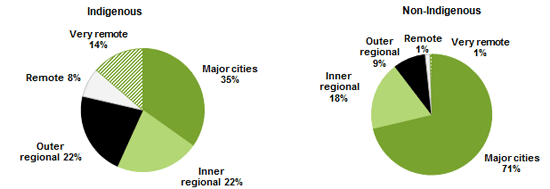
- This report measures the wellbeing of Aboriginal and Torres Strait Islander Australians, and was produced in consultation with governments and Aboriginal and Torres Strait Islander Australians. Based on 2011 Census data, as at June 2011, around 3 per cent of the Australian population (approximately 670 000 people) were estimated as being of Aboriginal or Torres Strait Islander origin.
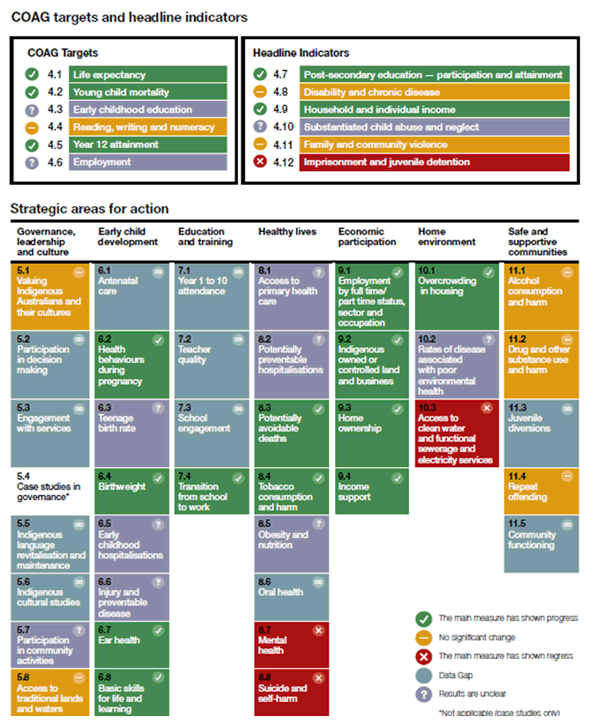
- Outcomes have improved in a number of areas, including some COAG targets.
- The gap in life expectancy narrowed from 11.4 years to 10.6 years for males and from 9.6 years to 9.5 years for females from 2005-2007 to 2010-2012.
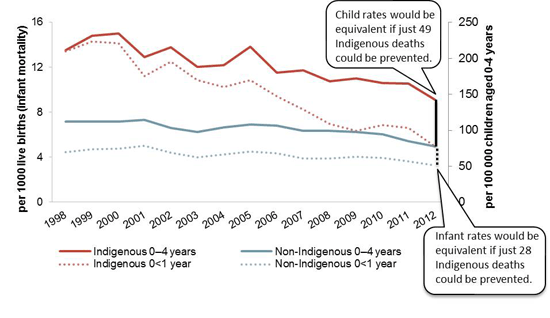
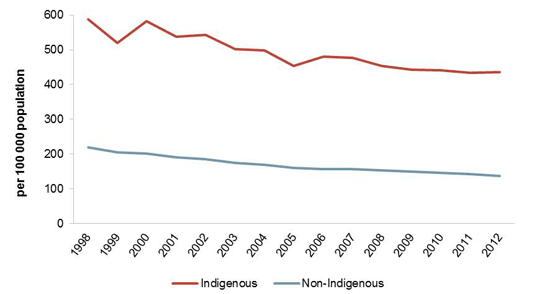
- Mortality rates for children improved significantly between 1998 and 2012, particular for 0<1 year olds, whose mortality rates more than halved (from 14 to 5 deaths per 1000 live births). In addition, the proportion of low birthweight babies has decreased.
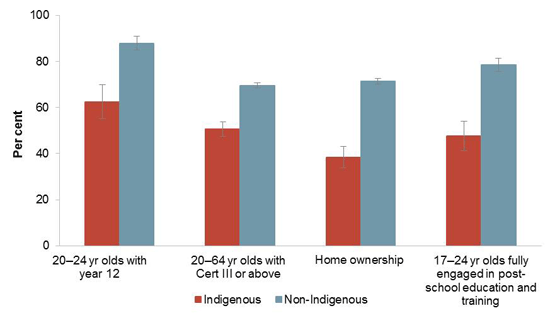
- The proportion of 20-24 year olds completing year 12 or above increased from 45 per cent in 2008 to 59 per cent in 2012-13.
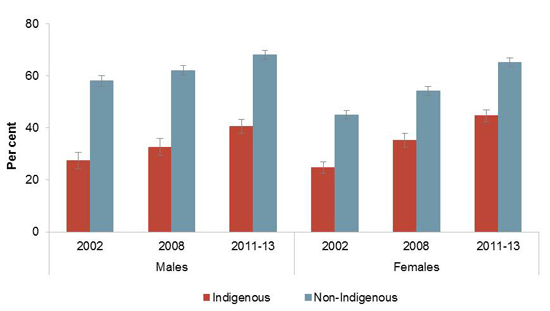
- The proportion of 20-64 year olds with or working towards post-school qualifications increased from 26 per cent in 2002 to 43 per cent in 2012-13.
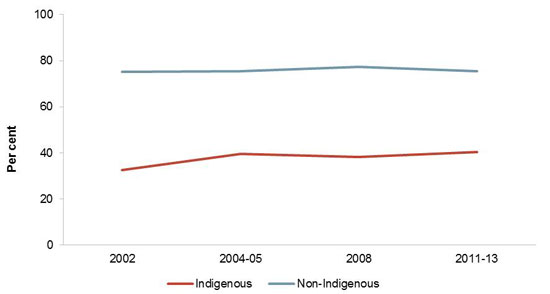
- The proportion of adults whose main income was from employment increased from 32 per cent in 2002 to 41 per cent in 2012-13, with a corresponding decrease in the proportion on income support. Increasing proportions of employed people were in full time and managerial positions.
- However, there has been little or no change for some indicators.
- There was virtually no change in the proportions of students achieving national minimum standards for reading, writing and numeracy from 2008 to 2013.
- Relatively high rates of family and community violence were unchanged between 2002 and 2008, and there was little change in alcohol and substance use and harm over time.
- Relatively high rates of disability and chronic disease have not changed.
- Outcomes have worsened in some areas.
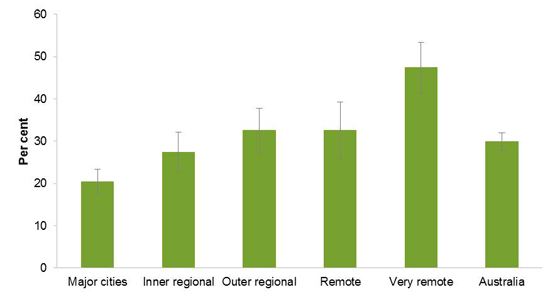
- The proportion of adults reporting high/very high levels of psychological distress increased from 27 per cent in 2004-05 to 30 per cent in 2012-13, and hospitalisations for intentional self-harm increased by 48 per cent over this period.
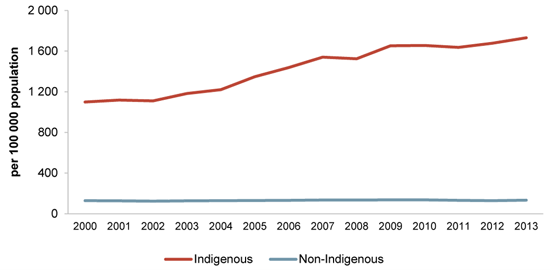
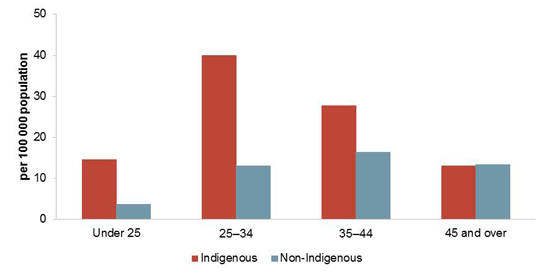
- The adult imprisonment rate increased 57 per cent between 2000 and 2013. Juvenile detention rates increased sharply between 2000-01 and 2007-08, and fluctuated since at around 24 times the rate for non Indigenous youth.
- Change over time cannot be assessed for all the indicators - some indicators have no trend data; some indicators report on use of services and change over time might be due to changing access to services rather than changes in the underlying outcome (for example, child protection rates); and some indicators include related measures that have moved in different directions (for example, children's hospitalisations for injury and disease have increased but death rates have decreased).
Video: Overcoming Indigenous Disadvantage 2014
Overcoming Indigenous Disadvantage 2014
The Overcoming Indigenous Disadvantage Report 2014 is the most comprehensive wellbeing report of its kind, produced in Australia.
More than data, statistics and measurements, the report tells the very real story of the wellbeing of Aboriginal and Torres Strait Islander Australians.
It's about the strengths and resilience of Indigenous peoples across Australia preserving culture, improving health, increasing education outcomes and employment opportunities and cultivating strong leadership and governance.
If you want to know about the wellbeing of Aboriginal and Torres Strait Islanders and are interested in policy and service delivery, this report is a must read.
For Indigenous Australians, just like me, the report highlights positive change and progress. It also tells us where there are gaps in outcomes compared with non-Indigenous people and where there is more work to do.
Let's take a closer look.
More young people are completing Year 12.
Getting educated - 59% of young people had completed year 12 in 2012 - 2013.
And getting post Year 12 qualifications.
Indigenous Australians who have a bachelor's degree are just as likely to get a job as other non- Indigenous Australians with the same qualification.
We're living longer.
Birth weights are improving and infant mortality is falling.
We're smoking less.
We're earning more, working full time, in senior, professional roles.
And as a result relying less on government.
Our culture and history is regarded as important by over 80% of all Australians.
While there's good news, there remains some very serious issues for our people.
We're still over-represented in the criminal justice system as both victims and offenders.
The number of our youths in detention got worse as did the number of Indigenous adults in prison.
The rates of child abuse and neglect remain very high.
Our mental health issues occur at a higher rate than non-Indigenous Australians.
With psychological distress three times higher.
And suicide and self-harm two times higher.
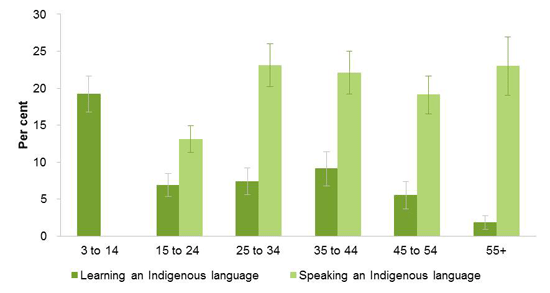
The number of Indigenous languages being spoken continues to decrease, posing a challenge to preserving our native tongues.
But is offset with Indigenous speakers holding steady at 17% with 20% of our youth actively learning an Indigenous language.
Some of the positive outcomes can be linked to successful programs that are making real differences like.
'Families as First Teachers' in the Northern Territory, which is run in 21 remote Indigenous communities since mid 2011, the program promotes early learning and parenting support. Since starting, pre-school enrolments in those communities has increased.
The Yiriman Project, taking young people and elders on trips back to country to immerse them in the stories, songs and knowledge of their cultural heritage - building confidence and self-esteem, helping curb suicide, self harm and substance abuse in participating communities. So go on explore the facts and share in our wellbeing - where we've come from and where we heading too.
You can find the complete report plus overviews and fact sheets on the Australian Government Productivity Commission website www.pc.gov.au
And join in the conversation on Facebook and Twitter. Use the handle @oidozprodcom
It's about yesterday, today and tomorrow.