
Growing trust and trusting growth: the economic case for integrity

Speech
23 September 2026
In this Centre for Public Integrity Oration, Danielle Wood explores why trust matters for economic growth – and why economic growth matters for trust.
She argues that the integrity of our governments and institutions is essential to our long-term prosperity, in part because it engenders public trust. As trust has declined, she says, governments have found it harder to make the kinds of reforms we need to grow the economy, in turn further eroding trust.
To avoid that downward spiral, she calls for governments and pundits to focus on delivery, encourage honest policy debates that are realistic about trade-offs, and avoid denigrating our institutions.
Download the speech
 Growing trust and trusting growth: the economic case for integrity (PDF 404.7 KB)
Read the speech
Thank you hugely for the opportunity to be here on beautiful Gadigal land. And thank you to Clayton Utz for providing this wonderful space so we can best admire it.
I am a long-time follower of the work of the Centre for Public Integrity, and was chuffed to receive the invite from the Hon Anthony Whealy KC and Dr Catherine Williams to deliver the Oration this evening.
It prompted a memory of an interaction I had when I was CEO of Grattan Institute and invited to speak on a panel at an administrative law conference.
The topic was the politicisation of government grants — the polite lawyer way of saying pork barrelling. Another member of the panel was a former politician whose view was that administrative checks and balances were unnecessary because ultimately the public would have their say every three years.
That view was accompanied by a string of pretty strong invectives against the Centre for Public Integrity. You had evidently upset him on the topic at some point. And while I was grateful to not be on the receiving end of the tirade, I remember thinking, ‘wow — the CPI is clearly cutting through’.
And that view has only strengthened. I believe that as a nation we are a better place for the Centre’s work.
Whatever politicians might say, the average citizen is not spending their weekends steeped in the minutiae of donations data or flicking through audit reports over their morning coffee.
The Centre’s work highlights the biggest threats to decision making in the national interest and what governments can do about them.
Tonight I want to focus on why that matters.
And in particular, why it matters for the health of our economy.
It is of course not the only reason we should care about public integrity. But it is an important one that is often overlooked. And one that is ultimately felt in the living standards of all Australians.
Economic growth: a short love note
Let me just start with a short love note to economic growth, because I suspect the audience might be a little heavier on legal rather than economic qualifications this evening.
And while I learned from my time at the ACCC that all almost lawyers secretly consider themselves to be ‘natural economists’, a little refresher never hurt anyone...
Over the long run, our material living standards are determined by economic growth — and specifically productivity growth. Productivity growth happens when we improve our skills, technology and ways of working so that for each hour worked we produce more or higher-quality goods and services.
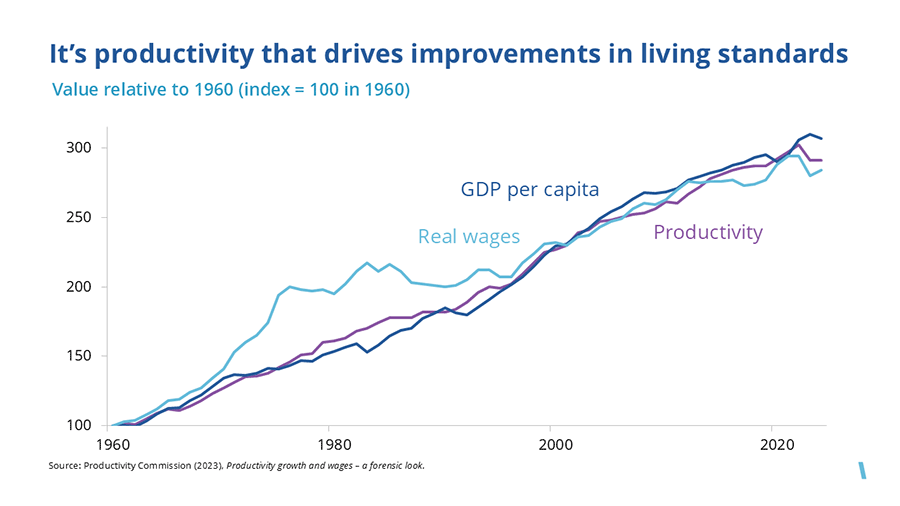
Higher productivity is the reason the average Australian today has an income triple that of the average Australian in 1960. 2
Now, strangely, when I had my daughter, none of the other parents in the maternity ward seemed to be looking at their wrinkly newborn and dreaming that they would inherit a world of steady productivity growth of a couple of per cent a year.
But I think we all hope that future generations will be better off than us — less stressed about paying the rent, able to afford an unforgettable family holiday or the latest healthcare treatments, and maybe without having to work so much to achieve it all.
And that’s what productivity enables.
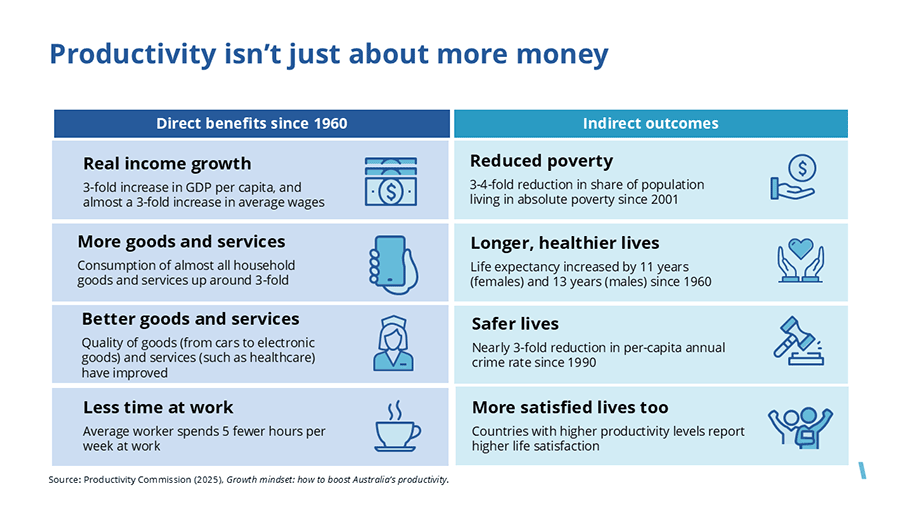
Our ability to produce more with less is the reason that Australians have longer, healthier lives, less poverty, and more and better goods and services AND work 5 fewer hours per week than the Australians of the 1960s. 3
Corruption reduces economic growth
Now that we are all pro-growthers, let me start with my most straightforward proposition of the evening: corruption is bad for growth.
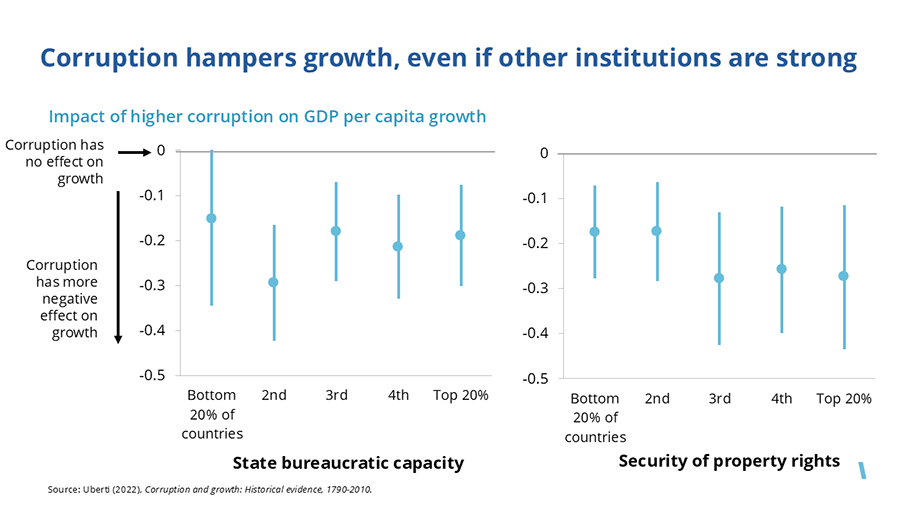
Countries with a higher level of corruption have a slower rate of economic growth. 4 That relationship holds across different levels of state capacity and property rights — corruption is corrosive even if other institutions are strong. 5
That corrosion happens through many different channels.
First, corruption acts as a tax on business activity — and an uncertain tax at that. How much will I have to bribe someone to get a licence to operate? Is the government going to give a leg-up to my competitors?
Foreign investors are less likely to invest, 6 and some potential businesses never even get a start. We see this in reverse when governments crack down on corruption: the number of businesses in the sectors most dependent on government relationships grow. 7 On the other hand, share market returns for luxury goods firms decline. 8 A corruption purge is not a good time to be all in on superyachts...
Corruption also discourages innovation and investment in R&D — what’s the point in sweating over a new discovery when you can just boost market share through a sweetheart deal? 9But collectively, this means we miss out on the benefits of innovation and its flow through to higher productivity.
As well as wasting talent, corruption wastes public resources. The IMF found that more corrupt countries are less efficient in delivering infrastructure projects, adding to the cost to the public. 10 And tilted selection processes for grants reduce the payoff for society. In China, for example, public R&D subsidies generated more patents after an anti-corruption campaign cleaned the process up. 11
Even more fundamentally, tax breaks for mates or stacked procurement processes mean less money for public goods, such as health and education, which improve both the lives of everyday citizens and the productive capacity of the economy. 12
A more corrupt environment also creates the incentive for the proliferation of ever more red tape and delays — or from the corrupt bureaucrat’s perspective, more opportunities to clip the ticket. 13 All that red tape throws sand in the gears of economic dynamism.
And lastly, corruption can erode some forms of what economists call ‘civic’ or ‘social capital’ — essentially the trust between fellow citizens. 14 Despite our reputation as lovers of naked self-interest, economists since Adam Smith have known that markets depend heavily on shared norms of honesty, fair dealing, and co-operation among strangers. A country where suspicion and distrust are rife is a country with weaker financial institutions and fewer mutually beneficial deals. 15 I’m sorry to tell you that no lawyer, even the ones in this room, can contract for every eventuality.
Even when corruption is grey
Now I understand these costs might be more obvious in countries where bags of money regularly change hands. And while our corruption commission case histories suggest we aren’t immune from the old paper bag of cash now and again, a far more common problem in Australia is so-called ‘grey corruption’.
Grey corruption is a broad term that encompasses any actions where governments exercise their powers to favour private interests or political interests over the national interest. This can include being influenced by money or favours, nepotism, and our old friend pork barrelling — where money is allocated based on a political calculus rather than a sound policy rationale.
This grey corruption can chill economic activity through many of the same channels as more traditional corruption.
The Centre for Public Integrity has documented many of these shades of grey, from the role of money in politics to lax lobbying rules. 16
It has also been a theme of the Productivity Commission’s work over time.
We’ve argued for caution on undisciplined support for particular industries — not just because of the waste of taxpayers’ money from failures to ‘pick winners’ but also the risks that open up as soon as governments declare there are winners to be picked. 17 The ROI from lobbying, donations, and other forms of currying favour can look more attractive than those from innovating or driving efficiencies if the government puts large enough pots of money on the table.
Similarly, our 2014 public infrastructure inquiry highlighted the risks from infrastructure investment decisions being made on political, rather than cost-benefit, grounds. 18 The costs of politicisation might be invisible but they are insidious — more worthy projects and communities missing out, lower growth, and wasted taxpayer dollars.
Now, this is the grey bit of grey. Governments should fund public infrastructure projects and there are some legitimate cases for industry policy. 19 But processes and transparency are crucial to ensure the laundry stays white. Clear criteria, open processes, independent assessments, budget rules, and transparency on the costs and benefits 20 can all help reduce the long-term growth-sapping risks of wading in the grey.
The flip side: strong institutions matter
One of the best safeguards against corruption and its insidious economics effect is strong institutions acting in the national interest.
As Catherine mentioned in her opening, economists Daron Acemoglu, Simon Johnson and James Robinson won the 2024 Nobel Prize in Economics for their work highlighting the impact of institutions on long-run differences in national prosperity. They argue that inclusive institutions that protect property rights and give people a stake in the economy foster investment in technology and skills — both crucial to long-run growth. 21
Now, the contrast between a banana republic — or perhaps a banana autocracy — and a modern liberal democracy is clear. But once you’ve got the basics in place — rule of law, property rights, some public education — does it matter if your institutions are 10% ‘better’ than your neighbour’s?
New work suggests that even marginal improvements in institutional quality do have real economic effects.
One example is ease of access to the judicial system. Long delays in court processes make it riskier for firms to sign contracts with suppliers, stymieing potentially beneficial deals. 22 There’s also some evidence delays discourage entrepreneurs 23 and add to the costs of bankruptcy. 24
Another case where the shades of grey matter is central bank independence. International work suggests even when central banks are legally independent, governor appointments that have a tinge of political association lead to higher expected and actual inflation. 25 It’s not just central banks: more political appointments tend to result in worse performance across a range of institutions. 26
In the regulation space, the literature suggests there’s a big difference between a watchdog that’s muzzled and one that’s nipping at your heels. The closure of some competition regulator offices was followed by an increase in some collusion indicators. 27 A month-long financial regulator shutdown saw insider trading increase. 28 An understaffed banking regulator meant higher odds of bank failure. 29
So where do Australia’s institutions sit on the sliding scale?
We are lucky to have a long history of effective institutions. First Nations Australians cared for Country in a way that sustained Australia’s lands, water and people for millennia, bound by cultural, environmental, and relationship obligations. 30
In our more recent history as a federation, we were early to women’s suffrage — pretty radical in 1902 — and compulsory voting — still pretty radical by international standards today.
Another of our innovations, the secret ballot — or the ‘Australian ballot’ as it was known — was so successful in reducing intimidation and corruption at elections that it was quickly copied elsewhere. And our system of preferential voting has been admired around the world for the ‘centripetal force’ and political stability it encourages. 31
I haven’t crunched the numbers, but I reckon Australia’s electoral reforms must be close to iron ore when it comes to our leading exports.
But much of what makes our elections free and fair is the more prosaic work of our strong independent institutions. We were early to appoint specialised election administrators who were relatively free from political interference, and that independence was formalised in 1984.
In more recent decades we have continued to build out the set of economic and integrity bodies that push us towards better and cleaner governments — even if they all draw from the same blue-grey logo palette...
On the economic side, we have an independent central bank to set interest rates; independent regulators for corporations, competition and consumer issues, utilities and financial services; a parliamentary budget office to provide independent budget analysis, and a well-respected statistical agency. Not to mention a productivity commission to give advice on policy issues — quite a rare beast by international standards!
Our integrity ecosystem spans everything from auditors general to corruption commissions to independent appeals bodies.
All of these rely on a degree of separation from political considerations and control to work.
The central bank can decide it’s in the best interest of the nation to put up interest rates immediately before an election, the auditor-general might bell the cat on politicised grants programs, and the statistical agency can release statistics that run counter to the economic narrative of the government of the day.
To do this they rely ultimately on the professionalism and impartiality of their boards, senior leadership and staff.
To enable this national interest lens, many countries, including Australia, have embraced independent statutory officers to head up these institutions, often with some oversight from parliaments. Australia has enjoyed long standing bipartisan support for these arrangements.
But they are not invulnerable. Work or referrals can be withheld, political responsiveness can be considered in recruitment decisions, institutions can be starved of resources for pursuing their agendas too robustly.
The ‘democratic backsliding’ witnessed in some countries in recent years shows that we cannot take institutional strength for granted. 32
Our institutional fabric depends on norms and good faith from political leaders. And in turn, those norms depend on public trust. When people value and respect independent institutions, attempts to undermine them come at a political cost. When that trust erodes, institutions become far more vulnerable.
A crisis of trust?
Now, bemoaning the loss of trust in politics and to some extent institutions is not a new hobby. I co-authored a report called A crisis of trust a decade ago, and even then it was feeling a bit cliché. 33
Trust in government has been declining for decades although there has been some improvement in recent years. 34
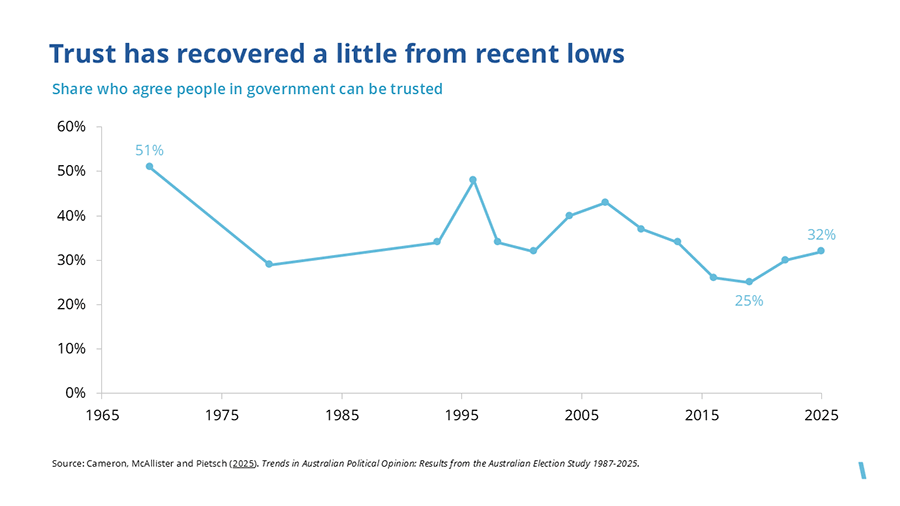
And trust in institutions has largely held up, at least until recently. Across measures of government and institutions we tend to perform relatively well by OECD standards. 35
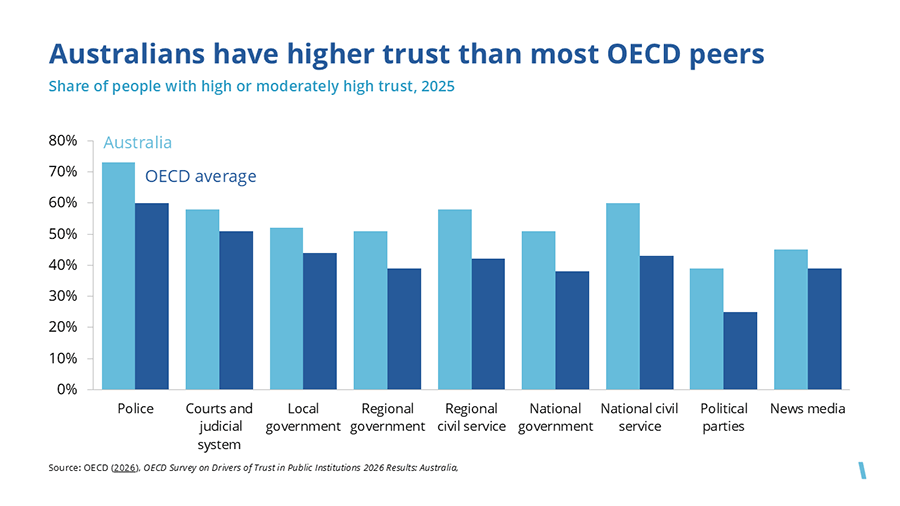
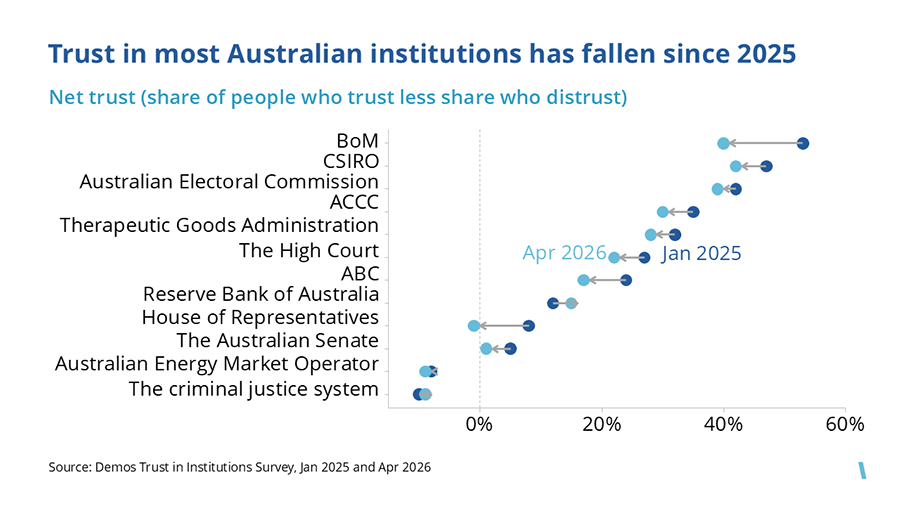
Now we need to be a little bit careful with this data. The survey was taken in 2025. In the months since we have seen an extraordinary shift in political polls and warning signs of declining trust in institutions in other surveys. 36
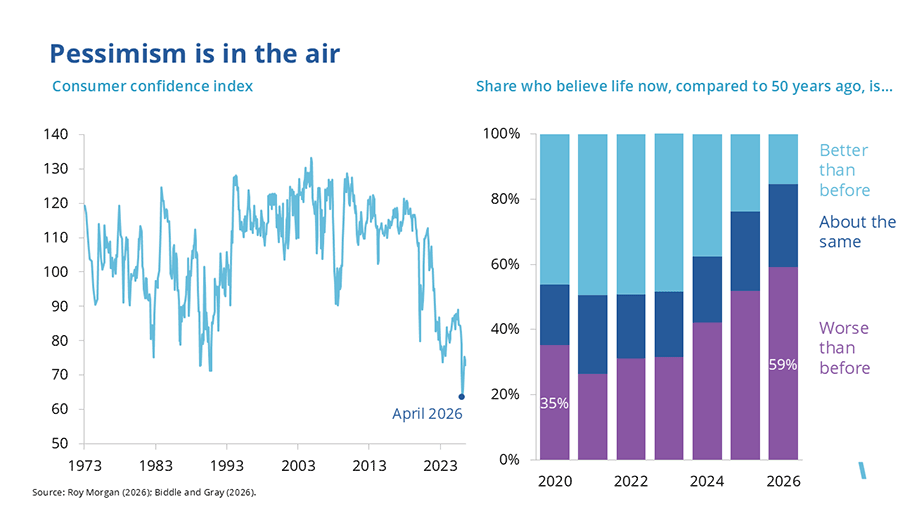
The same period has seen a decline in consumer sentiment. 37 There’s a real pessimism in the air, so much so that that almost 60% of Australians now say that life is worse than 50 years ago 38 — stagflation and polyester leisure suits notwithstanding!
The cost of declining trust
Where does this leave us? Australians are economically dissatisfied and there are early warning lights that trust in both governments and institutions may be on the decline.
I talked earlier about the ways in which corruption can reduce growth. A loss of trust can have many of the same effects — it’s been linked to economic impacts from higher tax avoidance to lower entrepreneurship. 39
Loss of trust also makes it harder for governments to take on difficult reforms. 40
Major policy reform is inherently an exercise in trust — trust that the government is pursuing a reform because it is in the national interest, trust in the modelling of the costs and impacts, trust that any promised compensation will be delivered, trust that implementation issues can be ironed out.
Without trust, big reforms stand little chance of survival. 41The scare campaigns are so target rich that direct hits are almost inevitable.
And so, in a low trust environment, governments find it harder to do the reforms needed to boost economic performance and respond to new and evolving challenges. 42
Yet that very failure risks feeding further distrust. The core macroeconomic variables — growth, unemployment, and inflation — are strong predictors of trust in government. 43
Economic stagnation and declining trust are a vicious cycle we should work hard to avoid.
Growing trust: towards policy making in the national interest
So let me turn now to what can governments can do to rebuild trust and hopefully avoid that downward spiral.
A first order response is integrity guardrails to stop governments doing the wrong things.
The types of conduct the Centre has shone a light on for a decade — graft and corruption, entitlement misuse, the revolving door, paying for access, pork barrelling — have a range of undesirable economic effects as I noted earlier. But they also all erode the public’s faith in politics. 44 Every time one of these scandals hits the front page I feel like hitting my head against a brick wall. Another arrow in the heart of faith in our democracy.
But as well as the bad things, trust responds to whether governments are doing the good things — delivering policy and programs and preserving institutions in the national interest.
Tonight, I want to focus on three shifts on this front that I think can make a difference.
Theme 1: Delivery, Delivery, Delivery
Governments earn our trust when they prove themselves worthy of it by delivering for the community. This is why trust also depends on public service performance — whether governments are delivering the basics well. 45
This is intuitive — people like systems that seem to work well and support them when they need it.
Australians generally have more positive views of our public services than other nations. 46 We are particularly satisfied with our healthcare and education systems, and our ability to find information about administrative procedures.
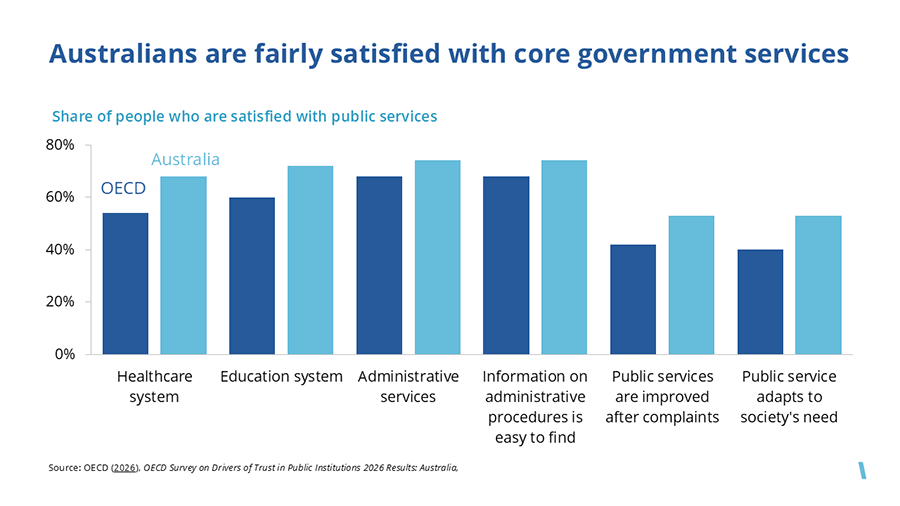
For many Australians, being able to see their local GP with a Medicare card or enrol easily in a local public school is the system working as it should.
Governments might not get bouquets for it — except in The Onion 47 — but it builds some of the connective tissue that underpins trust.
The flip is that when we fail to deliver, that trust is easily lost.
And what matters for how a policy is felt on the ground is how it is implemented.
Too often we ignore the importance of delivery. Our media celebrates or rages against the latest policy announcement, race calls its passage through the parliament and then... it disappears from view.
Spare a thought for the bureaucrats pursuing important but unsexy work — the kind of thing that makes people's eyes glaze over at a party, except maybe in Canberra:
- Those racing to stand up Thriving Kids supports so children with mild to moderate autism or learning delays can be treated in community settings.
- The ones patiently negotiating national licensing rules for electricians so tradies can seamlessly work across state borders.
- Those tirelessly trying to improve the usability and uptake of digital health records so that patients can have a single point-of-call for their medical information.
Because while the caravan of public attention might roll on, the government’s focus on what’s working should not.
One way to keep eyes on delivery is for governments to monitor the quality of the core services they are providing.
The PC publishes regular data benchmarking the quality of state and Commonwealth service provision through the Report on Government Services. 48 Some statistics like 'ambulance ramping times' do jump into public consciousness as a salient symbol of service problems.
Regular surveys are also useful to get a pulse check on how people feel core services are performing. In Victoria this happens annually across all councils — turns out we love our libraries but are decidedly less happy with the standards of public toilets. 49
The Australian Government has done something similar since 2018. In 2025, the news was mainly positive, with the public particularly satisfied with services provided by the Department of Foreign Affairs and Trade, Pharmaceutical Benefits Scheme, and Medicare. 50
Expanding this type of reporting to a broader range of public services, including at the state level, could provide another source of intelligence about where issues may be emerging.
Another crucial part of effective service delivery is scrutinising whether policies do what they say on the can.
The Australian Centre for Evaluation was established in 2023, with the mission of embedding more rigorous and systematic policy evaluation throughout the Australian Government.
High-quality evaluation is critical for better policy making. It can strengthen the case for effective programs and allow us to tweak programs underway to make them work even better. But it also allows us to save money on programs that don’t work.
While the government’s push to test ‘what works’ is welcome, there is more to do. This year’s stocktake identified 847 evaluations completed or on foot, but we are still a long way from rigorous evaluation of every government initiative. 51 And currently only a third of government entities routinely publish their evaluation findings 52 — which is critical to building the accountability feedback loop
Theme 2: Understanding the trade-offs
All of this speaks to the importance of governing well. But to be fair to our governments, this is not always an easy proposition.
Policy makers face tough budget constraints and operate in a complex environment in which rolling shocks have become the norm.
An economist understands this as a scarcity problem: scare money, scarce time, scarce political capital. An environment where trade-offs are very real and must be weighed carefully.
As sad as it might be for me, most people don’t think about the problems of government like an economist.
Think about the scene in the movie Dave where a small business owner with a side hustle as a presidential impersonator ends up serving as the actual President. 53
With a bit of creative thinking — all totted up on a notepad — he finds that he can easily balance the budget without making any painful trade-offs. 54 Cue the applause.
I think this 'Dave’ sense that things are easy is often at play in budget discussions in Australia. Many pretend there are applause generating, flute-music-worthy easy outs on the hard decisions.
Some of the favourite magic puddings of money — addressing multinational tax avoidance, taxing billionaires more or cutting public servants — are appealing because they sound straightforward and the losers are easy to distance yourself from. 55 But in any realistic form, these raise far less money than their proponents seem to assume. 56
The same magical thinking is present in discussions around new regulation.
I’ve spoken a lot about the challenge of the rising regulatory burden in Australia. The number of restrictive clauses in legislative instruments has ballooned in the past two decades. 57
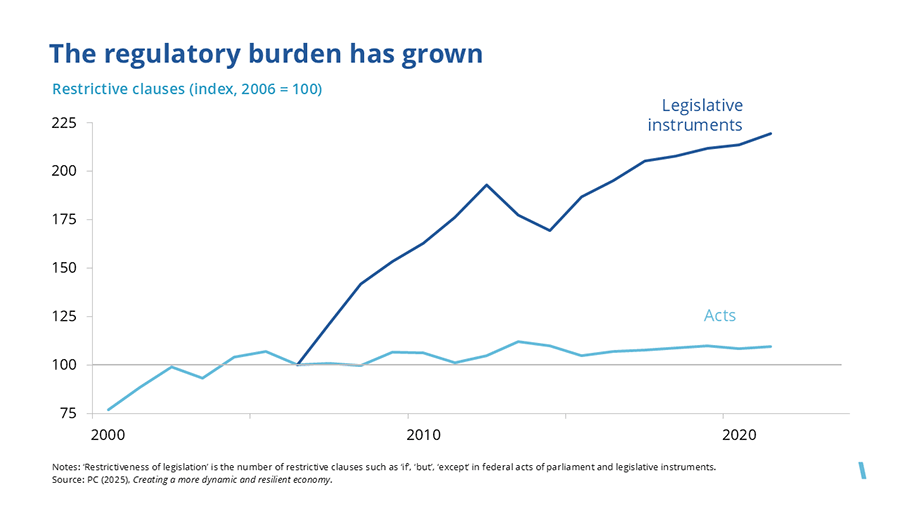
I think part of the reason is that regulations seem like a ‘get out of jail free’ card for hard decisions. A new reporting obligation or oversight process feels like a low-cost way to signal genuine concern about a risk or a recent crisis.
But of course, these types of obligations aren’t costless.
An Australian Institute of Company Directors survey found that 55% of board time is spent on compliance issues, up from 24% a decade ago. 58 That means less time for contemplating strategy, big investment decisions or succession plans
But too often, these very real trade-offs aren’t even mentioned when a new regulation is on the table.
Both better policy outcomes and trust depend on a better policy conversation.
If people think it’s easy to balance the budget or regulate every harm away, they are more likely to think governments that miss the mark are incompetent or corrupt. And if governments pretend they are easy, they will pursue costly policies that eat away at our prosperity and further reduce trust over time.
Governments shouldn't shy away from hard conversations about the costs and benefits of different policy options. Our national economic debate remains more sophisticated than in most countries, but our leaders need to level with us and avoid the lure of magical thinking.
As a South Australian I was pleased to see Treasurer Tom Koutsantonis embracing some of this realism recently. When asked about proposals for free public transport fares, he said, ‘it would be lovely to give everyone free public transport and free car parking and a puppy’. 59
If only it wasn’t for those pesky budget constraints...
The same message is true for policy pundits, experts and academics. We all have a role to play in getting dirty in the details, acknowledging that the answers aren’t simple.
If you want to pontificate about the need for 'more reform', great, but what are you suggesting governments actually do? If you want government to spend more on a whole lot of nice-to-haves, where else do you think they could save or raise extra money?
And finally, outside the glare of public debate, we need our institutions providing credible estimates of the trade-offs to ground our decisions
This means strengthening the impact assessment process for regulation so that all policies go through early, rigorous and transparent cost-benefit analysis. 60 It means making sure that our budget processes embrace transparency, including providing realistic longer-term projections. 61 And it means making sure that our integrity bodies have the resources and processes to shine a light on decisions that prioritise political or personal interests over the national one.
Theme 3: Don’t play politics with institutions
The final way governments can support trust is to avoid playing politics with our institutions.
As I have shown, Australia’s robust, independent and sometimes innovative institutions have been the bedrock of our prosperity.
And although they are not under direct assault in the way that they are in some other parts of the world, it does not mean they are invulnerable.
In a world where ‘cut through’ is at a premium, throwing shade on the messenger can be simpler and easier than debating the finer points of the message.
As Catherine mentioned, the Productivity Commission experienced this recently after releasing our interim report on the distribution of GST revenue. We were asked to review changes made in 2018 which had the effect of giving Western Australia more revenue than they would have received under the earlier system. Our interim view is that the changes were costly for taxpayers and have largely not achieved their intent. 62
It was a message that understandably was not going to be well-liked in Western Australia. We were not at all surprised at the strong position the government took on the interim findings. But we were surprised to be labelled a bunch of ‘East Coast Clowns’ and ‘dodgy, deceitful and... dumb.’ 63
My primary concern about comments like these that 'play the man, not the ball' is the impact on institutional trust. There is an important distinction between arguing an institution 'got it wrong' on a particular issue and placing a question in people’s minds about the impartiality and calibre of the organisation and its work more broadly.
We are by no means the only institution to have been subject to opportunistic political attacks. Climate scientists have been through the wringer in recent years.
Douglas Hilton, the CEO of CSIRO, reflected on the cost of ongoing attacks in 2024:
‘For science to be useful and for challenges to be overcome it requires the trust of the community. Maintaining trust requires scientists to act with integrity. Maintaining trust also requires our political leaders to resist the temptation to disparage science.’ 64
Ongoing disparagement of science or expertise over time erodes trust.
The United States has seen acceptance of facts, analysis, and experts decay in recent years. 65 Public trust in science, for example, has diverged significantly among different political groups. 66
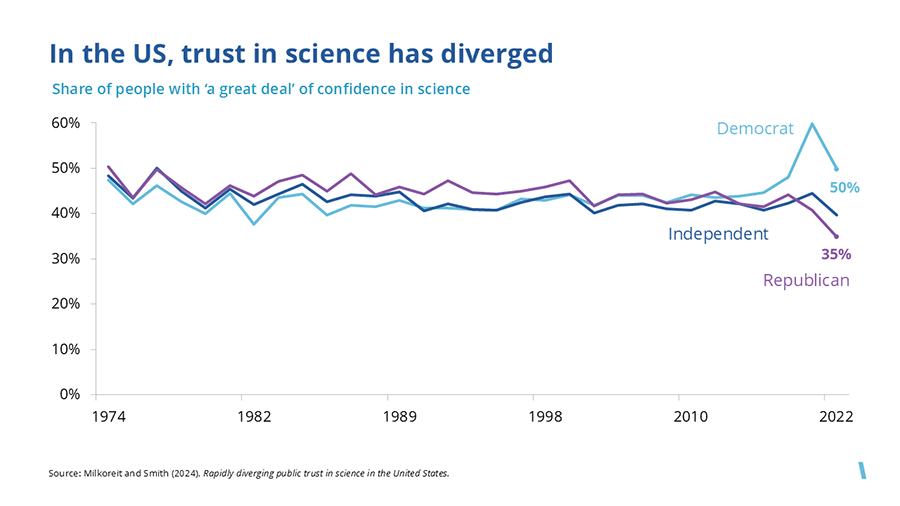
It’s nigh on impossible to have a reasoned debate without a bedrock of agreed fact. And it's hard to get those facts on the record when people dismiss expertise out of hand.
Thankfully, that’s not typically the case here. Attacks on institutions remain rare and are not well accepted.
Indeed, in my PC experience I was heartened by support from everyone from the Treasurer — who said ‘I think you can disagree with the conclusions of the Productivity Commission without denigrating them’ 67 — to the many members of the public who wrote emails with words of support.
But we should absolutely not let it become part of our culture.
Robust debate on the issues? Absolutely.
Periodic review of organisational performance and effectiveness? 68 Perfectly appropriate.
But name calling instead of debating the evidence? Let's leave it for the school yard.
Conclusion
With that off my chest, let me conclude.
If I can leave you with one message tonight it’s that public integrity matters.
It matters for trust between citizens, institutions and governments.
It matters for the ability of businesses to be dynamic and innovative.
It matters for the capacity of governments to deliver the services people expect.
And for all these reasons it matters for productivity and income growth.
Pointing out gaps in our integrity system might upset politicians from time to time but it keeps our democracy strong. I’m pleased the Centre for Public Integrity is here and I’m pleased to know it will keep pushing for integrity in every corner of public life.
And I assure you the PC will be just as relentless in our work advocating for policy and delivery in the national interest.
As we’ve seen, those two goals go hand in hand — a society where governments earn people’s trust is one where it’s easier to do hard things and earn that trust all over again.
So I hope tonight, I won’t be the only one dreaming of a cleaner, more trusting and more prosperous future for our next generation of wrinkly babies.
Footnotes
- With thanks to Liz Baldwin for her invaluable contribution Return to text
- PC (Productivity Commission) 2025, Growth mindset: how to boost Australia’s productivity, 5 productivity inquiries Return to text
- PC (Productivity Commission) 2025, Growth mindset: how to boost Australia’s productivity, 5 productivity inquiries, Canberra. Return to text
- Gründler, K and Potrafke, N 2019, ‘Corruption and economic growth: New empirical evidence’, European Journal of Political Economy, vol60, p101810. Return to text
- Uberti, LJ 2022, ‘Corruption and growth: Historical evidence, 1790–2010’, Journal of Comparative Economics, vol50, no2, pp321–349. Return to text
- Cieślik, A and Goczek, Ł 2018, ‘Control of corruption, international investment, and economic growth – Evidence from panel data’, World Development, vol103, pp323–335. Return to text
- Colonnelli, E and Prem, M 2022, ‘Corruption and firms’, The Review of Economic Studies, vol89, no2, pp695–732; Ding, H et al. 2020, Equilibrium Consequences of Corruption on Firms: Evidence from China’s Anti-Corruption Campaign, Working Paper, National Bureau of Economic Research, https://www.nber.org/papers/w26656. Return to text
- Nitschka, T 2022, ‘China’s anti-corruption campaign and stock returns of luxury goods firms’, Financial Markets and Portfolio Management, vol36, no2, pp159–177. Return to text
- Anokhin, S and Schulze, WS 2009, ‘Entrepreneurship, innovation, and corruption’, Special Issue Ethics and Entrepreneurship, vol24, no5, pp465–476; Athanasouli, D and Goujard, A 2015, ‘Corruption and management practices: Firm level evidence’, Journal of Comparative Economics, vol43, no4, pp1014–1034; Dincer, O 2019, ‘Does corruption slow down innovation? Evidence from a cointegrated panel of U.S. states’, European Journal of Political Economy, vol56, pp1–10; Ellis, J et al. 2020, ‘Corruption and Corporate Innovation’, Journal of Financial and Quantitative Analysis, vol55, no7, pp2124–2149. Return to text
- International Monetary Fund 2019, Fiscal Monitor, https://www.imf.org/-/media/files/publications/fiscal-monitor/2019/april/english/ch2.pdf. Return to text
- Fang, L et al. 2023, ‘Anticorruption, government subsidies, and innovation: Evidence from China’, Management Science, vol69, no8, pp4363–4388. Return to text
- Ferraz, C et al. 2012, ‘Corrupting learning: Evidence from missing federal education funds in Brazil’, Journal of Public Economics, vol96, no9–10, pp712–726. Return to text
- Mattsson, M 2025, ‘When does corruption cause red tape? Bribe discrimination under asymmetric information’, Journal of Public Economics, vol250, p105483. Return to text
- Banerjee, R 2016, ‘Corruption, norm violation and decay in social capital’, Journal of Public Economics, vol137, pp14–27; Richey, S 2010, ‘The Impact of Corruption on Social Trust’, American Politics Research, vol38, no4, pp676–690. Return to text
- Guiso, L et al. 2004, ‘The Role of Social Capital in Financial Development’, American Economic Review, vol94, no3, pp526–556; Gupta, A et al. 2020, ‘Do Informal Contracts Matter for Corporate Innovation? Evidence from Social Capital’, Journal of Financial and Quantitative Analysis, vol55, no5, pp1657–1684. Return to text
- Centre for Public Integrity 2025, A Seat at the Table: Embedding integrity, transparency and equality into the federal lobbying regime, 9 July, https://publicintegrity.org.au/research_papers/lobbying-reform-australia/; 2026, Political Donor Directory, https://publicintegrity.org.au/political-donor-directory/. Return to text
- PC (Productivity Commission) 2025, Guardrails for modern industry policy, Research paper. Return to text
- PC (Productivity Commission) 2014, Public Infrastructure, Report no. 71, Canberra. Return to text
- PC (Productivity Commission) 2025, Guardrails for modern industry policy, Research paper. Return to text
- PC (Productivity Commission) 2014, Public Infrastructure, Report no. 71, Canberra. Return to text
- Acemoglu, D 2025, ‘Nobel Lecture: Institutions, Technology, and Prosperity’, American Economic Review, vol115, no6, pp1709–1748. Return to text
- Boehm, J and Oberfield, E 2020, ‘Misallocation in the Market for Inputs: Enforcement and the Organization of Production’, The Quarterly Journal of Economics, vol135, no4, pp2007–2058; Giacomelli, S and Menon, C 2017, ‘Does weak contract enforcement affect firm size? Evidence from the neighbour’s court’, Journal of Economic Geography, vol17, no6, pp1251–1282; Ramos-Maqueda, M and Chen, DL 2026, ‘Justice, Growth, and Governance: Causal Evidence on How Courts Shape Economic Outcomes and Conflict’, Journal of Economic Surveys, vol40, no4, pp1789–1805. Return to text
- García-Posada, M and Mora-Sanguinetti, JS 2015, ‘Entrepreneurship and enforcement institutions: disaggregated evidence for Spain’, European Journal of Law and Economics, vol40, no1, pp49–74; Lichand, G and Soares, RR 2014, ‘Access to Justice and Entrepreneurship: Evidence from Brazil’s Special Civil Tribunals’, The Journal of Law and Economics, vol57, no2, pp459–499. Return to text
- Iverson, B 2018, ‘Get in line: Chapter 11 restructuring in crowded bankruptcy courts’, Management Science, vol64, no11, pp5370–5394; Müller, K 2022, ‘Busy bankruptcy courts and the cost of credit’, Journal of Financial Economics, vol143, no2, pp824–845. Return to text
- Bolhuis, MA et al. 2026, ‘The Macroeconomic Consequences of Undermining Central Bank Independence: Evidence from Governor Transitions’, IMF Working Papers, vol2026, no040, https://www.elibrary.imf.org/view/journals/001/2026/040/article-A001-en.xml; Ioannidou, V et al. 2022, ‘(In)dependent central banks’, https://papers.ssrn.com/sol3/papers.cfm?abstract_id=4262695. Return to text
- Wood, D et al. 2022, New politics: A better process for public appointments, Grattan Institute, https://grattan.edu.au/report/new-politics-public-appointments/. Return to text
- Babina, T et al. 2023, Antitrust Enforcement Increases Economic Activity, Working Paper, National Bureau of Economic Research, https://www.nber.org/papers/w31597; Ha, S et al. 2024, ‘Motivating collusion’, Journal of Financial Economics, vol154, p103798. Return to text
- Bens, DA et al. 2026, ‘Economic Consequences of Political Polarization: Evidence from an SEC Shutdown and Its Effect on Insider Trading’, The Accounting Review, vol101, no3, pp39–66. Return to text
- Kandrac, J and Schlusche, B 2021, ‘The Effect of Bank Supervision and Examination on Risk Taking: Evidence from a Natural Experiment’, The Review of Financial Studies, vol34, no6, pp3181–3212. Return to text
- Brigg, M et al. 2026, ‘Entangled political institutions and forms: From corporatisation to treaty’, Australian Journal of Public Administration, https://onlinelibrary.wiley.com/doi/abs/10.1111/1467-8500.70054. Return to text
- Hill, L 2021, ‘Australia’s Electoral Innovations’, in Lewis, JM and Tiernan, A (eds), The Oxford Handbook of Australian Politics, Oxford University Press, https://doi.org/10.1093/oxfordhb/9780198805465.013.2. Return to text
- Democratic backsliding includes the dismantling of the architecture of independent institutions and democratic government Bermeo, N 2016, ‘On Democratic Backsliding’, Journal of Democracy, vol27, no1, pp5–19. Return to text
- Wood, D and Daley, J 2018, A crisis of trust: The rise of protest politics in Australia, Grattan Institute, https://grattan.edu.au/report/a-crisis-of-trust/. Return to text
- Cameron, S et al. 2025, Trends in Australian Political Opinion: Results from the Australian Election Study, 1987-2025, The Australian Election Study, https://australianelectionstudy.org/publications/. Return to text
- OECD (Organisation for Economic Co-operation and Development) 2026, OECD Survey on Drivers of Trust in Public Institutions 2026 Results: Australia, OECD Publishing, https://www.oecd.org/en/publications/oecd-survey-on-drivers-of-trust-in-public-institutions-2026-results_c88c8869-en/australia_2996fc72-en.html. Return to text
- DemosAU 2026, Trust in Australia’s national institutions is declining, https://demosau.com/news/trust-in-australias-national-institutions-is-declining/. Return to text
- Roy Morgan Research 2026, Consumer Confidence Monthly Ratings 1973-2026, https://www.roymorgan.com/morgan-poll/consumer-confidence-anz-roy-morgan-australian-cc-monthly-ratings. Return to text
- Biddle, N and Gray, M 2026, Holding together, Just: Wellbeing, Economic Strain, and Democratic Resilience in Australia, March 2026, ANU Centre for Social Policy Research, https://polis.cass.anu.edu.au/research/publications/holding-together-just-wellbeing-economic-strain-and-democratic-resilience. Return to text
- Besley, T and Dray, S 2024, ‘Trust and State Effectiveness: The Political Economy of Compliance’, The Economic Journal, vol134, no662, pp2225–2251; Eesley, C and Lee, YS 2023, ‘In institutions we trust? Trust in government and the allocation of entrepreneurial intentions’, Organization Science, vol34, no2, pp532–556. Return to text
- Gabriel, OW and Trüdinger, E-M 2011, ‘Embellishing welfare state reforms? Political trust and the support for welfare state reforms in Germany’, German Politics, vol20, no2, pp273–292; Garritzmann, JL et al. 2023, ‘Public opinion towards welfare state reform: The role of political trust and government satisfaction’, European Journal of Political Research, vol62, no1, pp197–220; Jacobs, AM and Matthews, JS 2017, ‘Policy attitudes in institutional context: Rules, uncertainty, and the mass politics of public investment’, American Journal of Political Science, vol61, no1, pp194–207. Return to text
- Exadaktylos, T and Zahariadis, N 2014, ‘Quid pro Quo: Political Trust and Policy Implementation in Greece during the Age of Austerity’, Politics & Policy, vol42, no1, pp160–183; Györffy, D 2008, ‘Political Trust and the Success of Fiscal Consolidation: Lessons from Sweden and Hungary’, Zeitschrift für Staats- und Europawissenschaften (ZSE) / Journal for Comparative Government and European Policy, vol6, no1, pp75–100. Return to text
- For example, OECD research suggests deregulatory reforms through the 1980s and 1990s contributed around 0.25 percentage points to annual labour productivity growth each year. But in the absence of ongoing reforms in the past two decades, the reform dividend has faded: Andrews, D et al. 2025, Regulation and Growth: Lessons from nearly 50 years of product market reforms, 24 June, OECD, https://www.oecd.org/en/publications/regulation-and-growth_3b3285df-en.html. Return to text
- Acemoglu, D et al. 2025, ‘(Successful) democracies breed their own support’, Review of Economic Studies, vol92, no2, pp621–655; Besley, T et al. 2026, ‘Growth experiences and trust in government’, The Quarterly Journal of Economics, vol141, no2, pp1761–1822; Popova, O et al. 2026, ‘Inflation, unemployment, and institutional trust: the global evidence’, Oxford Economic Papers, vol78, no1, pp157–178; Van Erkel, PF a. and Van Der Meer, TWG 2016, ‘Macroeconomic performance, political trust and the Great Recession: A multilevel analysis of the effects of within-country fluctuations in macroeconomic performance on political trust in 15 EU countries, 1999–2011’, European Journal of Political Research, vol55, no1, pp177–197. Return to text
- Ares, M and Hernández, E 2017, ‘The corrosive effect of corruption on trust in politicians: Evidence from a natural experiment’, Research & Politics, vol4, no2, p2053168017714185; von Sikorski, C et al. 2020, ‘How political scandals affect the electorate. Tracing the eroding and spillover effects of scandals with a panel study’, Political Psychology, vol41, no3, pp549–568; Solé-Ollé, A and Sorribas-Navarro, P 2018, ‘Trust no more? On the lasting effects of corruption scandals’, European Journal of Political Economy, vol55, pp185–203. Return to text
- Zhang, J et al. 2022, ‘A Meta-Analysis of the Government Performance—Trust Link: Taking Cultural and Methodological Factors into Account’, Public Administration Review, vol82, no1, pp39–58. Return to text
- OECD (Organisation for Economic Co-operation and Development) 2026, OECD Survey on Drivers of Trust in Public Institutions 2026 Results: Australia, OECD Publishing, https://www.oecd.org/en/publications/oecd-survey-on-drivers-of-trust-in-public-institutions-2026-results_c88c8869-en/australia_2996fc72-en.html. Return to text
- The Onion 2011, Postal Service Celebrates Another Awesome Day Of Delivering Mail, https://theonion.com/postal-service-celebrates-another-awesome-day-of-delive-1819572356/. Return to text
- SCRGSP (Steering Committee for the Review of Government Service Provision) 2026, Report on Government Services 2026, Productivity Commission, Canberra. Return to text
- Victorian Department of Government Services 2026, Victorian Councils Community Satisfaction Report 2026, https://www.localgovernment.vic.gov.au/__data/assets/pdf_file/0025/226582/Community-Satisfaction-Survey-State-wide-Report-2026.pdf. Return to text
- Australian Public Service Commission 2025, Trust in Australian public services: 2025 Annual Report, https://www.apsc.gov.au/publication/trust-australian-public-services-2025-annual-report. Return to text
- Australian Centre for Evaluation 2026, State of Evaluation in the Australian Government 2026, Department of the Treasury, https://evaluation.treasury.gov.au/publications/state-evaluation-australian-government-2026. Return to text
- Australian Centre for Evaluation 2026, State of Evaluation in the Australian Government 2026, Department of the Treasury, https://evaluation.treasury.gov.au/publications/state-evaluation-australian-government-2026. Return to text
- Dave movie reference inspired by Matt Yglesias – I didn’t rush out to see this movie as a teenager but very much enjoyed it 30 years later!
Yglesias, M 2026, Americans think everyone is corrupt, Slow Boring, https://www.slowboring.com/p/americans-think-everyone-is-corrupt. Return to text - Warner Bros. Pictures (1993), Dave. Balancing the Budget scene: https://www.youtube.com/watch?v=ZARAldXlSyA Return to text
- With no offense to my public servant colleagues or any billionaires bearing the high opportunity cost of reading this speech Return to text
- Wood, D et al. 2023, Back in black? a menu of measures to repair the budget, Grattan Institute, https://grattan.edu.au/report/back-in-black-a-menu-of-measures-to-repair-the-budget/. Return to text
- PC (Productivity Commission) 2025, Creating a more dynamic and resilient economy, Inquiry report no. 109, Canberra. Return to text
- Mandala Partners 2025, $160 billion and counting: The cost of Commonwealth regulatory complexity, Australian Institute of Company Directors, https://www.aicd.com.au/news-media/research-and-reports/economic-cost-of-regulatory-complexity.html. Return to text
- ABC News 2026, ‘SA rules out free public transport, for now, as dozens of servos are out of some fuels’, 30 March, https://www.abc.net.au/news/2026-03-30/sa-treasurer-says-free-public-transport-not-on-the-cards/106510092. Return to text
- PC (Productivity Commission) 2025, Creating a more dynamic and resilient economy, Inquiry report no. 109, Canberra. Return to text
- Reinhardt, S 2026, Does the Budget get in the way of good policy?, 8 July, Parliamentary Budget Office, https://www.pbo.gov.au/sites/default/files/2026-07/ACE%202026%20PBO%20Speech%20-%208%20July%202026.pdf; Victorian Parliamentary Budget Office 2021, Fiscal objectives, targets and risks - options to improve Victoria’s fiscal framework, https://pbo.vic.gov.au/response/2942. Return to text
- PC (Productivity Commission) 2026, GST distribution reforms: interim report, Canberra. Return to text
- Ho, C 2026, ‘Angry WA premier lashes “east-coast clowns” on explosive GST report’, ABC News, 14 August, https://www.abc.net.au/news/2026-08-14/wa-premier-lashes-east-coast-clowns-over-gst-report/107039200. Return to text
- Hilton, D 2024, Open letter from Dr Doug Hilton, CSIRO, https://www.csiro.au/en/news/all/news/2024/march/open-letter-from-dr-doug-hilton-chief-executive-csiro. Return to text
- Rich, MD 2018, Truth decay: An initial exploration of the diminishing role of facts and analysis in American public life, Rand Corporation. Return to text
- Milkoreit, M and Smith, EK 2024, ‘Rapidly diverging public trust in science in the United States’, Public Understanding of Science, vol34, no5, pp616–627. Return to text
- Chalmers, J 2026, Transcript of press conference, Logan, Treasury Ministers, https://ministers.treasury.gov.au/ministers/jim-chalmers-2022/transcripts/press-conference-logan-0. Return to text
- Australian Public Service Commission 2021, Capability Review Program, https://www.apsc.gov.au/initiatives-and-programs/workforce-information/research-analysis-and-publications/capability-review-program; De Brouwer, G et al. 2023, An RBA fit for the future: Review of the Reserve Bank of Australia, https://rbareview.gov.au/sites/rbareview.gov.au/files/2023-06/rbareview-report-at_0.pdf; Financial Regulator Assessment Authority 2022, Effectiveness and Capability Reviews of the Australian Securities and Investments Commission, https://fraa.gov.au/publications/effectiveness-and-capability-reviews-australian-securities-and-investments-commission. Return to text