
Regulating for growth

Speech
7 August 2026
Chair Danielle Wood presented to the ACCC/AER Regulatory Conference in Brisbane.
Download the speech
 Regulating for growth (PDF 412.3 KB)
Read the speech
It's wonderful to be back at the regulatory conference – it feels like a treat to have a whole conference devoted just to regulation. I spend a lot of my time trying to convince people to get excited about growth and regulation – it’s nice to be at home among a bunch of regulatory nerds that need no convincing.
The reason I do spend so much of my time trying to get people’s hearts racing about growth is that it matters for us all.
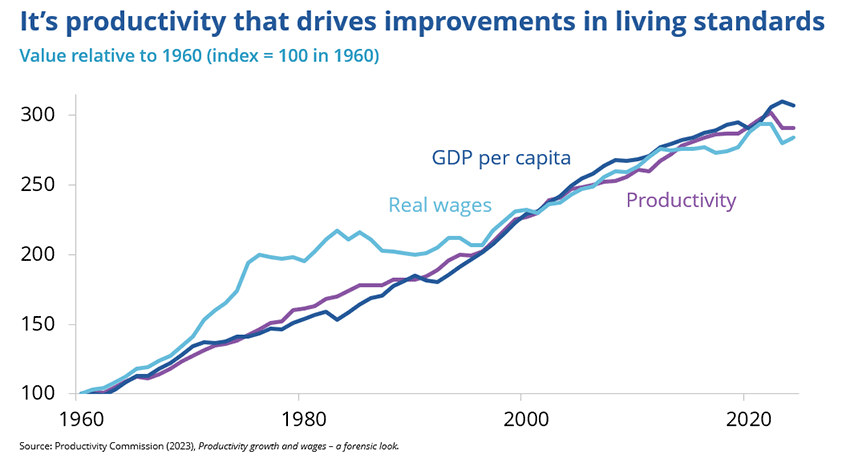
In the long run, productivity is what drives improvements in wages and material living standards. The average Australian today earns 3 times more than the average Australian in 1960 because we’ve grown our productivity. 1
And it is fundamental to the intergenerational bargain. Since the 1940s, every birth cohort has enjoyed higher average incomes than those born before them at the same age. 2
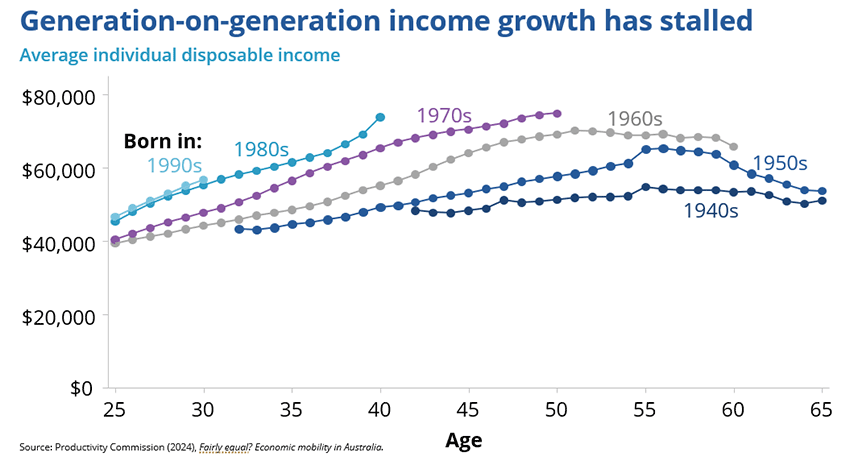
That’s until we get to our 1990s babies, the late millennials, who hit the job market when wages growth was sluggish. 3 They are the first to see almost no progress in their incomes compared to those born a decade earlier.
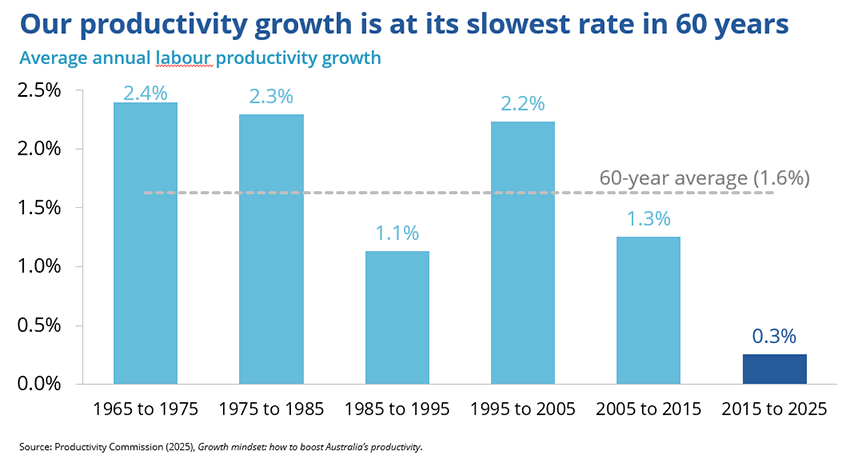
And what sits behind this intergenerational challenge is our lost decade of productivity.
Since 2015, average annual productivity growth has been about one quarter of its long-run average. 4
There are many explanations for our stalling productivity – from falling business investment and dynamism to the structural increase in our demand for non-market services.
But it’s also probably true that recent governments have done less major reform than in previous decades. And they have increasingly pursued other worthy objectives – social goals, environmental protection, economic risk mitigation – while ignoring or downplaying the consequences of their decisions for growth.
---
One way this manifests is the ballooning regulatory burden.
A survey of company directors found that in 2025, boards were spending 55% of their time on compliance – up from 24% ten years ago. 5 That means more time on box ticking and less time contemplating strategy, technology rollouts or major investments.
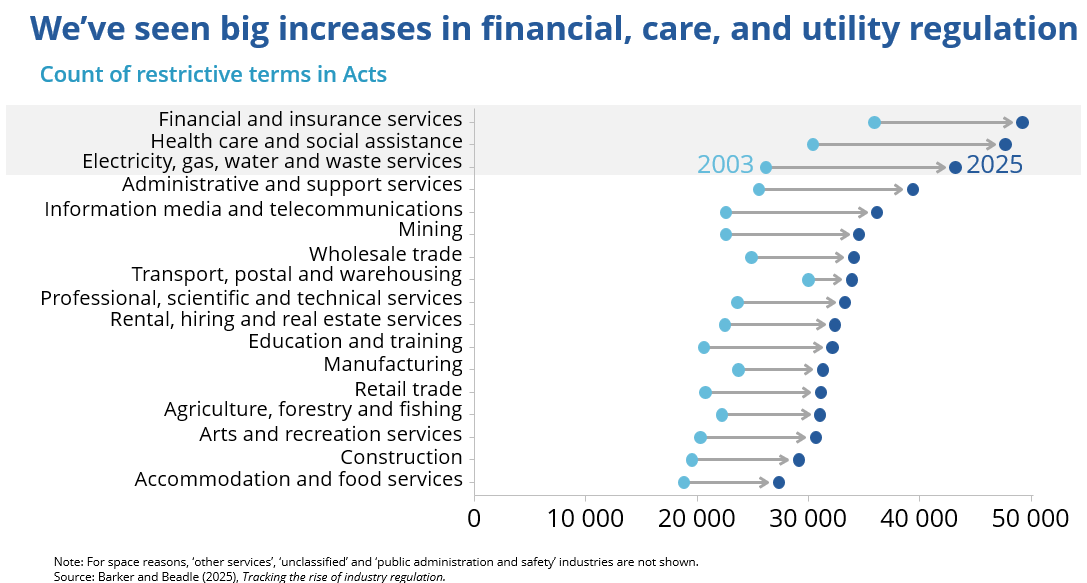
We see the same trend in the number of restrictive clauses in legislation. Some of the biggest increases have been in the financial services, care, and utilities sectors. 6 I’m sure many people here are intimately familiar with nearly every one of those tens of thousands of regulatory clauses.
For businesses, this adds up to regulatory hairballs: a mass of regulations that take time and resources just to comprehend and do the paperwork for, let alone actually substantively comply with. And in many cases, the fixed costs of regulatory compliance can be a better competitive moat than any oligopolist could dream up.
When we asked businesses about their biggest issues for the productivity inquiries we undertook last year, regulatory burden came up more than any other.
The issue spans from the merely painful – 31 approval steps to open a cafe here in Brisbane – to the hugely consequential. 7 We build half as much house per hour worked as we did 30 years ago. 8 Prior to recent environmental approval reforms, it could take several years to get a windfarm approved in NSW. 9 We estimated that connecting new wind farms and key transmission to the National Electricity Market one year faster could reduce electricity prices by 7% over the next decade. 10
---
A law or regulation is rarely conceived for the purpose of causing delays and headaches. No one actively sets out to make it hard to build houses or critical energy infrastructure or to reduce my choices for a morning flat white. But this is so often where the system, left unchecked, ends up. 11
Some of this comes from public demand. It’s a fairly consistent pattern across the world that as we grow richer, we’re willing to pay more to avoid risk. 12 We can afford to pay more for redundancies and insurance – both in terms of harms (think workplace accidents) and reliability (how often we’ll accept the lights going out). 13
Risk has been pushed to the front of all of our minds in the past few years. The security of supply chains and services we take for granted has been tested by pandemic, war and natural disasters.
But building in resilience, redundancy or just-in-case regulations adds cost today.
We might well be perfectly prepared to pay those costs – sometimes the insurance premium is worth it – but we should make this decision with a clear-eyed view as to what those costs are.
The PC has done some work on this in the context of broader economic resilience.
We looked at the value of different resilience measures by calculating the ongoing costs versus the benefits if a disruption occurs – and therefore how often you have to believe a disaster will happen for an investment to be ‘worth it’ in an expected value sense. 14
Here’s one example of the calculus for paying for a stockpile of personal protective equipment – worth it if you think a supply disruption will happen at least once every 55 years.
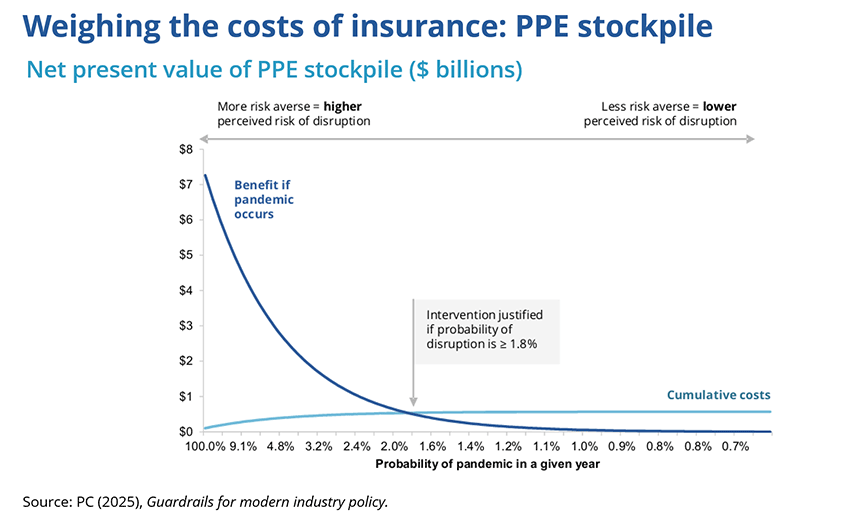
Of course, the same logic can be used to think about resilience in our infrastructure – are we upgrading our transmission lines for a 1-in-20 year fire, or a 1-in-500 year one? The line between sensible insurance and gold plating will always be a judgement call but having clear numbers on costs and potential savings ensures it is a well-informed one.
---
Returning to our regulatory predicament, nowhere is it harder to do this type of dispassionate cost benefit analysis than in the eye of a crisis.
When something goes wrong, governments face immense and immediate pressure to serve up a response in the media and parliament. We want to know why it happened and how we can stop it happening again.
In the heat of the moment, it is very hard to admit that sometimes bad things happen, or even that a good policy response will take time. We demand action: a new reporting requirement, screening check, procedure or safeguard. Like giving a three-year-old a band-aid for a headache, it’s the gesture that counts more than the outcome.
It takes a brave politician to stare down a crisis. The only recent Australian example I can recall is the South Australian premier resisting calls for an inquiry following a serious accident at the Tour Down Under. “I’m reluctant to overreact to it given that it is such a freak occurrence,” he said. 15
The pressure to patch on the run has been evident in response to a crisis that’s top of mind for many – the cost-of-living crisis.
During our current inquiry into National Water Reform, we’ve noted that some water service providers are under pressure to limit water bill increases as a result of government directions or expectations. 16
Minimising cost for consumers is always a worthy goal. But as everyone in this room knows, this short-term cost crunching can create new problems down the track.
If utilities delay efficient spending, we can face higher costs later or risks to service quality and resilience. And artificially constraining capital available to utilities can limit new investment and make it harder to build new homes – further worsening housing affordability. 17
Regulators have always had to balance the goal of lower prices with the need to maintain sufficient incentives for new investment. But when politics is involved, it’s especially important that these judgements, and their impact on utilities’ investment capacity and long-term decision making, are transparent. 18
---
Even when directions are less explicit, signals from the top filter down. When those signals are saying ‘nothing can go wrong’, regulators have a strong incentive to adopt a cautious, slow-and-steady response.
We see this culture embedded throughout the public service. Junior bureaucrats are often advised to think of the tabloid test – would you want this to end up on the front page of the Herald Sun, or the Courier Mail?
And while it’s a good standard for ethical conduct – although maybe these days it should be updated to the ‘viral TikTok test’ – it can have a chilling effect when the fear of any negative outcome, however unlikely, guides regulatory policy and decisions.
Newspapers, coronial inquests, royal commissions, Senate Estimates, and viral TikToks have the benefit of hindsight: it’s easy to see the errors that were made and the tears in the net. Even a South Australian coroner admitted the impulse to find fault is hard to resist. 19
It is a steely leader who takes a cost-benefit approach through demands that nothing go wrong. The pull towards ‘just in case’ decisions is strong.
One way this plays out is in a cautious approach to new technology.
Prefabricated construction methods, which can speed up the process of building new homes, are a good example. 20 With prefab construction, components can be manufactured offsite, rain, hail or shine. And tradies can work on multiple units at a time at the one location, cutting timeframes substantially.
But uptake is very low – less than 5% across all construction.
There’s no explicit provision in the National Construction Code that bans prefab, but the code was designed for onsite construction. Some requirements – such as checking individual components – are difficult with prefab pods that are installed onsite as complete units. And then there’s the cultural piece – regulators and building certifiers across jurisdictions vary in their conservatism and acceptance of prefab.
It makes sense. When the priority is guaranteeing that nothing goes wrong, every new technology – no matter how big the upsides for others– looks an awful lot like a downside risk to a regulator.
Governments are tackling this issue now, but it has arguably slowed the scale-up of a sector that will be an important part of meeting our housing supply challenge.
Another consequence of this ‘nothing can go wrong’ mindset is the creep of stakeholder engagement and consultation processes.
Now these processes come from an admirable place – a desire to ensure the community has a voice in key decisions. Our collective soft spot for The Castle speaks to the value of the ‘vibe’ that all of us should have a say in decisions that affect our lives.
The inclusion of consumer and broader stakeholder voices in key regulatory decisions has been one of the positive developments in regulation over the past two decades.
But over time, the scope and expectations of stakeholder engagement have grown.
Regulators encourage energy networks to develop and report against stakeholder engagement plans, engage through multiple channels (such as surveys, consumer panels and workshops), show how consumer feedback has influenced a proposal and consider resourcing consumer representatives to commission independent advice. 21
Multiply those requirements across the vast array of rule changes and projects happening at any one time, and the volume quickly becomes vast.
For example, engagement requirements apply even to some relatively minor, like-for-like transmission replacement works. Yet consumers have shown little interest in engaging with the processes – submissions were received in response to less than 10% of replacement capital expenditure projects. 22
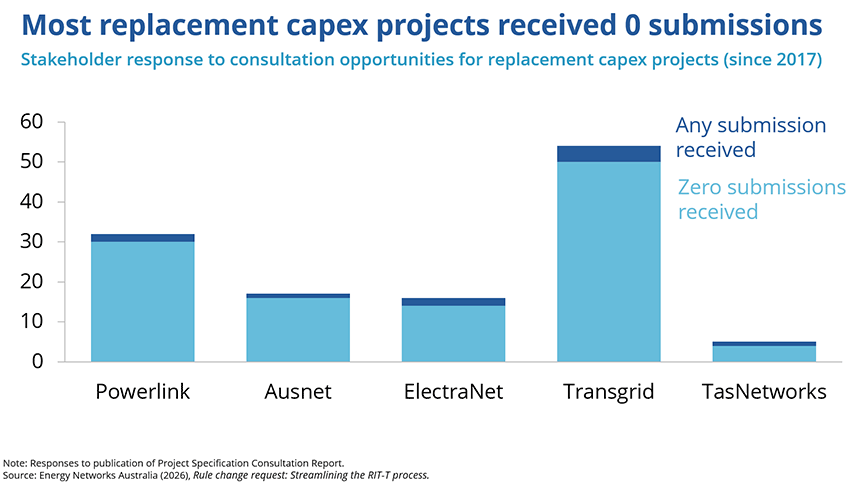
All this engagement has costs. There are the direct costs of staffing and managing those processes, plus the time to develop consultation plans and open windows for submissions. It all adds to the long run-up to getting anything done.
And even the best-designed stakeholder engagement plan will struggle to avoid a NIMBY bias. The consumers who are most likely to lose out from a project, whether it’s a transmission line, a data centre or, indeed, a new airport runway, are highly motivated to engage. The millions of consumers who might have benefited from money off their bill aren’t.
These processes can’t avoid the fundamental truth: doing big things usually involves pissing someone off. Even with the best process, there’s no guarantee of consensus.
As US academic Marc Dunkelman, the author of Why Nothing Works, has said, ‘We have a fantasy … that if you get everybody in the room early enough in a planning process, you can create a product or an outcome that has no trade-offs.’ 23
As regulators and policy makers, we need to face up to those trade-offs – not hide in the shadow of the consultation report.
---
So how can we shift our regulatory systems towards finding a way through those trade-offs and getting things done?
Politicians have a big role in setting the tone and getting the architecture in place. It was great to see the recent federal budget include a focus on regulatory reform. 24
And more recently the federal government has embedded growth and dynamism into the statements of expectations for ASIC and APRA. 25 That leadership piece is important – it helps to know the minister has your back if something goes wrong.
There’s more work to do. I’d like to see politicians keep the focus on growth by committing to tracking the regulatory burden and holding back the tide over the next decade. That means imposing discipline across every portfolio – no new regulatory burdens without an offset elsewhere – and deep dives into some specific sectors where the regulatory hairballs have grown.
---
There’s plenty regulators can do to shift the growth dial within the current system.
One of the most important things is a mindset shift, or perhaps a mindset expansion.
Expanding from thinking about what’s right for stakeholders today to all those who will be affected by long-term decisions – future generations too.
Expanding from thinking about the costs of an activity to the benefits too.
This doesn’t mean going soft, but it does mean being conscious of the very real costs of delay and the complexities on the ground.
There are some brilliant examples across the country of regulators embedding this mindset.
Western Australia’s Small Business Commissioner set up a forum to try to ease pain pints in council approvals. 26 They facilitated workshops between council officers and small business owners. The owners explained their licensing frustrations and the impact on their business: sleepless nights, lost income, even having to remortgage a house.
The process brought them face-to-face with the humans at the end of their decisions in a profound way – some council officers were literally in tears. Local governments committed to improve communication, auto-approve some applications, and set up a business liaison to help navigate trickier approvals. But business owners reported the biggest change was in the attitude and helpfulness of the council staff.
Embracing innovation can be another powerful tool.
I’m excited about the potential of AI to speed up regulatory processes across government.
There’s been some great trials of this in the planning space in certain judications – from helping industry navigate the regulatory maze, to automating document review and doing simple first-pass assessments. 27
But innovation isn’t just about new technologies. New ways of working can be just as transformative.
Regulatory sandboxes are a good example of – ironically – thinking outside the box. Regulators agree to relax rules while businesses trial innovative new projects, with the regulator closely monitoring outcomes. They’re a way for regulators to facilitate innovation while balancing consumer protection.
In the financial space, for example, Treasury’s recent review of ASIC’s sandbox found that it had been a good way for businesses to test the viability of innovative products in a real-world setting. 28
But the sandbox could have been even more successful if it weren’t so boxed in (forgive me). There was no clear exit ramp to a regular licence, nor was there collaboration with other regulators in the space.
Embracing these types of innovations involves a leap of faith. There’s always an element of risk in trying something new or sharing oversight. But that’s where the mindset shift comes in.
Soon after he was inaugurated, John F. Kennedy’s Commerce Department displayed signs at every desk asking, ‘What have you done for growth today?’ 29
And while that might sound a bit American cheese for our Australian taste, perhaps we could all benefit from absorbing some of that mindset – keeping an eye to what we’re giving up when ‘computer says no’ or when processes move slow.
The answer to our productivity malaise won’t be found in a single place or solved with a singly policy. But we need a mindset shift across the regulation supply chain, from policy makers to regulators, if we are to rediscover our dynamism and our growth ambitions.
The benefits may not be as visible or salient in our daily work as the risks but let me assure you they are real. Unshackling business and making it easier to build and innovate is the only way to ensure that we deliver better outcomes for the next generation. And that I think is worth taking a few risks for.
Footnotes
- PC (Productivity Commission) 2025, Growth mindset: how to boost Australia’s productivity, 5 productivity inquiries, Canberra. Return to text
- PC (Productivity Commission) 2024, Fairly equal? Economic mobility in Australia, Research paper. Return to text
- PC (Productivity Commission) 2020, Why did young people’s incomes decline?, Commission Research Paper, Canberra. Return to text
- PC (Productivity Commission) 2025, Growth mindset: how to boost Australia’s productivity, 5 productivity inquiries, Canberra. Return to text
- Mandala 2025, $160 billion and counting: The cost of Commonwealth regulatory complexity, https://www.aicd.com.au/content/dam/aicd/pdf/news-media/research/2025/economic-cost-of-regulatory-complexity-report.pdf Return to text
- Barker, A and Beadle, D 2025, Tracking the rise of industry regulation, Committee for Economic Development of Australia, https://www.ceda.com.au/research-and-policy/research/government-regulation/tracking-the-rise-of-industry-regulation. Return to text
- PC (Productivity Commission) 2025, Creating a more dynamic and resilient economy, Inquiry report no. 109, Canberra. Return to text
- PC (Productivity Commission) 2025, Housing construction productivity: Can we fix it?, Research paper, Canberra. Return to text
- Clean Energy Investor Group 2026, Delivering major clean energy projects in NSW: Review of NSW statutory planning approvals processes, http://www.ceig.org.au/wp-content/uploads/2026/06/Delivering-Clean-Energy-Projects-in-NSW-2026-Update-Review-of-NSW-Statutory-Planning-Approvals-Processes.pdf Return to text
- PC (Productivity Commission) 2025, Investing in cheaper, cleaner energy and the net zero transformation, Inquiry report no. 113, Canberra. Return to text
- Wood, D 2026, The Red Tape Impulse, Inflection Points, https://inflectionpoints.work/articles/the-red-tape-impulse. Return to text
- Masterman, CJ and Viscusi, WK 2018, ‘The income elasticity of global values of a statistical life: Stated preference evidence’, Journal of Benefit-Cost Analysis, vol. 9, no. 3, pp. 407–434. Return to text
- Larsen, PH et al. 2025, Final report for Phase 1 of National Initiative to Update the Interruption Cost Estimate (ICE) Calculator, Lawrence Berkeley National Laboratory, https://eta-publications.lbl.gov/sites/default/files/2025-06/ice_2.0_phase_i_final_report_29may2025.pdf. Return to text
- PC (Productivity Commission) 2025, Guardrails for modern industry policy, Research paper. Return to text
- McHugh, T 2025, ‘Major update on hurt woman in horror TDU crowd crash’, The Advertiser, 20 January, https://www.adelaidenow.com.au/sport/tour-down-under/tour-down-under-crash-victim-spectator-in-stable-condition-after-serious-injuries-in-horror-adelaide-pileup/news-story/0867eeba93d9e3ecf4967e3e3afd37c0 Return to text
- PC (Productivity Commission) 2026, National Water Reform 2026: Water services reform directions, Interim update, Canberra, June. Return to text
- PC (Productivity Commission) 2026, Housing supply regulation, Interim report. Return to text
- PC (Productivity Commission) 2026, National Water Reform 2026: Water services reform directions, Interim update, Canberra, June. Return to text
- He said, ‘The temptation to criticise the minutiae of every decision that was taken by a group of individuals or by the individuals themselves is sometimes difficult to resist.’ Schapel, A 2007, Inquest into the deaths of Star Ellen Borlase, Jack Morley Borlase, Helen Kald Castle, Judith Maud Griffith, Jody Maria Kay, Graham Joseph Russell, Zoe Russell-Kay, Trent Alan Murnane and Neil George Richardson, Coroner’s Court of South Australia, https://www.courts.sa.gov.au/download/2007-findings/?ind=1631154860920&filename=Wangary+Fires+Inquest+BORLASE%2C+CASTLE%2C+GRIFFITH.pdf&wpdmdl=13841&refresh=6a0ed06436d611779355748 Return to text
- PC (Productivity Commission) 2025, Housing construction productivity: Can we fix it?, Research paper, Canberra. Return to text
- Australian Energy Regulator 2024, Better resets handbook, https://www.aer.gov.au/about/strategic-initiatives/better-resets-handbook; Australian Energy Regulator 2024, Cost Benefit Analysis guidelines - 2024 - Version 3, https://www.aer.gov.au/system/files/2025-05/AER%20-%20Cost%20Benefit%20Analysis%20guidelines%20-%202024%20-%20Version%203.pdf Return to text
- Energy Networks Australia 2026, Rule change request: Streamlining the RIT-T process, https://www.aemc.gov.au/sites/default/files/2026-02/ENA%20RIT-T%20rule%20change%20request_19%20Feb%202026%20%281%29.pdf Return to text
- Cited in Klein, E and Galvin, A 2026, ‘Opinion | What Worries Me Most About “Abundance”’, The New York Times, 28 April, https://www.nytimes.com/2026/04/28/opinion/ezra-klein-podcast-thompson-dunkelman.html Return to text
- Treasury 2026, Whole-of-Government Regulatory Reform Agenda: Budget 2026–27 Fact Sheet, https://budget.gov.au/content/factsheets/download/factsheet-regulatory-reform.pdf Return to text
- Chalmers, J 2026, New Statements of Expectations for APRA and ASIC to focus more on growth, https://ministers.treasury.gov.au/ministers/jim-chalmers-2022/media-releases/new-statements-expectations-apra-and-asic-focus-more Return to text
- WA Small Business Development Corporation 2022, Small Business Friendly Approvals Program sees early results, https://www.smallbusiness.wa.gov.au/blog/small-business-friendly-approvals-program-sees-early-results Return to text
- Huon Valley Council 2026, Huon Valley Council launches AI Planning Agent, 25 February, https://www.huonvalley.tas.gov.au/huon-valley-council-launches-ai-planning-agent/; Inside State Government 2025, SA to trial AI planning technology to fast-track housing, 20 March, https://www.insidestategovernment.com.au/sa-to-trial-ai-planning-technology-to-fast-track-housing/; Scully, P 2025, ‘NSW takes the lead on adoption of Artificial Intelligence in planning’, NSW Government, https://www.nsw.gov.au/ministerial-releases/nsw-takes-lead-on-adoption-of-artificial-intelligence-planning Return to text
- El Dimachki, M 2026, Final report: Independent Review of the Enhanced Regulatory Sandbox, Treasury, https://treasury.gov.au/sites/default/files/2026-06/p2026-781304.pdf Return to text
- Collins, RM 2002, More: The politics of economic growth in postwar America, Oxford University Press, Oxford, p 52. Return to text