
Overcoming Indigenous Disadvantage: Key Indicators 2020
The Overcoming Indigenous Disadvantage report measures the wellbeing of Aboriginal and Torres Strait Islander people.
This comprehensive report card measures where things have improved (or not) against 52 indicators across a range of areas including governance, leadership and culture, early childhood, education, economic participation, health, home environment and safe and supportive communities. The report includes case studies on governance, with a specific focus on identifying arrangements that support shared decision-making between Aboriginal and Torres Strait Islander people and Australian governments.
This report was produced in consultation with all Australian governments, the Coalition of Aboriginal and Torres Strait Islander Peak Organisations and other Aboriginal and Torres Strait Islander people and organisations.
The 2020 report was released on 3 December 2020.
Please note: Aboriginal and Torres Strait Islander people are advised that this website may contain names, images and voices of deceased people. It may also link to other websites which contain names, images and voices of deceased people.
Download the report
- Overview booklet - Overcoming Indigenous Disadvantage: Key Indicators 2020 (PDF - 5150 Kb)
- Overview booklet - Overcoming Indigenous Disadvantage: Key Indicators 2020 (Word - 933 Kb)
- Overcoming Indigenous Disadvantage Key Indicators 2020 (PDF - 37.7 MB)
- Overcoming Indigenous Disadvantage Key Indicators 2020 (ZIP - 5.5 MB)
 Overview booklet - Overcoming Indigenous Disadvantage: Key Indicators 2020 (PDF - 5150 Kb)
 Overview booklet - Overcoming Indigenous Disadvantage: Key Indicators 2020 (Word - 933 Kb)
 Overcoming Indigenous Disadvantage Key Indicators 2020 (ZIP - 5.5 MB)
At A Glance
Overcoming Indigenous Disadvantage 2020
The 2020 Overcoming Indigenous Disadvantage (OID) report shows mixed outcomes for Aboriginal and Torres Strait Islander people.
Four years on from the previous Report there continues to be improvement in many areas of early child development, economic participation and some aspects of health and education.
But areas such as justice and mental health remain concerning, with increases in the rates of imprisonment, suicide and self-harm.
If change is to occur these outcomes need to be understood in context; recognising the strengths of Aboriginal and Torres Strait Islander people that contribute to their wellbeing, as well as the structural and systemic barriers that can undermine or erode their wellbeing.
“Poorer outcomes are not due to people being Aboriginal or Torres Strait Islander, but can be attributed to the additional personal challenges and structural barriers faced by many Aboriginal and Torres Strait Islander people,” Chair Michael Brennan said.
Policies and programs may appear neutral on the surface, but can operate in an uneven or unfair manner that is detrimental to Aboriginal and Torres Strait Islander people.
“Removing these structural barriers is critical if the wellbeing of Aboriginal and Torres Strait Islander people is to improve,” Mr Brennan said.
Shared decision-making — the focus of the case studies in this Report — is a common element in approaches that appear successful in improving outcomes.
“Aboriginal and Torres Strait Islander people’s participation in decisions on policy, program and service design and delivery is important to drive real change on the ground,” said Commissioner Romlie Mokak.
With the National Agreement on Closing the Gap in place, the Report can assist those in policy and program design and delivery and should be compulsory reading for anyone interested in the wellbeing of Aboriginal and Torres Strait Islander people.
It is the most comprehensive report on the wellbeing of Aboriginal and Torres Strait Islander people produced in Australia.
The Report is produced by the Productivity Commission for the Steering Committee for the Review of Government Service Provision, and is the eighth in the series.
The 2020 OID report, overview and short video can be found at: www.pc.gov.au/oid2020
- This report measures the wellbeing of Aboriginal and Torres Strait Islander people. It provides comprehensive data across a range of outcome areas, along with supporting material on the strengths of Aboriginal and Torres Strait Islander people, and the structural and systemic barriers that need to be addressed if outcomes are to further improve.
- In many areas outcomes have improved for Aboriginal and Torres Strait Islander people.
- Mortality rates for children improved between 1998 and 2018, particularly for 0<1 year olds, whose mortality rates more than halved (from 13 to 5 deaths per 1000 live births).
- Education improvements included increases in the proportion of 20–24 year olds completing year 12 or above (from 2008 to 2018‑19) and the proportion of 20–64 year olds with or working towards post‑school qualifications (almost doubling from 2002 to 2018‑19).
- From 2014 to 2018, more people in the general community felt it was important to know about Aboriginal and Torres Strait Islander histories and cultures and more people rated their level of knowledge of both as high.
- But in some areas outcomes have not improved for Aboriginal and Torres Strait Islander people.
- Rates of children in out-of-home care have almost tripled in the past 15 years (60 per 1000 children in 2018-19).
- The proportion of adults reporting high levels of psychological distress increased from 27 per cent in 2004-05 to 31 per cent in 2018-19, and the rate of deaths from suicide and self-harm increased by 40 per cent over the decade to 2018.
- The adult imprisonment rate increased 72 per cent between 2000 and 2019, and whilst the youth detention rate has decreased it is still 22 times the rate for non-Indigenous youth.
- When outcomes have not improved they need to be understood with reference to the personal challenges and systemic and structural barriers that many Aboriginal and Torres Strait Islander people have experienced and continue to face.
- Aboriginal and Torres Strait Islander people have a higher prevalence of the personal risk factors associated with poorer outcomes and are more likely to have multiple risk factors.
- Aboriginal and Torres Strait Islander people are often disproportionally affected by structural barriers due to their particular circumstances or the disadvantage they experience.
- Connection to culture is a key to many Aboriginal and Torres Strait Islander people’s identity and strength. These cultures are a foundation on which wellbeing can continue to be built.
- Common characteristics of approaches that appear to be successful in improving outcomes for Aboriginal and Torres Strait Islander people include:
- Enabling Aboriginal and Torres Strait Islander people to share in decision‑making on things that affect them.
- Addressing laws, policies, and practices that operate to the detriment of Aboriginal and Torres Strait Islander people.
- Ongoing government investment, collaboration and coordination.
- Ensuring access to effective culturally safe services, at the right time and suited to the local context.
- Addressing racism and discrimination in the Australian community, through structural changes, and building knowledge and education.
It’s been four years since the last Overcoming Indigenous Disadvantage Report.
It covers early child development, health, housing, education, economic participation, safe communities and governance, leadership and culture.
This report produced by the Productivity Commission is THE most comprehensive report on the wellbeing of Aboriginal and Torres Strait Islander people.
It shows where things are getting better, worse where there’s been no change, or where we need more information or better information to assess how things are tracking.
But the outcomes in this report need to be understood in context.
This means understanding our shared history since colonisation and the impacts on Aboriginal and Torres Strait Islander people today.
This edition of the report not only gives us a high level picture of the wellbeing of Aboriginal and Torres Strait Islander people but it also tells us where the barriers for positive change lie and some of the things that might work to overcome these.
One thing that is key is shared decision-making between Aboriginal and Torres Strait Islander people and governments – and this is the focus of the case studies in this report and acknowledges that governments, even with good intentions, are not those best placed to understand what works to improve outcomes for Aboriginal and Torres Strait Islander people.
This is now the 8th edition of the Overcoming Indigenous Disadvantage report.
While outcomes have improved in some areas since our first edition nearly 20 years ago, there are some areas where we are yet to see any improvement.
This report demonstrates that a better understanding of Aboriginal and Torres Strait Islander people is needed if we are to improve outcomes.
We hope that this report will provide a useful tool to Aboriginal and Torres Strait Islander people and for those that work in policy and program areas to facilitate this change.
 The main measure has shown progress
 No significant change
 The main measure has shown regress
 Data Gap
 Results are unclear


 Attachment tables (XLSX - 2934 Kb)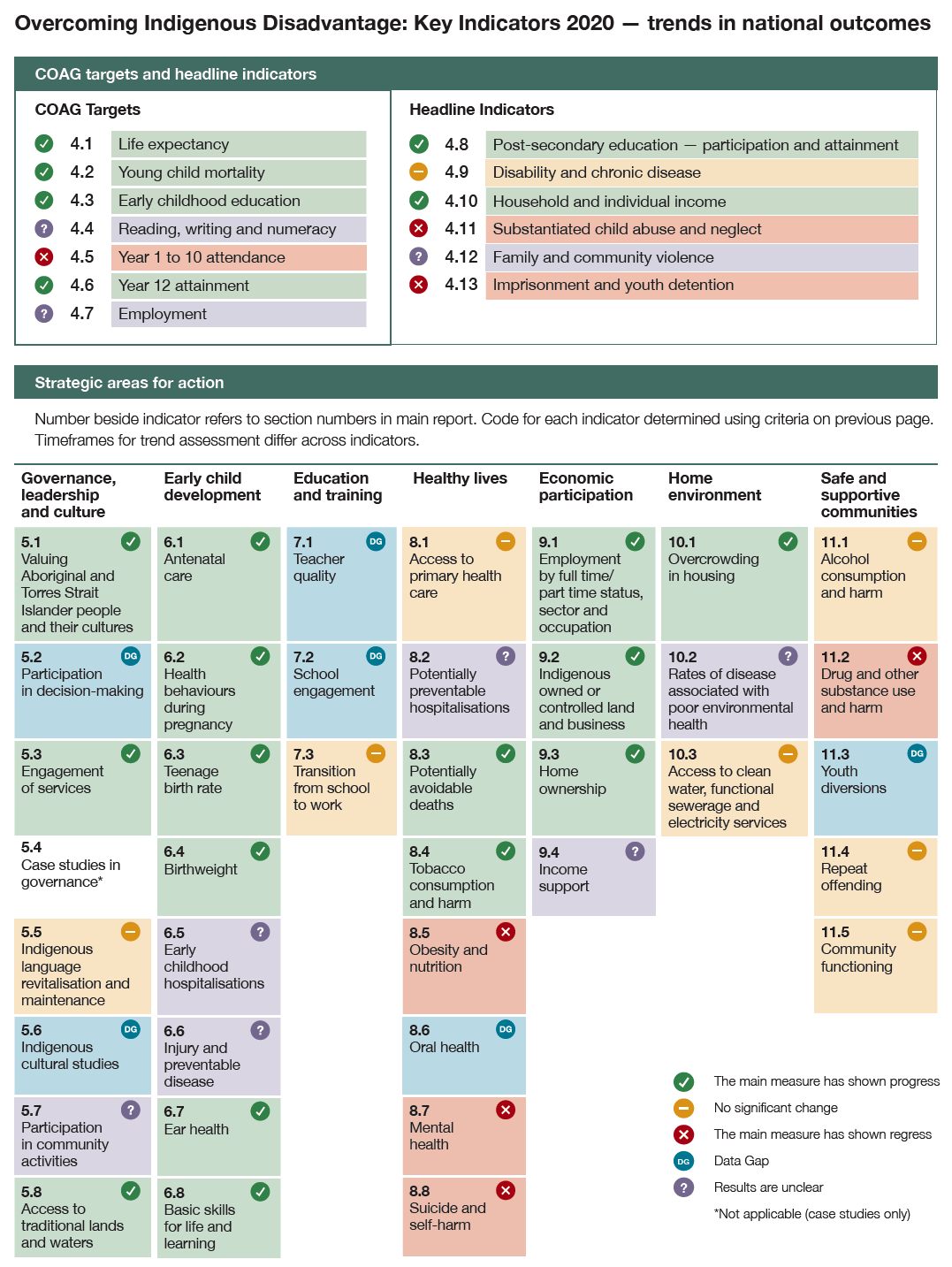
Printed copies
Printed copies of this report can be purchased from Canprint Communications.
Publications feedback
We value your comments about this publication and encourage you to provide feedback.