
Annual productivity bulletin 2026

PC productivity insights
Released 19 / 02 / 2026
This year’s annual productivity bulletin shows that Australia’s multifactor productivity (MFP), which measures how well labour and capital combine to produce outputs, declined by 0.5% in 2024-25, falling below the 20-year average.
To further consider how well we use capital to produce output, this years’ feature article examines Australia’s capital productivity performance over time and in an international context. It highlights the importance of investing in new technologies and efficiently allocating and managing capital to ensure we are using our capital to effectively improve labour productivity and living standards.
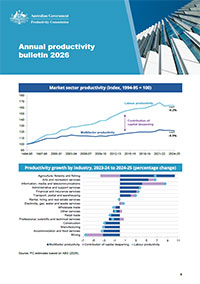
 Annual productivity bulletin 2026 (PDF 484.5 KB)
 Annual productivity bulletin 2026 (DOCX 961.8 KB)
 Chart data (XLSX 57.1 KB)
Multifactor productivity (MFP) is a measure of how well labour and capital inputs are combined to produce outputs and is a key determinant of growth in income and living standards. Unfortunately, the most recent ABS data shows that Australia’s MFP has declined over the 12 months to June 2025.
MFP decreased by 0.5% over 2024-25, below the 20-year average of 0.4% growth per year and well below the 1.6% annual average increases between 1994-95 to 2003-04. At an industry level, agriculture, forestry and fishing led MFP growth at 10.4% over the last year. Mining saw its fifth consecutive year of declining MFP and had the largest fall of any industry in 2024-25 at 3.2%.
There are many possible reasons for Australia’s recent poor track record of MFP growth. One possible reason is slowing accumulation of human capital – while our labour force continues to grow, we also need a skilled workforce that can adapt to changes and meet employer demands. Our recent report, Building a skilled and adaptable workforce, identified a number of ways government can improve the quality of the workforce.
Likewise, our workers need capital to be their most productive. While the amount of capital is crucial, the quality of our capital matters too – it is important that we invest in the right types of assets and use new and existing capital effectively.
In the feature article in this year’s annual productivity bulletin, research economist Joseph Christensen examines Australia’s capital productivity performance over time and in an international context. He finds that market sector capital productivity in Australia has fallen by more than 18% since 1995, with most of this decrease occurring during the mining boom when capital investment in the mining sector grew rapidly.
But he also notes that decreasing capital productivity on its own is not necessarily a bad thing. Joseph examines the relationship between labour productivity and capital intensity, and finds some positive signs for Australia – we used our capital more efficiently than average in 2023, achieving higher labour productivity with a slightly lower capital intensity. However, there is still room for improvement – workers in the most productive countries are 12% more productive with the same amount of capital.
This analysis highlights the importance of investing in innovation and promoting conditions that encourage productive investment, the efficient maintenance of existing capital, and the efficient utilisation of new and existing capital to increase productivity and improve living standards.
Media requests
Media team – 02 6240 3330 / media@pc.gov.au
- Market sector productivity
- Productivity growth by industry
- Update from Alex Robson
- Beyond the accumulation of capital: Australia’s capital productivity performance
- Capital productivity in Australia has decreased a lot since 1995
- Australia’s capital productivity looks about average, but there is room for improvement
- Lessons for policy
- References
- Copyright and publication detail
- Appendix
- What is capital?
- How is capital measured?
We value your comments about this publication and encourage you to provide feedback.