
Quarterly productivity bulletin - December 2025

PC productivity insights
Released 11 / 12 / 2025
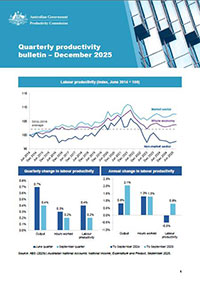
While we are beginning to see green shoots of improvement, labour productivity is still much lower than we would like it to be. This latest quarterly productivity bulletin shows labour productivity increased by 0.2% in the September quarter and 0.8% over the year to September 2025.
The bulletin also considers what lessons we can learn from historical periods of labour productivity growth in the non-market sector, and finds that, due to challenges measuring labour productivity in the sector, we cannot evaluate the non-market sector on its productivity record alone.
Download the bulletin
 Quarterly productivity bulletin – December 2025 (PDF 459.5 KB)
 Quarterly productivity bulletin – December 2025 (DOCX 1.9 MB)
Quarterly productivity bulletin December 2025
Deputy Chair Dr Alex Robson
While we are beginning to see green shoots of improvement, labour productivity is still much lower than we would like it to be.
Labour productivity increased by 0.2% in the September quarter and by 0.8% over the year to September 2025. The good news is we have now observed four consecutive quarters of labour productivity growth since last September. But the bad news is the growth is quite small – 0.8% since last September still means growth is less than half its long-term average. This kind of increase won’t give us the long-term benefits we know are possible from productivity growth.
Digging a little deeper, we can see that labour productivity in the market sector has grown by 1.0% over the past 12 months, while labour productivity in the non-market sector has shrunk by 0.3%. The non-market sector, broadly defined as those industries that are dominated by government involvement, has tended to have lower growth in labour productivity than the market sector. However, new data released by the ABS last quarter suggests that this has not always been the case.
In this bulletin’s feature article, research economists Archana Subramaniam and Billy Morton find that, unfortunately, unpacking these numbers does not reveal a lost secret to non-market sector labour productivity growth. Instead, it highlights the challenges of measuring productivity in the non-market sector.
This uncertainty doesn’t reduce the need for reform in the non-market sector. In the interim report of our Delivering quality care more efficiently inquiry, we presented three productivity-enhancing policy reform areas for the care economy (a large portion of the non-market sector): reforming quality and safety regulation to support a more cohesive care economy; embedding collaborative commissioning to increase the integration of care services; and creating a national framework to support government investment in prevention.
However, policymakers should not evaluate the performance of the non-market sector on its productivity record alone. As Archana and Billy explain: ‘to fully observe [productivity] gains, we’ll need better measures that account for quality and outcomes. In the meantime, policymakers need to understand and communicate the data limitations, consider complementary measures of success in the non-market sector and conduct rigorous cost-benefit analysis to pursue good policy – even if the benefits don’t always show up directly in the national accounts.’
Media requests
Quarterly productivity bulletin – December 2025
- Labour productivity update
- Update from Alex Robson
- Labour productivity in the non-market sector: can we learn from the past?
- Copyright and publication detail
Appendix: Supporting evidence
- A primer on productivity
- Detailed productivity statistics
- Productivity data revisions
We value your comments about this publication and encourage you to provide feedback.