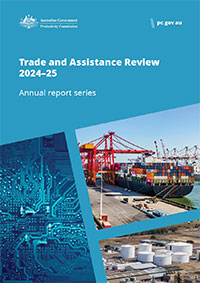
Trade and Assistance Review 2024-25
Annual report series
Released 20 / 08 / 2026
The Trade and Assistance Review (TAR) contains the PC’s latest estimates of Australian Government assistance to industry, and provides a summary of developments in industry assistance, trade policy and foreign investment.
Download the report
 Trade and Assistance Review 2024-25 (PDF 1.4 MB)
 Trade and Assistance Review 2024-25 (DOCX 6.1 MB)
 Appendix B assistance estimates and data tables (XLSX 457.0 KB)
Industry assistance shifting towards targeted measures
Australian Government assistance to industry is increasingly shifting towards measures targeted at particular industries and sectors, according to the Productivity Commission’s latest Trade and Assistance Review.
Industry budgetary assistance increased by 6.4% to $16.8 billion in 2024-25, while remaining at around its long-term level as a share of GDP. But the Future Made in Australia agenda has led a shift away from broad-based programs towards assistance targeting specific industries. Nearly $570 million of the increase in budgetary assistance is estimated to be attributable to programs associated with the FMIA agenda, with most programs related to the clean energy sector.
“While the overall level of assistance has remained relatively steady as a share of the economy, its composition is changing as governments make greater use of targeted measures,” said Productivity Commission Deputy Chair Dr Alex Robson.
“This is trend is likely to continue as the FMIA agenda continues to roll out. The production tax incentives that commence from 2027-28 are projected to provide more than $11 billion in assistance throughout the next decade and beyond.”
Domestic fuel security policy
The report also considers government intervention to improve domestic fuel security amid disruptions to global oil supply chains arising from conflict in the Middle East.
Assistance aimed at improving domestic fuel security is likely to increase and is expected to begin contributing to the Commission’s estimates of industry assistance from 2026-27.
“There can be a role for government in managing the risks created by global oil shocks, but the level and form of that intervention matters,” Dr Robson said.
“Stockpiling, supporting domestic production and strengthening trading relationships all carry different costs. The objective should be sensible risk management – reducing Australia’s vulnerabilities at the lowest cost.”
How governments are intervening in AI markets
The report looks at how governments around the world are increasingly intervening in AI markets to support domestic industries, strengthen security and resilience, or align AI services with domestic objectives and values.
“International assistance for AI will have mixed effects for Australia,” said Commissioner Catherine de Fontenay.
“Overseas subsidies can lower the cost of AI services for Australian businesses and consumers and help diversify supply chains. But trade barriers can also make it harder for Australian firms to reach overseas markets. And measures that restrict competition can increase the prices Australians pay.”
“If restrictions spread and compound across different parts of the AI technology stack, they could be particularly damaging for Australia’s software industry and reduce the productivity gains we could otherwise get from wider AI adoption.”
Australia building international relationships while protectionism grows
The report finds that Australia has continued to strengthen its international economic relationships even as protectionism grows globally.
Australia has signed a free trade agreement with the European Union, brought the Australia–United Arab Emirates Comprehensive Economic Partnership Agreement into force and upgraded the ASEAN–Australia–New Zealand Free Trade Area. Australia is also continuing negotiations on a new free trade agreement with India.
The Australian Government has also committed to abolishing a further 497 nuisance tariffs from 2026-27, following the removal of 457 tariffs from 1 July 2024.
The report finds there is a strong case for taking the remaining statutory tariff rates to zero. It shows that Australia’s tariffs may well cost more than they raise – compliance costs for businesses accessing tariff preferences and concessions were between $1.4 billion and $4.1 billion in 2024-25, compared with $1.9 billion in tariff revenue.
At the same time, protectionism continued to grow globally through 2024 and 2025, while changes to United States tariff policy have added to uncertainty in the global trading system.
“The biggest risk from protectionism is not simply the direct cost of an individual tariff or subsidy,” Dr Robson said.
“When one country introduces protectionist measures, others can come under pressure to respond. That risks a cycle of intervention and retaliation that ultimately reduces living standards and economic growth.
“Australia’s interests are best served by avoiding that cycle, continuing to build strong trading relationships and supporting an open international trading system.”
Media requests
Media team – 02 6240 3330 / media@pc.gov.au
- Preliminaries: Cover, Copyright and publication detail, Contents, and Foreword
- Executive summary
- 1. Industry assistance – estimates and recent developments
- A look at budgetary assistance in 2024–25
- A look at concessional finance in 2024–25
- A renewed focus on domestic fuel security may impact future industry assistance estimates
- 2. Trade policy developments
- Australia continues to support a multilateral trade environment
- Internationally, trade protectionism continues to rise
- 3. Recent developments in AI-related industry and trade policy
- AI requires a complex, globally sourced set of inputs
- Governments are increasingly intervening in AI markets
- AI-related trade restrictions have mixed impacts on Australia
- 4. Foreign investment policy
- Developments in foreign investment policy
- Developments in foreign investment
- Foreign direct investment applications
- A. Public engagement
- B. Assistance estimates
- Abbreviations
- References
Printed copies of this report can be purchased from Canprint Communications.
We value your comments about this publication and encourage you to provide feedback.