
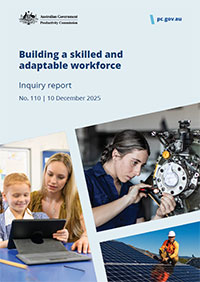
Building a skilled and adaptable workforce

Inquiry report
Released 19 / 12 / 2025
The PC was asked by the Australian Government to conduct an inquiry into Building a skilled and adaptable workforce. As part of this work, we were tasked with identifying priority reforms and developing actionable recommendations.
In this final inquiry report, the PC presents recommendations focused on four key policy reform areas:
- Equitable access to the best teaching resources to improve school student outcomes
- Enabling tertiary education pathways
- Boosting work-related training to build skills and adaptability
- Fit-for-purpose occupational entry regulations.
This inquiry report was handed to the Australian Government on 10 December 2025 and released on 19 December 2025. It was later tabled in Parliament on 29 January 2026.
Download the report
 Inquiry report (PDF 2.4 MB)
 Inquiry report (DOCX 6.5 MB)
The following excel file contains tables of data used to make the figures within this report.
Chart data (Excel - 74.3 KB) Chart data (Excel - 74.3 KB)
Preliminaries: Cover, Copyright and publication detail, Transmittal letter, Terms of reference, Disclosure of interests, Acknowledgements and Contents
Executive summary
Recommendations
About this inquiry
- 1. Equitable access to the best teaching resources to improve school student outcomes
- Australia’s education challenge
- Supporting teachers with high-quality instructional materials, edtech and professional development
- Implementation considerations
- 2. Enabling tertiary education pathways
- Effective credit transfer and RPL processes can support students, but reform is required
- Concrete steps towards a national credit and RPL system
- Considerations for improving and streamlining credit transfer and RPL processes
- 3. Boosting work-related training to build skills and adaptability
- Australia’s low training rates are a missed opportunity
- Financial incentives with advice can help SMEs develop a culture of training
- A pilot program should build in evaluation to gather evidence on what works to increase training
- 4. Fit-for-purpose occupational entry regulations
- OERs are designed to protect workers and consumers
- OERs are not always the right tool for the job
- Replacing OERs with more efficient alternatives
- Targeting qualification requirements to risk
- Expanding entry pathways while ensuring competence
- Governance is vital to reducing inappropriate OERs
- Appendices
- A. Public consultation
- B. Occupational entry regulations — case studies and jurisdictional differences
- B.1 Overly stringent occupational entry regulations
- B.2 Qualification requirements are being reviewed for some occupations
- B.3 State and territory differences in OERs may identify excessive restrictions
- C. Technical appendix
- C.1 Modelling the economy-wide impacts of providing high-quality instructional materials and adopting edtech in school education
- C.2 Enabling tertiary education pathways
- C.3 Work-related training in small and medium enterprises
- C.4 Analysis of occupational entry regulations
- Attachment A: Review of ‘estimating the labour productivity effects of easing OER stringency
- Abbreviations
- References
Printed copies of this report can be purchased from Canprint Communications.
We value your comments about this publication and encourage you to provide feedback.