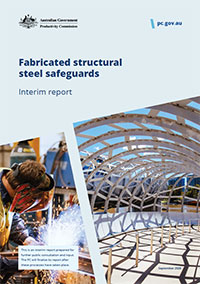
Fabricated structural steel safeguards

Interim report
Released 03 / 09 / 2026
This report assesses whether provisional safeguard measures should be introduced for imported fabricated structural steel products, and makes interim findings about whether definitive measures should be introduced.
Download the report
 Overview (PDF 686.9 KB)
 Overview (DOCX 5.1 MB)
 Chart data (XLSX 114.4 KB)
Submissions were by Friday 30 September 2026.
Webinar
The PC held a webinar regarding this interim report on 10 September 2026.
Webinar transcript
Responses to questions
Fabricated structural steel safeguards inquiry – interim report
The Productivity Commission has released the interim report of its investigation into whether safeguard measures are warranted against imports of certain fabricated structural steel products.
The interim report finds that the conditions for the introduction of provisional safeguard measures are not met. It also makes the interim finding that the conditions for definitive safeguard measures are not met.
Safeguard measures are trade barriers, such as tariffs, quotas or tariff rate quotas, that can be applied in limited circumstances to temporarily protect a domestic industry. Under World Trade Organisation (WTO) rules, safeguards are reserved for extraordinary circumstances and their introduction requires evidence of a recent, sudden, sharp and significant increase in imports that has caused, or threatens to cause, serious injury to the domestic industry.
The Australian Steel Institute, on behalf of the industry, lodged an application requesting that the Australian Government apply safeguard measures for fabricated structural steel products. The PC is Australia’s competent authority to investigate whether safeguard measures are justified under WTO rules.
The interim report finds that while imports of fabricated structural steel have increased, the nature of that increase does not meet the required legal standard.
‘Imports increased during the investigation period, but this growth was broadly in line with longer-term trends,’ said Commissioner Catherine de Fontenay.
In the investigation period (2020–21 to 2024–25) imports increased at an average annual rate of 6 per cent. This is below the average growth rate in earlier years.
To apply safeguard measures, an increase in imports must also be causing serious injury or pose a threat of serious injury. ‘Injury’ could include a change in profits, sales, employment or productivity.
Drawing on comprehensive administrative data for the industry, the report finds that sales, profits, production, productivity, capacity utilisation, and employment all increased over the investigation period, while import market share declined marginally (in value terms).
‘At an aggregate level, the evidence does not show serious injury across the domestic industry, or a threat of serious injury that meets the threshold for safeguard measures,’ said Commissioner Barry Sterland.
‘Our international trade obligations require the PC to assess the domestic industry overall. Submissions and our consultations and engagement with industry show that some individual businesses and market segments are under pressure, and we found evidence for this in the data. However, the evidence does not show that this is the case for the industry as a whole,’ said Commissioner Sterland.
The PC based its assessment on information provided by inquiry participants and anonymised administrative data held by the Australian Bureau of Statistics.
The PC has received 107 submissions and held three days of public hearings from 13 to 15 May. In the course of the investigation, the PC has met with 38 different organisations including governments and industries from countries trading with Australia, individual domestic producers, steel distributors, steel producers, construction firms and peak bodies representing these market segments.
The PC’s analysis covered a conservative population of 376 businesses composed of ASI members as well as 40 fabricators identified by the PC. This population is considered to represent a major proportion of domestic fabricated structural steel production. The PC also tested its findings using an expanded population of 514 businesses, with the same overall conclusion.
In view of the interim nature of these findings, the PC also set out a number of considerations for assessing the circumstances where safeguard measures would be in the public interest, and the design of measures to minimise any costs to the broader economy.
The PC is seeking further evidence on its interim findings, with submissions due by 30 September 2026. The interim report and information about making a submission are available at pc.gov.au/inquiries-and-research/steel-safeguards.
Preliminaries: Cover, Copyright and publication detail, Opportunity for comment, Terms of reference, Disclosure of interests, Acknowledgements, BLADE disclaimer notice, AI transparency statement, and Contents
Overview
Key points
- About the inquiry
- Scope of the safeguard investigation
- 2.1 The product and the domestic industry
- 2.2 The period of investigation
- 2.3 Excluded countries
- Imports
- 3.1 How have imports changed?
- 3.2 Unforeseen developments and GATT obligations
- Injury
- 4.1 Assessing injury
- 4.2 Is there serious injury?
- 4.3 Is there a threat of serious injury?
- 4.4 Assessment of overall impairment and threat thereof
- Are the conditions for safeguard measures met?
- 5.1 The conditions for safeguard measures are not met
- 5.2 FSS imports are a long-term feature of the Australian market
- Public interest assessment and measure design considerations
- 6.1 Public interest assessment
- 6.2 Measure design
Appendices
- A. Public engagement
- B. Technical appendix
- B.1 Analysis of imports
- B.2 Identifying the Australian FSS industry
- B.3 Estimating domestic production
- B.4 Construction of injury metrics
Abbreviations
References
Printed copies of this report can be purchased from Canprint Communications.