
Quarterly productivity bulletin – June 2026

PC productivity insights
Released 11 / 06/ 2026
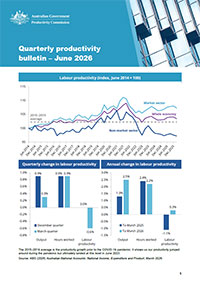
Australia’s labour productivity fell by 0.6% in the March quarter and grew by just 0.3% over the year, with hours worked continuing to outpace output.
The article included in this edition examines productivity in the electricity industry, showing how long-term investment in cleaner, more reliable energy has weighed on measured productivity, while highlighting opportunities to improve efficiency and reduce costs over time.
Download the bulletin
 Quarterly productivity bulletin – June 2026 (PDF 445.1 KB)
 Quarterly productivity bulletin – June 2026 (DOCX 2.0 MB)
 Chart data (XLSX 54.9 KB)
Quarterly productivity bulletin – June 2026
Deputy Chair Dr Alex Robson
Australia’s labour productivity growth is going from bad to worse.
Labour productivity fell by 0.6% in the March quarter and over the year to March has grown by only 0.3%. Growth in hours worked remains strong (0.9% increase over the quarter, 2.2% increase over the year). The accounting is straightforward: the value of goods and services we produce is increasing, but not by as much as hours worked. In aggregate, we are working harder and longer, but we are not working smarter.
The results are particularly concerning in the market sector – labour productivity fell by 0.7% in the quarter, and only grew by 0.4% in the year to March. Non-market sector labour productivity fell by 0.3% in the March quarter, and by 0.1% over the year to March.
Australia’s labour productivity appears stuck at the levels we settled into after the COVID-19 pandemic. We are now 0.1% below where we were in March 2023, when the ‘productivity bubble’ we saw during the pandemic burst.
A productive economy needs reliable and affordable energy. In this Bulletin’s feature article, we take a closer look at productivity in the electricity industry.
There has been significant investment over the past 20 years to replace coal assets reaching end of life. While this investment was clearly necessary, it has seen measured productivity fall significantly as there is a lag between when new energy assets are built and when they start producing at full capacity.
Further, some of the benefits of these investments, like improved network quality and lower emissions, are not picked up in conventional measures of productivity.
This isn’t to say that governments cannot do more to help ensure this transformation evolves in the most productive way possible. Australia should continue to identify and act on opportunities to improve productivity through the most efficient and cost-effective investments. We draw on our recent inquiry report – Investing in cheaper, cleaner energy and the net zero transformation – to emphasise the need for an integrated suite of policies, working in concert, to improve productivity in the electricity sector and minimise costs for consumers.
Media requests
Quarterly productivity bulletin – June 2026
- Labour productivity update
- Update from Alex Robson
- Electricity industry productivity: what the numbers miss and how to improve them
- Appendix A: Technical appendix
- Copyright and publication detail
Appendix B: Supporting evidence
- A primer on productivity
- Detailed productivity statistics
- Productivity data revisions
We value your comments about this publication and encourage you to provide feedback.