Report on Government Services 2026
PART B, SECTION 3: LATEST UPDATE 3 JUNE 2026
3 Early childhood education and care
Latest update 3 June 2026
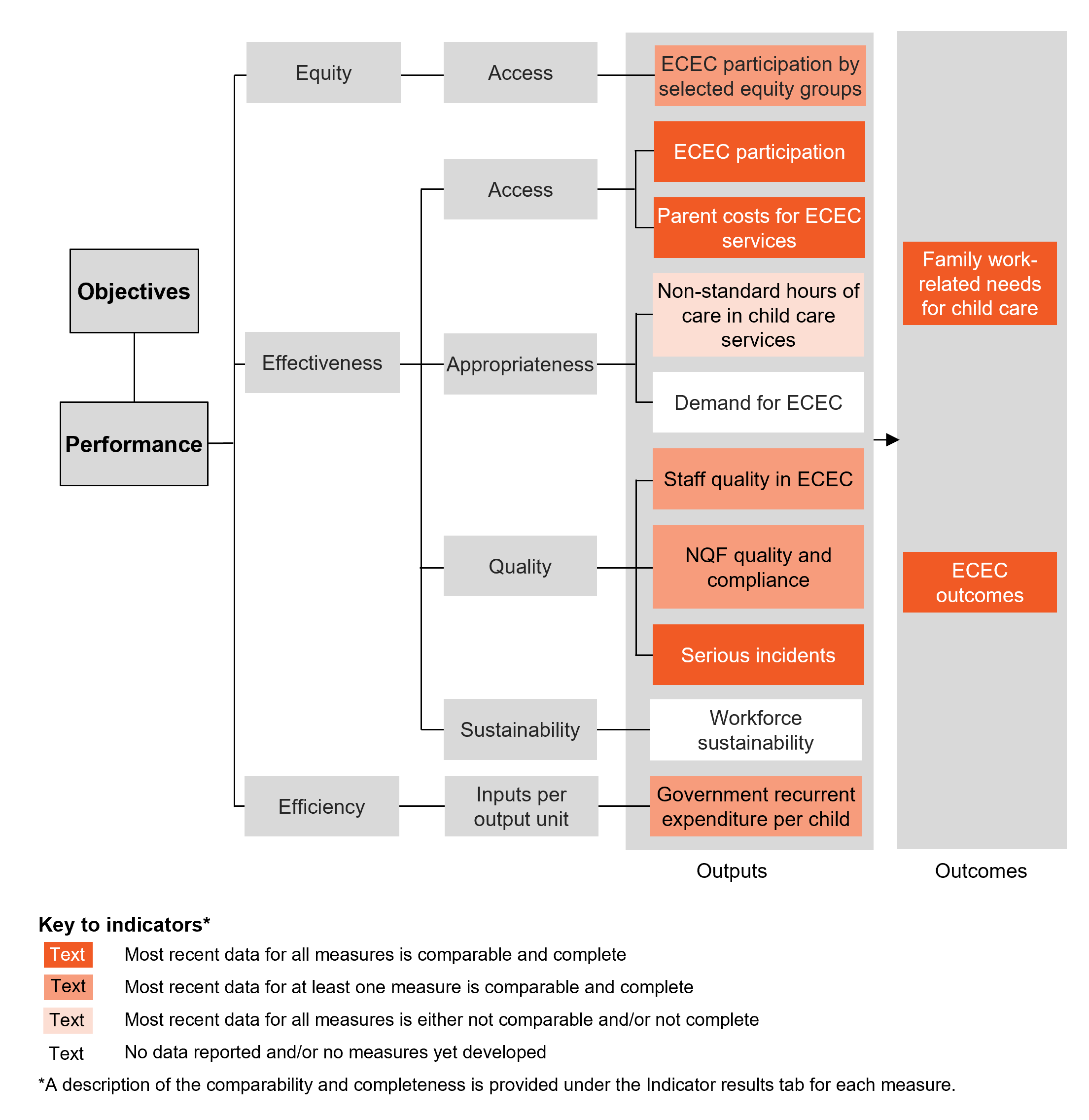
Indicator results for:
- ECEC participation by selected equity groups, 2025 data (measure 2: Preschool program participation)
- ECEC participation, 2025 data (measure 2: Preschool program participation)
- Parent costs for ECEC services, 2025 data (measure 3: preschool program costs)
Context on:
This section reports on the performance of early childhood education and care (ECEC) services, which comprise child care and preschool services.
The Indicator results tab uses data from the data tables to provide information on the performance for each indicator in the Indicator framework. The same data is also available in CSV format.
Data downloads
- 3 Early childhood education and care data tables (Excel - 657.4 KB)
- 3 Early childhood education and care dataset (CSV - 2 MB)
 3 Early childhood education and care data tables (Excel - 657.4 KB)
 3 Early childhood education and care dataset (CSV - 2 MB)
Refer to the corresponding table number in the data tables for detailed definitions, caveats, footnotes and data source(s).
 Guide: How to find what you need in RoGS (PDF - 812.9 KB)
Context
Objectives for ECEC services
ECEC services aim to meet the education, care and development needs of children, and meet the needs of families including enabling increased workforce participation, by providing universal access to early childhood education services for eligible children and accessible child care services that:
- are high quality, affordable, flexible and can be sustainably implemented across a range of settings
- are delivered in a safe, nurturing and inclusive environment
- target improved access for, and participation by, Aboriginal and Torres Strait Islander children, and children experiencing vulnerability and disadvantage.
Governments aim for ECEC services to meet these objectives in an equitable and efficient manner.
The ECEC sector provides a range of services for children based on their age and education, care and development needs. ECEC services provide the following broad service types:
- Child care services – provide education and care services to children aged 0–12 years including the following service types: centre based day care; family day care; outside school hours care (OSHC); and other care. 'Explanatory material' tab includes definitions.
- Preschool services – are services that deliver a preschool program. A ‘preschool program’ is a structured, play‑based learning program, delivered by a degree qualified teacher, aimed at children in the year or two before they commence full-time schooling (table 3.1).
| Preschool program | Transition to primary school Foundation year (year prior to Year 1) | |||
|---|---|---|---|---|
| State/territory | Program name | Age of entry – preschool program in year before full‑time schooling (YBFS) | School year | Age of entry |
| NSWa | Preschool | 4 years by 31 July | Kindergarten | 5 years by 31 July |
| Vicb | Kindergarten | 4 years by 30 April | Preparatory | 5 years by 30 April |
| Qld | Kindergarten | 4 years by 30 June | Preparatory | 5 years by 30 June |
| WA | Kindergarten | 4 years by 30 June | Pre-Primary | 5 years by 30 June |
| SAc | Preschool | 4 years by 1 May (Term 1) 4 years between 1 May and by 31 October (Term 3) | Reception | 5 years by 1 May (Term 1) 5 years between 1 May and 31 October (Term 3) |
| Tas | Kindergarten | 4 years by 1 January | Preparatory | 5 years by 1 January |
| ACT | Preschool | 4 years by 30 April | Kindergarten | 5 years by 30 April |
| NTd | Preschool | 4 years by 30 June | Transition | 5 years by 30 June |
a In New South Wales, all licensed children’s services for under 6-year-olds (who have not commenced kindergarten) are required to offer programs that meet children’s educational and developmental needs. b In Victoria, children aged 3 years can participate in kindergarten services in the year prior to YBFS. c South Australia provides early access to department funded preschool for Aboriginal and Torres Strait Islander children or children under the Guardianship of the Minister after their third birthday. South Australia implemented a mid-year intake into preschool in Term 3 2023. Caution should be used in interpreting state-specific YBFS estimates for South Australia as the data has not been adjusted for YBFS mid-year intake enrolments. The compulsory school starting age in South Australia is 6 years at the oldest. d In the Northern Territory, children living in very remote areas can attend preschool from the age of 3 years. Parents may accompany their child and remain with them at each preschool session if they choose.
Source: ABS 2025; state and territory governments (unpublished).
An ECEC service may offer more than one service type, such as centre based day care and OSHC (both child care services). The most common type of integrated service is a preschool program delivered within centre based day care. The range of service types offered differs across states and territories and between service providers.
ECEC services can also provide other non-education services such as maternal and child health services and family support services. The services provided differ according to community need, with more extensive services often being provided in disadvantaged communities.
The Australian, state and territory governments have different but complementary roles in ECEC. In 2023-24, the Australian Government’s main roles and responsibilities included:
- paying the Child Care Subsidy (CCS),1 which is generally paid directly to child care providers. The types of child care for which families receive subsidised care are in table 3.2
- providing funding to state and territory governments to support reforms to improve preschool participation and outcomes, through the Preschool Reform Agreement (PRA)
- providing operational and capital funding to some providers.
| NSWa | Vicb | Qld | WA | SA | Tasc | ACTd | NTe | Aust | ||
|---|---|---|---|---|---|---|---|---|---|---|
| Funded child care services, for service types: | Centre based day care |
|
|
|
|
|
|
|
|
|
| Family day care |
|
|
|
|
|
|
|
|
| |
| OSHC |
|
|
|
|
|
|
|
|
| |
| In home care |
|
|
|
|
|
|
|
|
| |
| Funded preschool services or programs, in: | Local government or community preschools |
|
|
|
|
|
|
|
|
|
| For-profit centre based day care |
|
|
|
|
|
|
|
|
| |
| Not-for-profit centre based day care |
|
|
|
|
|
|
|
|
| |
| Government school |
|
|
|
|
|
|
|
|
| |
| Non-government school |
|
|
|
|
|
|
|
|
|
 Government provides funding to at least one of these services.
 Government does not provide funding to any of these services.
a New South Wales subsidises early access to community preschool for 3-year-old Aboriginal and Torres Strait Islander children and 3-year-old children from low-income families. b In Victoria, funded 3-year-old kindergarten is available statewide from 2022. This is in addition to 3-year-old kindergarten already being available to Aboriginal and Torres Strait Islander children, and children experiencing vulnerability and disadvantage. c In Tasmania, some child care services may receive funding under an annual, small capital grants (minor infrastructure) program. These services are not included in this table unless they also receive recurrent funding. d The Australian Capital Territory provides funding to centre based ECEC services through targeted and universal 3-year-old preschool. Child care services and preschool services outside the government sector may also receive support through capital grants, rental subsidies, and funding through budget initiatives. These services are not included in this table unless they also receive recurrent funding. e The Northern Territory Government also provides funding to 3-year-old kindergarten services.
Source: Australian, state and territory governments (unpublished).
State and territory governments’ roles and responsibilities vary across jurisdictions but mainly include:
- funding and/or providing preschool services and, in some cases, providing funding to child care services (including some that also receive Australian Government funding)
- providing funding to support the implementation of the PRA
- regulating approved services under the National Quality Framework (NQF) and licensing and/or registering child care services not approved under the NQF
- implementing strategies to improve the quality of ECEC programs
- providing curriculum, information, support, advice, and training and development to ECEC providers.
Local governments also plan, fund and deliver ECEC. But due to data limitations, the only local government data included in this section is that involving Australian, state and territory government funding and/or licensing.
- The CCS replaced the Child Care Benefit and Child Care Rebate from 2 July 2018. The Child Care Subsidy System (CCSS) was introduced to manage the payment and administration of the CCS and is the source of the data. From 2018 service categories changed: centre based day care replaced long day care and occasional care, which were previously reported separately; and OSHC replaced outside school hours care and vacation care. Budget based funded services are no longer separately identified. Locate Footnote 1 above
Total Australian, state and territory government recurrent and capital expenditure on ECEC services was $20.9 billion in 2024-25, a real increase of 10.6% from 2023-24 (table 3A.1). Australian Government expenditure accounted for $16.2 billion (77.9%) and state and territory government expenditure for $4.6 billion. Preschool services accounted for 83.5% of state and territory government expenditure (figure 3.1).
The Australian Government provided $466.7 million to state and territory governments in 2024-25 through the PRA (table 3A.4), which is included under state and territory government expenditure.
Services delivering ECEC
In the March quarter 2025, there were 15,158 Australian Government CCS approved child care services in Australia (table 3.3). Some child care services do not receive Australian Government funding, and are funded by state and territory governments only or do not receive any government funding.
In 2025, there were 13,882 ECEC services in Australia delivering preschool programs (table 3.4). Of these services, 9,538 (68.7%) were delivered from centre based day care and the remainder (31.3%) were delivered from stand‑alone preschool services or preschool services attached to a school.
Children using ECEC
In the March quarter 2025, over 1.4 million children aged 0–12 years (35.0%) attended Australian Government CCS approved child care services, similar to the proportion in 2024 (table 3A.8). More than half of all children aged 0–5 years were attending approved child care services; the highest proportion in the past 10 years. The majority of children aged 0–12 years were attending centre based care services (59.4%), followed by OSHC (40.3%) and family day care (5.0%) (table 3A.9).
In 2025, 586,662 children were enrolled in a preschool program, including programs for 3-year-olds (table 3A.10).2 Of these children, 298,608 were enrolled in the state-specific YBFS (table 3A.11). The total number of enrolments indicates service activity, while the number of enrolments in the state‑specific YBFS provides an estimate of the size of the cohort for whom the year of preschool is in the year before they will probably attend full-time school.
Estimated resident population for children aged 0–12 years at 31 December and children aged 3–5 years at 30 June are in tables 3A.12 and 3A.13 respectively. Population estimates for children aged in their state-specific YBFS are in table 3A.14.
- Data reported for 3-year-olds enrolled in a preschool program may be incomplete due to different reporting arrangements in each jurisdiction. Locate Footnote 2 above
A PDF of Part B Child care, education and training can be downloaded from the Part B sector overview page.