
Report on Government Services 2026
PART F, SECTION 15: RELEASED ON 29 JANUARY 2026
15 Services for people with disability
This section reports on Australian, state and territory government assistance to people with disability and their carers. Performance reporting currently focuses on assistance provided by governments to people with disability via the National Disability Insurance Scheme (NDIS) and through specialist disability services, as well as the broad social and economic outcomes of people with disability and their use of mainstream services.
The Indicator results tab uses data from the data tables to provide information on the performance for each indicator in the Indicator framework. The same data is also available in CSV format.
Data downloads
- 15 Services for people with disability data tables (Excel - 940.9 KB)
- 15 Services for people with disability dataset (CSV - 2.4 MB)
 15 Services for people with disability data tables (Excel - 940.9 KB)
 15 Services for people with disability dataset (CSV - 2.4 MB)
Refer to the corresponding table number in the data tables for detailed definitions, caveats, footnotes and data source(s).
 Guide: How to find what you need in RoGS (PDF - 812.9 KB)
Context
Objectives for services for people with disability
Disability services aim to support people with disability and their carers to have an enhanced quality of life, enjoy choice and wellbeing, achieve independence, and experience social and economic participation and full inclusion in the community.
Under the NDIS, governments aim to achieve this objective through the provision of an NDIS that:
- enables people with disability to exercise choice and control in the pursuit of their goals and the planning and delivery of their supports
- provides reasonable and necessary supports including early intervention supports
- promotes the provision of high quality and innovative supports
- provides timely decisions on access to NDIS applicants.
For specialist disability services provided outside the NDIS, governments aim to achieve this objective by providing access to disability services:
- that meet the needs of people with disability and their carers
- that provide skills and support to people with disability to enable them to live as independently as possible
- that meet a particular standard of quality
- on the basis of relative need
- that assist families and carers in their caring role.
Governments aim to meet these objectives in an equitable, efficient and sustainable manner.
Governments provide assistance to people with disability and their carers through the NDIS and specialist disability services.
The NDIS was established under the National Disability Insurance Scheme Act 2013 (Cth). The NDIS adopts an insurance-based model of funding and delivering supports for people with disability. The scheme is not means tested and is uncapped (demand-driven). The NDIS provides reasonable and necessary supports to people with a permanent and significant disability who need assistance with everyday activities.
People applying to access the scheme are assessed according to a standard set of criteria. People who meet these criteria receive a package of funding to purchase the supports identified in their approved plan. The NDIS market-based approach is based on the premise that people with disability should be able to exercise choice and control in the supports they access.
Services and supports provided to NDIS participants are regulated by the NDIS Quality and Safeguards Commission (NQSC). The NQSC's role includes provider registration, complaints management and reportable incidents, behaviour support, and compliance with practice standards and the NDIS code of conduct. During 2024-25, the NQSC received 33,789 complaints, and 2,305,071 notified of incidents of unauthorised use of restrictive practices and 34,104 other reportable incidents (excluding unauthorised use of restrictive practices) (tables 15A.58–60). Of the 34,104 other reportable incidents notified during 2024-25, most concerned alleged abuse and neglect (43.6%), followed by serious injury, including accidents (33.4%). The NDIA also receives complaints about the Scheme (NDIA 2025a).
Complaints about state-funded specialist disability services outside the NDIS can be made to independent agencies across jurisdictions (such as ombudsmen and disability services commissioners).
With the transition of state and territory services to the NDIS, the number and range of specialist disability services provided have declined. Specialist disability services that continue to be provided include:
- employment services, which the Australian Government delivers
- Basic Community Care (BCC) services, which assist people with disability or a chronic health condition aged under 65 years (and Aboriginal and Torres Strait Islander people aged under 50 years) to live independently and to actively participate and engage in their community.
People with disability have the same right of access to mainstream services as all Australians, consistent with the goals of Australia’s Disability Strategy 2021 - 2031 (the Strategy), which was launched on 3 December 2021. The Strategy sets out Australia's national disability policy framework. Its purpose is to:
- provide national leadership towards greater inclusion of people with disability
- guide activity across all areas of public policy to be inclusive and responsive to people with disability
- drive mainstream services and systems to improve outcomes for people with disability
- engage, inform and involve the whole community in achieving a more inclusive society.
All levels of government have committed to delivering more comprehensive and visible reporting under the Strategy through the Outcomes Framework. Governments will report annually on progress against seven outcome areas. Further information on the Strategy can be found at https://www.disabilitygateway.gov.au/ads, and the most recent data for the Outcomes Framework is available at https://www.aihw.gov.au/australias-disability-strategy.
Data on the participation of people with disability in mainstream government services can be found in other sections of this report (sections 3, 4, 5, 14, 18, 19 and sector overview G).
The Australian, state and territory governments have different but complementary roles and responsibilities:
- all governments share responsibility for NDIS policy, funding and governance (NDIA 2025c)
- state and territory governments are responsible for providing specialist disability services, except disability employment services
- state and territory governments have full financial and operational responsibility for BCC services for people with disability aged under 65 years (and Aboriginal and Torres Strait Islander people aged under 50 years)
- the Australian Government is responsible for providing employment services for people with disability and income support.
In 2024-25, total expenditure on disability services was $51.1 billion, an increase of 5.5% compared to 2023-24 and an average annual growth rate since 2019 of 16.2% (table 15A.1).
In 2024-25, governments contributed $46.1 billion to the NDIS, with a further $1.9 billion in government expenditure on direct service delivery outside of the NDIS (table 15A.1). For all jurisdictions, contributions to the NDIS formed the bulk of funding for disability services (tables 15A.3 and 15A.4). Further information on funding sources, categories of expenditure and government expenditure in prior years are available in data tables 15A.1–4.
In addition to contributing to NDIS participant costs, the Australian government also funds the NDIA as an independent statutory agency to implement the NDIS and the NDIS Quality and Safeguards Commission to oversee and regulate the NDIS. In 2024-25, operating expenses for the NDIA and the NDIS Quality and Safeguards Commission were $2.5 billion and $197.3 million, respectively (table 15A.1).
In 2024-25, the NDIS committed $61.0 billion in support to participants. This represents an increase of $6.5 billion (or 11.8%) in committed supports to participants compared to the previous financial year (table 15.1).
At 30 June 2025, $45.9 billion of support committed to participants during the 2024-25 financial year had been paid (table 15.1).
The ABS estimates that 5.5 million Australians, or 21.4% of the population, had disability in 2022 (3.2 million, or 15.0% of people aged under 65 years). This estimate increased from 2.4 million Australians, or 11.6%, in 2018 of people aged under 65 years. In 2022, an estimated 7.9% of the population had a profound or severe core activity limitation (5.1% of people aged under 65 years). These results are similar to 2018 and 2015. Males and females are similarly affected by disability (21.0% and 21.8% for all ages; 14.8% and 15.2% of people aged under 65 years) (ABS 2024, 2019, 2016).
Aboriginal and Torres Strait Islander people experience higher rates of disability than non-Indigenous people. In 2022, 11.6% of all Aboriginal and Torres Strait Islander people living in private dwellings (excluding those living in very remote areas and discrete Aboriginal and Torres Strait Islander communities) had a profound or severe core activity limitation, similar to 2018 (8.8%) and 2015 (7.3%) – around 1.6 times the proportion for non-Indigenous people (ABS 2024, 2021a).
Table 15A.5 contains additional information on disability prevalence.
National Disability Insurance Scheme participants
Nationally at 30 June 2025, there were 739,414 active NDIS participants with approved plans (table 15A.6), 60,529 of whom identified as Aboriginal or Torres Strait Islander (around 8.2% of NDIS participants) (table 15A.8). Nationally at 30 June 2025, 73,596 participants had left the NDIS since 1 July 2013 (NDIA 2025b).
Nationally at 30 June 2025, autism was the most common form of disability for NDIS participants (39.9%), followed by intellectual disability (14.6%) (table 15A.6). Data on the characteristics of NDIS participants is available in tables 15A.6–9.
Additional information on NDIS participants’ access to mainstream services and satisfaction with the NDIS is available in tables 15A.12–13. Information on the characteristics of active NDIS providers is available in table 15A.14. An analysis of the characteristics of NDIS participants linked to the Multi-Agency Data Integration Project is contained in Characteristics of National Disability Insurance Scheme participants, 2019: Analysis of linked data (ABS 2021b).
Users of Commonwealth employment services
Nationally in 2024-25, 122,898 people aged 15–64 year used Disability Management Services (table 15A.43) and 206,109 used Employment Support Services (table 15A.42). The use of employment services as a ratio of the potential population has decreased since 2021-22; this result is due to an increase in the estimated number of people with an employment restriction and a decrease in the number of people using Commonwealth employment services.
Use of Basic Community Care
As service users have transitioned to the NDIS, only limited data is available on BCC. In 2024-25, for the three jurisdictions for which BCC service user data were available (Victoria, Queensland and Tasmania), there were a combined 72,240 service recipients (table 15A.10). For the two jurisdictions for which data on hours were available (Victoria and Tasmania), service recipients received around 1.7 million hours of service (table 15A.11). The majority of service hours were for nursing care and domestic assistance (20.2% and 18.8% respectively) (table 15A.11). The quality of BCC data varies across jurisdictions and comparisons should be made with caution.
Disability support workforce
The NDIS Worker Screening Check sets a minimum national standard that all workers engaged by a registered NDIS provider in a risk-assessed role must meet. NDIS Worker Screening Check clearances expire every five years. Since the NDIS Worker Screening Check began, 1.1 million applications have been submitted (NDIS Commission 2025).
In the NDIS Commission Quarterly Performance Report Q4 2024-25 (NDIS Commission 2025), 10,545 behaviour support practitioners were considered suitable to deliver behaviour support services.
The most recent National Disability Services (NDS) 2025 Workforce Census provides updated information on the disability sector workforce. Nationally at December 2024, the disability workforce was predominantly female (two-thirds or 63%) and aged 25–44 years (49%). Additionally, 58% of the disability support workforce were employed on a permanent basis, with 21% of permanent workers employed full time. Casual workers comprised 40% of the disability support workforce. The Census also showed that over the past 12 months, turnover rates have remained steady for permanent workers (at 16%) and increased for casuals (from 24% to 26%) (NDS 2025).
Informal carers
Family and friends provide most of the care and support that people with disability receive. Information on informal carers enables governments to plan for future service demand, both for carer support and for assistance to the people they care for (see the Explanatory material tab for definitions of informal carers across different collections).
In 2022, an estimated 1.2 million informal primary carers (of which 822,200 were aged under 65 years) provided the majority of assistance with self-care, mobility and communication for people with disability (ABS 2024).
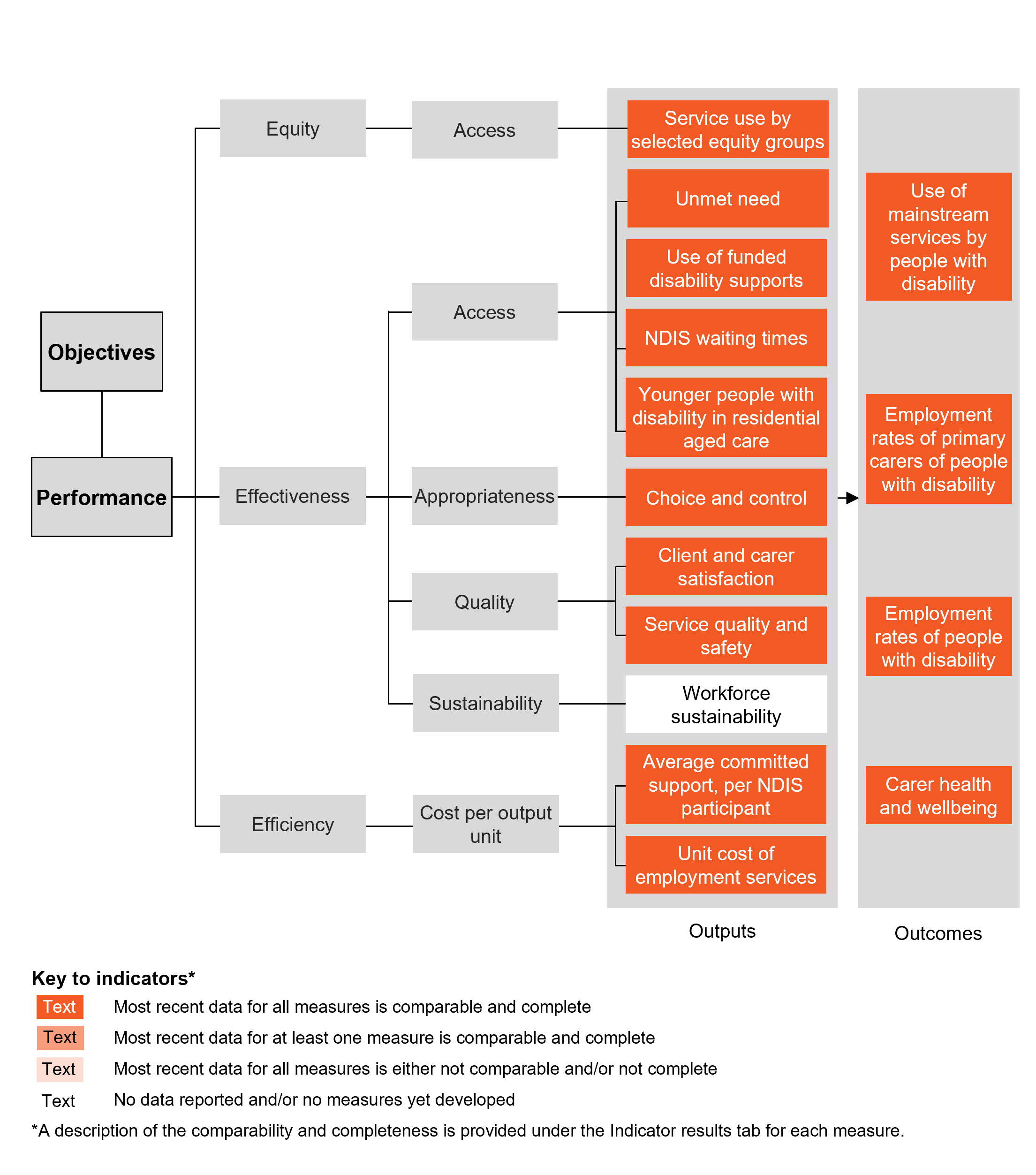


A PDF of Part F Community services can be downloaded from the Part F sector overview page.

Mesaure 1: Nationally at 30 June 2025, the proportion of the population who were participants in the NDIS was: