
Report on Government Services 2026
PART D, SECTION 9: RELEASED ON 3 FEBRUARY 2026
9 Emergency services for fire and other events
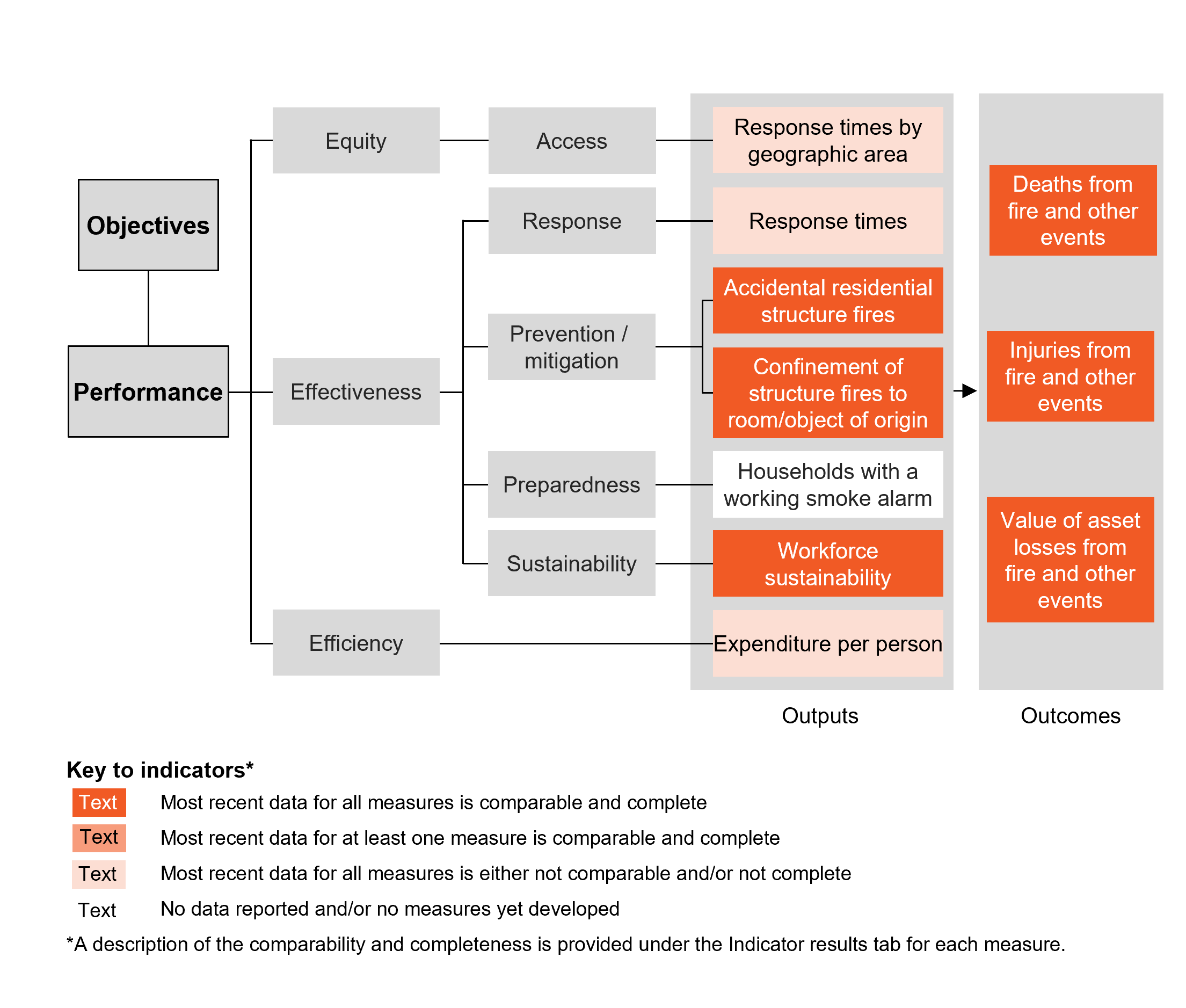
This section focuses on performance reporting for emergency services for fire events. Descriptive information is included on emergency services for other events.
The Indicator results tab uses data from the data tables to provide information on the performance for each indicator in the Indicator framework. The same data is also available in CSV format.
Data downloads
 9 Emergency services data tables (Excel - 352.2 KB)
 9 Emergency services dataset (CSV - 980.3 KB)
Refer to the corresponding table number in the data tables for detailed definitions, caveats, footnotes and data source(s).
 Guide: How to find what you need in RoGS (PDF - 812.9 KB)
Context
Objectives for emergency services for fire and other events
Emergency services for fire and other events aim to reduce the adverse effects of events on the community (including people, property, infrastructure, the economy and the environment). Governments seek to provide emergency services that:
- contribute to the community's management of risks and its preparedness, through the promotion of risk reduction and mitigation activities
- are accessible, responsive and sustainable.
Governments aim for emergency services to meet these objectives in an equitable and efficient manner.
An emergency event is an event that endangers or threatens to endanger life, property or the environment, and requires a significant and coordinated response. A fire event is an incident that is reported to a fire service organisation and requires a response. Fire events include (but are not limited to):
- structure fires (that is, fires inside a building or structure), regardless of whether there is damage to the structure
- landscape fires, including bushfires and grass fires, regardless of the size of the area burnt
- other fires, including vehicle and other mobile property fires, and outside rubbish fires.
Other events that require an emergency response from fire services or state and territory emergency services include road crash rescue, floods, storms and other natural disasters.
Fire service organisations and state and territory emergency services (STES) are some of the primary agencies involved in providing emergency services for fire and other events. The role of these organisations varies across jurisdictions but commonly includes prevention/mitigation, preparedness, response and recovery activities.
Each state and territory government operates multiple emergency service agencies, which service different populations and geographic areas according to specified governance arrangements (refer to table 9.1 below). Fire service and STES organisations work closely with other government departments and agencies that also have responsibilities in the case of fire and other emergency events.
This section covers the finances and activities of urban and rural fire service organisations and STES. For selected tables and jurisdictions, the fire service organisation data includes finances and activities of the relevant land management agencies.
| NSW | Fire and Rescue NSW; NSW Rural Fire Service (the fire agencies); National Parks and Wildlife Service; Forestry Corporation NSW (for fire response on their managed lands) and NSW State Emergency Service (SES) (for flood, storm and tsunami). |
|---|---|
| Vic | Fire Rescue Victoria; Country Fire Authority; Forest Fire Management Victoria and Victoria SES. |
| Qld | Queensland Fire Department – Queensland Fire and Rescue; Rural Fire Service Queensland; Queensland State Emergency Service (part of the Queensland Police Service); the Queensland Parks and Wildlife Service and Department of the Environment, Tourism, Science and Innovation (including national parks, state forests and world heritage areas). |
| WA | WA Department of Fire and Emergency Services. |
| SA | South Australian Metropolitan Fire Service; South Australian Country Fire Service and Forestry SA and SA State Emergency Service. |
| Tas | Tasmania Fire Service (for urban, structural and privately managed rural land); Tasmanian Parks & Wildlife Service (for national parks and other reserves, including future potential production forest lands); Sustainable Timber Tasmania (for declared forest land or State forest) and Tasmania State Emergency Service (for floods, storms or severe weather and coastal inundation [storm tide]). |
| ACT | ACT Fire and Rescue; ACT Rural Fire Service; ACT Parks and Conservation Service and ACT SES. |
| NT | NT Fire and Rescue Service; Bushfires NT; Parks and Wildlife Commission of the NT and NT Emergency Service (for cyclone, earthquake, floods, storm surge and water damage and tsunami). |
Nationally in 2024-25, the total revenue of fire service organisations was $6.6 billion (including Western Australia STES), a real increase of 4.4% from 2023-24 (table 9A.1).
STES revenue (excluding Western Australia) in 2024-25 was $448.9 million, a real decrease of 11.0% from 2023-24. A single department is responsible for both fire and emergency services in Western Australia and revenue cannot be separately reported for their SES (including volunteer marine rescue) (table 9.2).
Funding models to resource fire service organisations and STES organisations differ across jurisdictions. For fire services in the Australian Capital Territory and the Northern Territory, over 80% of revenue was from government grants in 2024-25. Levies were the largest source of revenue in Queensland, Western Australia, South Australia and Tasmania, over 55% in 2024-25. In New South Wales and Victoria revenue was well balanced between government and levies (table 9A.1).
For STES in 2024-25, state or territory government grants provided over 85% of revenue for Victoria, Queensland, Australian Capital Territory and the Northern Territory. Levies were the largest revenue source in New South Wales and South Australia (over 85%) (table 9A.2).
The Australian Government provides funding to state and territory governments through programs including:
- the Disaster Recovery Funding Arrangements, which provide assistance with relief and recovery efforts following an eligible natural disaster. Allocations vary across jurisdictions and over time depending on the timing and nature of natural disaster events, and the total cost of relief and recovery from disaster events may not be completely realised for some years.
- the Preparing Australian Communities Program Local, which supports projects that mitigate or reduce the risk, impact and consequences associated with large-scale natural hazards. In 2024‑25, the Australian Government spent $11.1 million on this fund, down from $41.3 million in 2023‑24 (table 9A.3)
- the Disaster Risk Reduction Fund, which supports initiatives to reduce the risk and limit the impact of disasters in line with the National Disaster Risk Reduction Framework. In 2024‑25, the Australian Government provided $20.9 million in funding under this program (table 9A.3)
- the Disaster Ready Fund, which commenced on 1 July 2023 and supports projects for disaster resilience and risk reduction. In 2024‑25, the Australian Government provided $200.0 million in funding under this program (table 9A.3).
In 2024‑25, the Australian Government also provided $567.3 million in disaster recovery payments to eligible individuals affected by a disaster, up from $83.5 million in 2023-24 (table 9A.3).
Human resources
Nationally in 2024-25, fire service organisations employed 24,760 full-time equivalent (FTE) paid personnel, with the majority (74.3%) being firefighters. A large number of volunteer personnel (190,042 people) supported delivery of services in 2024-25, an increase of 0.5% from 2023-24. Nationally, the numbers of volunteer personnel (both firefighters and support staff) have decreased by 16.0% over the reported time series (2015-16) (table 9A.4).
For STES, the majority of personnel were volunteers. In 2024-25 there were 26,068 STES volunteers (up by 7.0% from 2023-24) and 3,106 paid staff in 2024-25. The proportion of volunteer and paid personnel and the nature of their roles varied across jurisdictions (table 9A.5).
Demand for emergency services
Fire service organisations and STES provide emergency response and rescue services for a range of fire and other emergency events. Nationally in 2024-25, fire service organisations attended 472,361 emergency incidents, of which 101,553 were fire events. Fire service organisations also responded to other incident types including road crash rescues, floods and storms, and other hazardous conditions. The number of emergency incidents that fire service organisations responded to over the past 10 years (since 2015-16) increased by 23.5% (table 9A.6).
In 2024-25, STES organisations (excluding Queensland) attended 101,662 incidents, the majority of which were storm and cyclone events (71.7% or 72,931 events). The number of incidents requiring STES attendance over the past 10 years (since 2015-16) has increased by 49.4% (table 9A.7). Data on the number of hours STES organisations were in attendance is available in table 9A.8.
A PDF of Part D Emergency management can be downloaded from the Part D sector overview page.

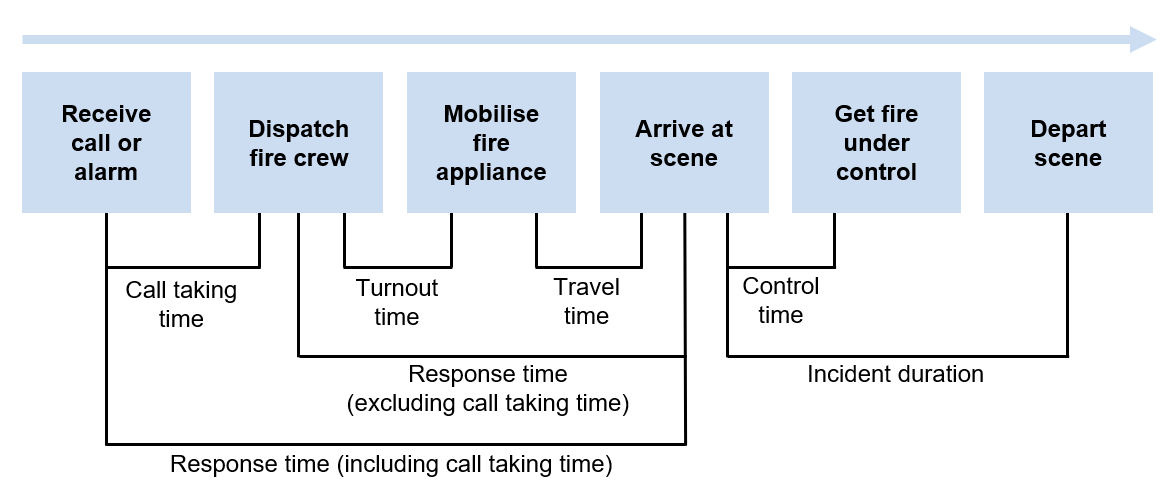
In 2024-25, major city response times for first fire crew appliances arriving at structure fires:
Response times are generally longer for all jurisdictions in regional and remote areas, compared to major cities (table 9.3).