
Opportunities in the circular economy

Australia’s circular economy: unlocking the opportunities
Inquiry report
Released 16 / 01 / 2026
In this inquiry, the Productivity Commission (PC) examined Australia’s opportunities in the circular economy to improve materials productivity and efficiency in ways that benefit the economy and the environment.
Our inquiry report identifies priority circular economy opportunities and advises on how best to measure progress and address barriers.
In undertaking the inquiry, the PC aimed to both contribute to the evidence base for policymaking about Australia’s circular economy transition and to provide practical policy advice for Australian governments.
The report was tabled in Parliament on 23 January 2026.
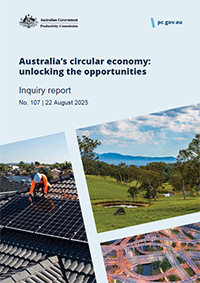
 Overview (PDF 840.4 KB)
 Overview (DOCX 6.8 MB)
 Chart data (XLSX 74.1 KB)
A national approach for a more sustainable and efficient economy
The Productivity Commission’s inquiry into the circular economy finds that the government can support sustainable and efficient materials use through reforming regulation, strengthening product stewardship obligations and fostering coordination and innovation.
The final report of the inquiry finds that circular economy practices, like reusing and repairing products and designing products to reduce input and waste disposal costs, can have meaningful environmental and economic benefits.
‘While many Australians are seizing the opportunity to make better use of materials, overall our progress has been slow. With the right approach to policy and regulation, we can support progress towards a more efficient and sustainable economy,’ said Commissioner Joanne Chong.
The report identifies opportunities to streamline regulations to make it easier for businesses to adopt innovative technologies and practices. For example, reducing overly restrictive standards and specifications in construction could provide access to lower cost and more sustainable materials.
‘We are expected to spend $270 billion on public infrastructure in the next four years alone. Allowing greater use of recycled or less emissions-intensive materials in these projects could reduce the economic and environmental cost of this work,’ said Commissioner Chong.
The report recommends that the Australian Government establish a Circular Economy Regulatory Reform Taskforce with state and territory governments to drive regulatory reforms and harmonisation.
‘Nationally coordinated regulatory reform is key to driving progress on sustainable and efficient materials use,’ said Commissioner Alison Roberts.
The report recommends the government progress a national product stewardship scheme for small-scale solar photovoltaic (PV) systems and investigate a similar scheme for EV batteries. It should also assist and work with state and territory governments to develop and implement a national framework for small electronics. This would require businesses who make, sell or import products to share responsibility for reducing waste throughout the product lifecycle.
‘State governments are forging ahead with their own product stewardship schemes. We require urgent national coordination on this issue to ensure consistency and certainty,’ said Commissioner Roberts.
‘Australia produces three times the e-waste per person of the average country but recovers relatively little of it’
‘When disposed of inefficiently, e-waste can harm the environment and human health. But recovering the valuable metals it contains presents a significant economic opportunity.’
The report also recommends initiatives to strengthen coordination and collaboration on circular economy initiatives. This includes establishing a challenge-based grant program that would encourage business, government and researchers to work together on new circular economy initiatives. Such programs have sparked innovation and delivered value for money internationally.
‘Circular economy practices thrive on collaboration and coordination. Government can help join the dots to develop new and innovative circular practices,’ said Commissioner Chong.
The report includes an indicative outcomes framework for Australia's circular economy transition, highlighting the importance of consistent metrics and data to inform policy and measure progress.
It also recommends place-based initiatives to enable coordination, address distance challenges and support businesses to develop and share new ideas. This includes a pilot for transition brokers, who can help build local circular economy knowledge and capability.
‘Local businesses can use their neighbours’ discarded materials as inputs for their own production and learn from each other about other innovative circular practices. Place-based initiatives can engage the local community as active participants in the circular economy,’ said Commissioner Chong.
- A circular economy aims to meet human needs with fewer and more sustainable materials, reducing the environmental impacts and costs of economic activity.
- Circular activities include designing products to use less materials, extending product lifespans via reuse and repair, and recycling and recovering materials to reduce waste.
- The benefits of circularity include more efficient use of the planet’s finite stock of natural capital to support economic and productivity growth; reduced harms to the environment, climate and biodiversity; and improved social outcomes such as health, amenity and intergenerational equity.
- Some circular activities reduce materials use in ways that simultaneously benefit the economy, the environment and society. Others have trade-offs, such as lowering materials use but increasing carbon emissions (for example, if recycling requires transporting waste long distances)
- Despite some uptake of circular economy opportunities in Australia, overall progress has been slow.
- Barriers to adopting circular economy opportunities include high costs; prescriptive, outdated or inconsistent regulations; coordination challenges and difficulties diffusing circular innovations; and limited practical information on circular opportunities.
- Circular economy-related policies in Australia are in early stages of development, but in several areas are evolving rapidly.
- Government policies related to materials productivity have traditionally focused on recycling. However, governments are increasingly focusing on earlier stages of the product life cycle.
- All levels of government have recently increased focus on policies that foster circular practices and reduce materials use. For example, actions already underway include reducing regulatory barriers to prefabricated housing and recognising the carbon benefits of biomethane in Australia’s carbon reporting system.
- The Productivity Commission recommends governments take further action to improve materials productivity in ways that benefit the economy and environment across three broad areas:
- streamlining and harmonising regulations to encourage businesses to adopt innovative technologies and practices, while protecting the environment and human health
- strengthening obligations for businesses that supply products with high-risk or high-value waste streams, such as small electronics or small-scale solar photovoltaic systems, through product stewardship
- promoting circular activities and innovation through programs and services that facilitate coordination, collaboration and capacity building.
- The Australian Government should develop an outcomes framework that connects each circular economy policy action to its related economic, social and environmental goals. This will support effective implementation, monitoring and evaluation of circular economy reforms.
- The Australian Government should use the outcomes framework to identify areas lacking metrics or data — such as sectors targeted for circular design policies — and develop a metrics and data collection strategy to close these key data gaps.
- Preliminaries: Cover, Copyright and publication detail, Transmittal letter, Terms of reference, Acknowledgements, Disclosure of interests and Contents
- Overview
- Key points
- Australia’s progress towards a more circular economy
- Addressing barriers to circularity
- Streamlining regulations to encourage circular activities
- Product stewardship for high-risk, high-value products
- Coordination, collaboration and capacity building
- Implementing reforms and monitoring progress
- Recommendations
- 1. Introduction
- 1.1 Motivations for a circular economy
- 1.2 What drives and what impedes circularity?
- 1.3 The role for government in the circular economy
- 1.4 Considerations for prioritisation
- 1.5 Applying the prioritisation framework
- 2. Built environment
- 2.1 Material use impacts and circular opportunities
- 2.2 Clarify where to focus reforms of standards for sustainable materials
- 2.3 Address knowledge gaps and confidence about sustainable materials
- 3. Food, agriculture and organics
- 3.1 Material use impacts and circular opportunities
- 3.2 Develop clearer regulatory processes for reusing organic materials
- 4. Mining
- 4.1 Material use impacts and circular opportunities
- 4.2 Facilitate repurposing of post mining land, infrastructure and mining residues
- 5. Electronics
- 5.1 Material use impacts and circular opportunities
- 5.2 Ensure a nationally consistent approach to product stewardship for small electronics
- 5.3 National product stewardship for solar PV systems and EV batteries
- 6. Textiles and clothing
- 6.1 Material use impacts and circular opportunities
- 6.2 Enhance textiles stewardship through greater transparency and accountability
- 7. Cross-sectoral arrangements
- 7.1 Reform, harmonise and align regulations
- 7.2 Support circular transitions for local communities and businesses through place-based approaches
- 7.3 Support innovation and investment
- 8. Strategic reform approach
- 8.1 Drive strategic reforms already underway
- 8.2 Ongoing and future opportunities and challenges
- 8.3 Develop an outcomes framework for circular economy reforms
- 9. Measuring Australia’s circular progress
- 9.1 Opportunities to enhance circularity metrics
- 9.2 Use a strategic approach to metric development
- 10. Phased pathways for reform
- 10.1 Phased and sequenced timelines for implementation
- Appendix A Public engagement
- Abbreviations
- References
Printed copies of this report can be purchased from Canprint Communications.
We value your comments about this publication and encourage you to provide feedback.