Determinants of regional airfares

Interim report
Released 11 / 11 / 2026
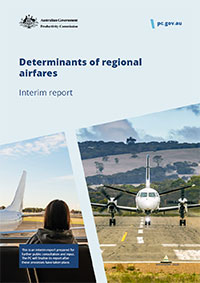
Air travel connects regional and remote Australians to healthcare, work, family and essential services. This interim report examines why regional airfares are often higher than fares between major cities and what governments can do to improve outcomes.
It finds that high fares largely reflect the cost of serving small populations, although fares, profits and opportunities for competition vary widely across routes.
The report proposes better-targeted government support to maintain connectivity, help patients travel for healthcare and fund critical airport infrastructure.
Download the report
 Executive summary (PDF 568.2 KB)
 Executive summary (DOCX 4.1 MB)
 Chart data (XLSX 56.9 KB)
Submissions are due by Tuesday 22 December 2026.
Public hearings
We will be holding hearings on:
- Friday 27 November 2026
- Monday 30 November 2026
- Wednesday 2 December 2026.
Hearings will be held online via MS Teams.
Registration for hearings will close on Thursday 19 November 2026.
Public webinar
This inquiry will hold a public webinar on Tuesday 17 November 2026 at 12 pm AEDT.
Join Commissioners Catherine de Fontenay and Martin Stokie as they present their findings and reform directions on the interim report. Attendees will also have the opportunity to ask questions about the report and inquiry process during the Q&A session.
Report sheds light on the cost of regional air travel
Airfares on regional routes are higher on average than on major city routes, largely due to the costs of serving smaller and more dispersed markets, according to a Productivity Commission report. The interim report of the inquiry into regional airfares says government support is best targeted towards people and communities that depend most on air travel.
The interim report uses data from airlines not previously available for analysis, alongside perspectives from regional communities across Australia collected through visits, consultations and surveys.
‘Many regional communities are frustrated by the high cost of flights. Previous government inquiries have looked at the issue, but until now we haven’t had the data or the evidence to understand what really sets the prices,’ said Commissioner Catherine de Fontenay.
‘For the first time, we’ve been given access to confidential cost and revenue data from the airlines. We now have a much better idea of what it costs to provide air services in the regions and the factors driving the high fares experienced by many communities,’ said Commissioner de Fontenay.
The report finds that on average, regional and remote airfares were 13% higher per kilometre than on major city routes between 2023 and 2025, but on some routes, such as short regional and short remote routes, the fare per kilometre was more than double.
The data shows that the higher prices of regional air services are largely due to the costs of providing them. Operating costs make up about 91% of the fare, on average, while profit margins average about 9%, broadly comparable to major city routes.
‘The data shows that the main reason regional flights are more expensive is because they cost more to operate,’ said Commissioner Martin Stokie.
‘Half of regional and remote routes operate 10 or fewer flights per week and more than a third of their seats are empty. When operators have to spread the costs of running flights across a small number of passengers, they’re often choosing between charging higher fares or running at a loss,’ said Commissioner Stokie.
However, the report finds that costs and profit margins vary widely between routes. On short remote routes with few passengers, profit margins can be lower than 5%, threatening their sustainability, while on mining routes, profits are significantly higher than average.
‘There is no single regional aviation market. The challenges facing a remote island community are very different to those facing a large regional tourism destination or a mining centre,’ said Commissioner de Fontenay.
The report finds competition is limited across regional aviation. More than 90% of regional and remote passengers flew with Qantas Group or Virgin Australia in 2025, while 72% of routes were served by only one carrier.
Many routes do not have enough passengers to sustain competing airlines. But on larger routes, barriers including economies of scale, network advantages, corporate travel relationships and brand loyalty can make it difficult for new airlines to enter and expand. The report says governments should aim to remove barriers to competition and avoid ongoing assistance for individual carriers.
If governments want to support regional air routes, the report says they should use transparent criteria and target those who would otherwise be unable to afford necessary travel.
‘We spoke to people in communities all around Australia who told us how important air travel is for them. Government policy should focus on maintaining important connections and ensuring people can access essential services,’ said Commissioner Stokie.
The report recommends governments pay particular attention to people travelling for medical care. It proposes strengthening patient assisted travel schemes to reduce barriers to healthcare for people in regional and remote communities, including by considering eligibility and coverage, and arrangements that reduce upfront financial costs for patients.
‘Government assistance should focus on keeping communities connected, rather than supporting particular airlines,’ said Commissioner de Fontenay.
The report also recommends governments take a system-wide approach to regional airport funding, prioritising the infrastructure that communities need to maintain connections and essential services.
‘Too often governments consider support for airports on a case-by-case basis – which risks giving too much funding to some airports and not enough to others,’ said Commissioner Stokie.
Submissions and registrations for public hearings are now open to inform the final report of the inquiry, which will be delivered to the government in April 2027.
Preliminaries: Cover, Copyright and publication detail, Opportunity for comment, Terms of reference, Disclosure of interests, Acknowledgments, AI disclosure, and Contents
Executive summary
Findings and reform directions
Information requests
- Understanding regional aviation
- 1.1 The regional aviation landscape
- 1.2 Air travel delivers social and economic benefits
- 1.3 Fares on regional and remote routes are higher
- 1.4 Policy should reflect the diversity of regional aviation
- What determines regional airfares and service outcomes?
- 2.1 Demand, costs and competition determine airfares
- 2.2 Demand is shaped by location, price and service quality
- 2.3 Costs are the main driver of regional airfares
- 2.4 High fares do not necessarily mean high profitability
- Competition in regional aviation
- 3.1 Competition in regional aviation is limited
- 3.2 Competition may not be sustainable on many routes
- 3.3 On high-volume routes there are barriers to more airline competition
- 3.4 Creating the conditions for competition
- Supporting regional air travel
- 4.1 Supporting access to and delivery of public services
- 4.2 Preserving aviation routes that are central to connectivity
- 4.3 Travel supporting wider socio-economic participation
- Sustainability of regional airports
- 5.1 The role and importance of regional airports
- 5.2 Financial performance reflects cost recovery choices
- 5.3 Infrastructure decisions should take a system-wide view
- 5.4 A framework for prioritising support for regional airport infrastructure
- 5.5 Australian Government regulation can add to regional airport costs
- A. Public consultation
- B. Data and methodology
- B.1 Main data sources
- B.2 Definitions and estimation methods
Glossary
References
Printed copies of this report can be purchased from Canprint Communications.