
Report on Government Services 2026
PART G, SECTION 19: RELEASED ON 29 JANUARY 2026
19 Homelessness services
This section focuses on specialist homelessness services funded by government under the National Agreement on Social Housing and Homelessness (NASHH). Other non-specialist homelessness services are not included in this report. The NASHH came into effect on 1 July 2024, replacing the National Housing and Homelessness Agreement (NHHA) that was in effect from 1 July 2018 to 30 June 2024.
The Indicator results tab uses data from the data tables to provide information on the performance for each indicator in the Indicator framework. The same data is also available in CSV format.
Data Downloads
- 19 Homelessness services data tables (Excel - 422.8 KB)
- 19 Homelessness services dataset (CSV - 1.1 MB)
 19 Homelessness services data tables (Excel - 422.8 KB)
 19 Homelessness services dataset (CSV - 1.1 MB)
Refer to the corresponding table number in the data tables for detailed definitions, caveats, footnotes and data source(s).
 Guide: How to find what you need in RoGS (PDF - 812.9 KB)
Context
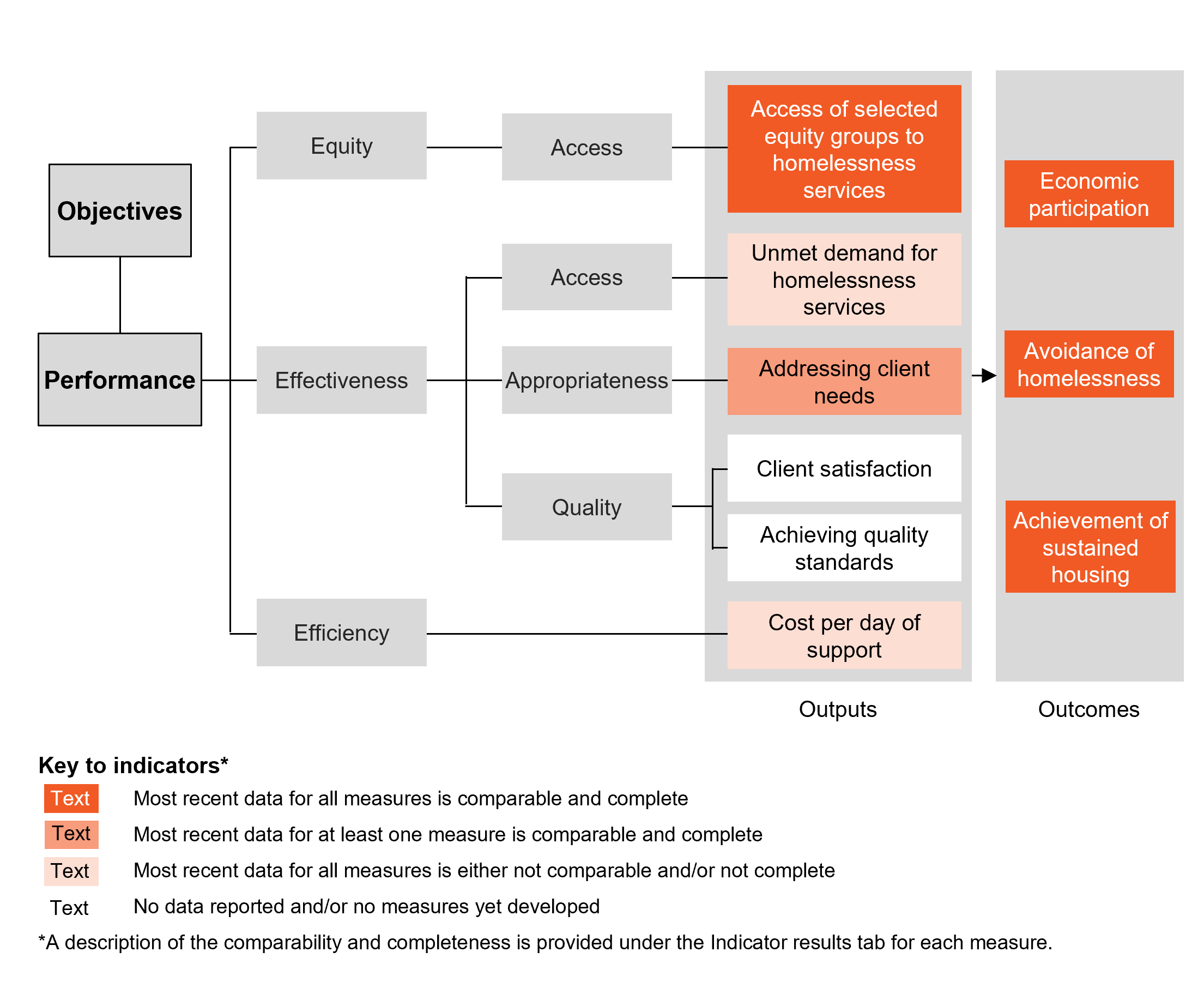
Objectives for specialist homelessness services
Specialist homelessness services aim to promote wellbeing and independence for people who are homeless or at risk of homelessness, by providing assistance that supports them to obtain and sustain housing and social and economic participation. Governments seek to achieve these aims through funding specialist homelessness services to deliver transitional supported accommodation and a range of related support services that:
- are accessible
- identify and address individuals' needs as appropriate
- are of high quality, provided by qualified staff in a safe environment.
Governments aim for specialist homelessness services to meet these objectives in an equitable and efficient manner.
Specialist homelessness services deliver a range of services to clients – including supported accommodation, counselling, advocacy, links to housing, health, education and employment services, outreach support, brokerage and meals services, and financial and employment assistance.
Accessing homelessness services in Australia
Systems for the assessment, intake, referral and ongoing case management of specialist homelessness services clients vary across states and territories. This variation may affect data comparability for specific performance indicators. Three service model categories are described below. Table 19.1 summarises the service model in each jurisdiction and the category to which they most closely align.
- Community sector funding and support – Assessment of client needs and intake into services is managed by individual specialist homelessness service providers in line with state or territory policies. Referral to other service providers is made if clients’ needs are not able to be met by the initial provider. These systems may be supported by a coordinating service that links clients to local specialist homelessness service providers. Coordinating services may also make an initial assessment of clients’ needs (but do not provide homelessness services directly).
- Central information management – Assessment of client needs, intake and referral is managed by any specialist homelessness service provider using state or territory central information management tools. The central information management system supports the identification of appropriate services for the client and indicates the availability/vacancy of those services across specialist homelessness service providers. Client information may be shared between providers upon referral (with client consent).
- Central intake – Assessment of client needs, intake and referral is managed by one or more ‘central intake’ agencies. Central intake agencies prioritise client access to services. For specialist homelessness services, clients are referred as services and/or vacancies are available. Central information management tools may be used to share information between central intake agencies and specialist homelessness service providers.
| State or Territory | System name | Description | Categorya |
|---|---|---|---|
| NSW | Link2home | Assessment and referral for homelessness services may be conducted by: 1) any specialist homelessness service provider; 2) the Link2home information and referral service; or 3) the NSW Domestic Violence Line. It is supported by a centralised service directory and vacancy management system. | Central information management |
| Vic | Opening Doors | Place‑based entry points operate across 17 local areas to provide assessment and coordinate intake into homelessness services, with a 24 hour response. | Central intake |
| Qld | Queensland Homelessness Information Platform | Assessment and referral for homelessness services is conducted by any specialist homelessness service provider. The information platform provides a consistent assessment, referral and prioritisation process. | Central information management |
| WA | Entrypoint Perth | Provides: - information, assessment and referral to specialist homelessness service providers in the metropolitan area ‑ information on accommodation and support options in regional WA ‑ information, assessment and referral to specialist homelessness service providers for individuals and families experiencing domestic violence in regional WA. | Community sector funding and support |
| SA | Homeless 2 Home | Provides client assessment, intake, referral and ongoing case management system accessible to specialist homelessness service providers. | Central information management |
| Tas | Housing connect | Client intake and referral is managed using a ‘front door’ model across the state. Clients receive housing and/or homelessness assistance and are connected to support for the duration of need. Referrals to and from crisis accommodation are made so that ‘no wrong door’ access is available to all people seeking housing and/or homelessness assistance. A shared information system streamlines the integrated Housing Connect model. | Central intake |
| ACT | OneLink | OneLink is the single intake and referral provider for the ACT. OneLink undertakes initial assessment, prioritisation of clients, and allocation to available vacancies in homelessness accommodation and/or support. OneLink does not undertake case management. It manages a waiting list for those who cannot be immediately assisted and provides information and advice. Brokerage funding is available to assist those in urgent need of help including those who cannot be immediately accommodated in a service. | Central intake |
| NT | SupportLinkNT | SupportLinkNT provides a fully managed referral service to NT Government Departments and Non‑Government Organisations to refer consenting clients to Non‑Government Organisations and other Government agencies for social support issues. All Specialist Homelessness Services undertake client referrals and assessments. | Central information management |
a The category provided is the most closely aligned to the jurisdictions intake and referral system. Each state and territory’s intake and referral system has its own characteristics.
Source: State and territory governments.
From 1 July 2024, specialist homelessness services are funded and delivered under the National Agreement on Social Housing and Homelessness (NASHH) and related Partnership Agreements between the Australian Government and state and territory governments.
Government funded specialist homelessness services are jointly funded by the Australian Government and state and territory governments via the homelessness component of NASHH funding. The homelessness component is matched equally between the Australian Government and state and territory governments.
State and territory governments are responsible for service delivery.
Direct expenditure on specialist homelessness services is undertaken by state and territory governments. Recurrent government expenditure on specialist homelessness services in 2024-25 was $1.8 billion (or $64.05 per person in the population) (table 19A.1) – 96.5% of which was provided to agencies to deliver specialist homelessness services. The remaining 3.5% was attributed to state and territory government administration costs (table 19A.1).
Population
Data on the prevalence of homelessness is sourced from the Australian Bureau of Statistics (ABS 2023). Nationally in 2021, approximately 48.2 Australians per 10,000 people in the population were experiencing homelessness on Census night – a decrease from 49.8 per 10,000 people from 2016 (table 19A.2). The rate was higher for Aboriginal and Torres Strait Islander people (approximately 306.8 per 10,000 people), and lower for people with disability (41.9 per 10,000 people) (table 19A.3).
The number of people aged 55 years or over experiencing homelessness increased by 30.4% between 2011 and 2021 (table 19A.4). The increase was greater for women (37.4%) than men (26.7%) (table 19A.4).
The ABS definition of homelessness includes six operational groups (rates are provided in table 19A.2). The proportion of the population experiencing homelessness in each group varies – in 2021, the highest proportion was ‘persons living in severely crowded dwellings’ (39.1%) (table 19A.2) (refer to 'Explanatory material' tab for what constitutes ‘severely crowded’). Similar proportions of people experiencing homelessness were living in supported accommodation provided by specialist homelessness service providers (19.8%) and in boarding houses (18.1%). People staying temporarily in other households comprised 13.5% of people experiencing homelessness. People in improvised dwellings, tents or sleepers out comprised 6.2% of people experiencing homelessness and 3.2% were in other temporary lodgings on Census night 2021 (table 19A.2).
Services
Specialist homelessness services provide a range of support services, including accommodation and accommodation-related assistance along with other specialist services (AIHW 2024). In 2024-25, services were provided to 288,970 people (figure 19.1).
A PDF of Part G Housing and homelessness can be downloaded from the Part G sector overview page.