Report on Government Services 2026
PART G, SECTION 18: LATEST UPDATE 3 JUNE 2026
18 Housing
Latest update 3 June 2026
Indicator results for:
Context on:
This section presents data on the performance of governments in providing social housing, including public housing, state owned and managed Indigenous housing (SOMIH), community housing and Indigenous community housing (ICH).
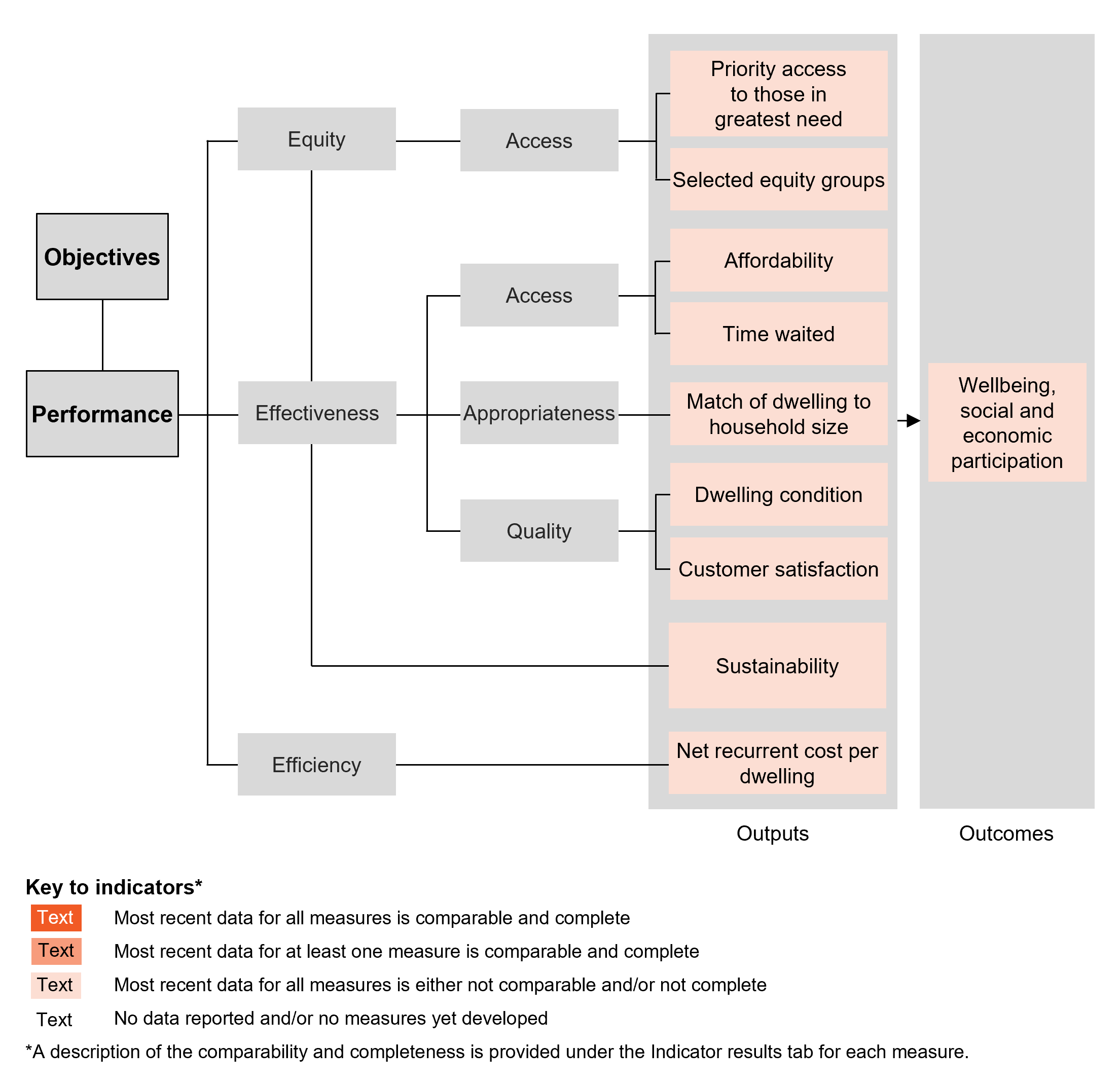
The Indicator results tab uses data from the data tables to provide information on the performance for each indicator in the Indicator framework. The same data in the data tables is also available in CSV format.
Data downloads
 18 Housing data tables (Excel - 425.1 KB)
 18 Housing dataset (CSV - 951.4 KB)
Refer to the corresponding table number in the data tables for detailed definitions, caveats, footnotes and data source(s).
 Guide: How to find what you need in RoGS (PDF - 812.9 KB)
Context
Objectives for social housing
Social housing services aim to provide people with low incomes who do not have alternative suitable housing options with access to social housing assistance that supports their social and economic participation and their wellbeing. The social housing services system seeks to achieve these aims through the provision of services that are:
- timely and affordable
- safe
- appropriate, meeting the needs of individual households
- high quality
- sustainable.
Governments aim for social housing services to meet these objectives in an equitable and efficient manner.
Social housing is subsidised rental housing provided by not-for-profit, non-government or government organisations to assist people who are unable to access suitable accommodation in the private market. Four types of social housing are reported in this section.
Types of social housing
- Public housing: dwellings owned (or leased) and managed by state and territory housing authorities. Public housing is generally accessed by people with low incomes and/or people in selected equity groups, and aims to provide a choice of housing location, physical type and management arrangements.
- State owned and managed Indigenous housing (SOMIH): dwellings owned and managed by state and territory housing authorities that are allocated only to Aboriginal and Torres Strait Islander tenants, including dwellings managed by government Indigenous housing agencies.
- Community housing: rental housing provided to low-to-moderate income households and/or people in selected equity groups, managed by community-based organisations that lease properties from government or have received a capital or recurrent subsidy from government. Community housing organisations (CHO) typically receive some form of government assistance, such as direct funding for the provision of land and property, but a number of CHOs are entirely self-funded. The key terms section on the Explanatory materials tab provides further information on different models of community housing.
- Indigenous community housing (ICH): dwellings owned or leased and managed by ICH organisations and community councils. ICH models vary across jurisdictions and can also include dwellings funded, managed or registered by government. ICH organisations include community organisations such as resource agencies and land councils.
Crisis and transitional housing is another type of social housing but cannot be separately identified in this report. Some crisis and transitional housing may be indirectly reported as forms of social housing in this report.
From 1 July 2024, social housing is funded and delivered under the National Agreement on Social Housing and Homelessness (NASHH) and related Partnership Agreements between the Australian Government and state and territory governments. This section does not report on housing programs provided outside the NASHH.
State and territory governments have primary responsibility for delivering social housing services either directly through public housing and SOMIH or through funding community housing providers. ICH is generally managed by ICH organisations (although some ICH dwellings are managed by state and territory housing authorities).
State and territory government net recurrent expenditure on social housing was $5.9 billion in 2024-25, an increase of $0.4 billion from 2023-24. In 2024-25, this expenditure included $4.4 billion for public housing and $539.4 million for SOMIH (table 18.1). Australian Government funding for services under the NASHH and related agreements was $1.9 billion in 2024-25 (refer to table GA.1 in the Housing and Homelessness Sector Overview). State and territory government capital (non‑recurrent) expenditure for social housing was $4.9 billion in 2024-25 (table 18A.1).
Nationally at 30 June 2025, there were 429,567 households and 450,607 social housing dwellings (tenancy rental units for community housing) (figure 18.1).
While the number of households living in public housing has decreased over the past decade (312,219 in 2016 to 285,256 in 2025), there has been an increase in the number of households living in community housing over the same timeframe, from 72,038 to 110,326 (table 18A.4). This in part reflects transfer of some public housing stock (management and/or title) to the community housing sector (table 18A.2), in line with government policy to expand the role of community housing in the provision of social and affordable housing.
Community housing programs vary within and across jurisdictions in their administration and the types of accommodation they provide. Refer to Key Terms in the Explanatory material tab for details on community housing models.
When analysing performance information across jurisdictions, it is important to consider differences in service delivery models, geographic population distribution (tables 18A.5–7), eligibility criteria for housing assistance and factors affecting waitlists. Some information on the context for public housing, SOMIH and community housing is provided in table 18.2.
Eligibility criteria for access to social housing
Eligibility criteria for social housing vary across social housing types and jurisdictions.
- Public housing – in most cases, jurisdictions require that applicants are Australian citizens or permanent residents and do not own or partially own residential property. All jurisdictions, except Victoria, require eligible applicants to reside in the respective state or territory. Most jurisdictions provide security of tenure after an initial probationary period and most jurisdictions have periodic reviews of eligibility (table 18.2).
- SOMIH – criteria are generally consistent with those for public housing once an applicant has been confirmed as Aboriginal and/or Torres Strait Islander. Terms of tenure for SOMIH are the same as those for public housing in most jurisdictions.
- Community housing – criteria are generally consistent with those for public housing in each jurisdiction.
| NSWc | Vicd | Qlde | WAf | SAg | Tash | ACTi | NTj | |
|---|---|---|---|---|---|---|---|---|
| Eligibility: Income and other asset limits vary depending on household type [number in square bracket refers to the number of people in the household] | ||||||||
| Income limit per week ($) | 780 (gross) [1] | 786 (Priority) [1] 1157 (ROI) [1] | 609 [1] | 540 [1] | 868 [1] | 797 [1] (new Tenants) | 858 [1] | 1088 [1] |
| Other asset limits ($) | By assessment of household circumstances | 22,998 (Priority) 58,183 (ROI) | 116,375 [1] 148,625 [>=2] | 38,400 [1] | 56,600 [1] 72,200 [>=2] | 35,000 (new Tenants) | 40,000 | 83,474 [1] |
| Minimum age (years) | 18 | 15 | None | 16 | None | 16 | 16 | 16 |
| Waitlist: Segment by | Single list of approved clients | Six priority segments and a register of interest | Need (four segments) | Two segmens by housing need (priority and wait turn) | Need (four segments) | Three levels: Highest Priority; Standard Priority; General | Need (three segments) | Two segments: Priority; General. |
| Tenure | ||||||||
| Probation period | 12 months | None | None | None | 12 months | 6 months | None | 6 months |
| Fixed term | 2, 5 or 10 years | None | 3 years (new tenancies) | No specific term | 1, 2, 5 and 10 years | Limited usage (from Jan 2024) | Apply in specific circumstances | Offered as a probationary agreement only |
| Ongoing | Tenants housed before 1 July 2005 | Yes | Yes | Ongoing | Tenants housed before 1 October 2010 | Ongoing (from Jan 2024) | Yes | Yes |
| Tenancy review | Yes | None | Yes (review of ongoing need and eligibility) | Annually and at end fixed term agreements | Prior to end of lease for probationary / fixed term tenancies | Annual | Limited review arrangements apply | Annually, on rental rebate application and at end fixed term agreements |
| Rebated rent setting: rent to income ratio (%) | ||||||||
| 25–30 | 25 | 25 | 25 | 25–30 | 25 | 25 | 25 | |
a At 30 June. b For further information, refer to state and territory government websites. c NSW: The first $5,000 of financial assets is exempt from assessment. Applicants under 18 years may be considered in certain circumstances. Shorter leases apply in particular circumstances. Tenancy review criteria: ongoing eligibility; disability, medical condition or permanent injury. Rent to income (ROI) ratio is based on household size, type and gross assessable income d Vic: Income/other asset limits effective from 15 May 2025 and are based on a single person household. Rent to income ratios: 25% of assessable primary income, 15% of Centrelink family payments (A) and (B) / Maintenance Payments. Higher asset limits apply where major disability modifications required. e Qld: Six month periodic tenancies apply in certain circumstances. Tenancy review policies include ongoing eligibility and a continuing need for the property. f WA: Higher income limits apply in the north west and remote areas. g SA: Income limits regularly updated based on SA Average Weekly Earnings (ABS data). Asset limits regularly updated based on Centrelink asset limits. Lease length based on compliance with conditions of tenancy and household circumstances. h Tas: Income and asset limits apply to new applicants and are updated regularly based on Low Income Health Care Card eligibility (most recently on 20 September 2025). For an existing single adult tenant, limits are $86,667 (income) and $122,443 (assets) and are updated annually pursuant to the Residential Tenancy Regulations 2015. i ACT: Tenancy review: income exceeding $103,582 in consecutive years and sustainable in the longer term. Fixed term tenancies: tenants with poor tenancy history required to access support and follow additional tenancy terms for 12 months; tenancy termination is possible if terms not followed. j NT: The household asset limit applies to new applicants or existing tenants under 55 years of age. For existing tenants aged 55 years or over, the limit is $300,992 (single, no dependants).
Source: State and territory governments (unpublished).
State owned and managed Indigenous housing policy context
As for public housing with the following exceptions:
- New South Wales: Tenure ongoing for all tenants
- Tasmania: Aboriginal Tenancy Allocation Panels assist in culturally appropriate allocation of properties. Waitlists segmented by need (three levels Category A, B and C)
- Northern Territory: dwellings are in Remote Communities, Town Camps and community living areas. Dwelling allocation is according to recommendations by local community Housing Reference Groups - applicants are prioritised according to need. Eligibility criteria include acceptance of the applicant as a permanent community resident. Income and other asset limits are not applicable. Rent to income ratio is 25% or less. Scheduled safety net tenancy review is based on income type(s).
Community housing policy context
As for public housing with the following exceptions:
- New South Wales: No tenure probation period; tenure is ongoing for all tenants. Rent to income ratio is 25–30% for tenant and spouse/live–in partner (15% for Family Tax Benefit recipients), and 15% for other household members aged 18–20 years
- Victoria: Public housing eligibility criteria apply for community housing organisations (CHO) participating in the Victorian Housing Register and are based on single person household. Other CHOs – rent to income ratio is 30% or less; minimum age, tenure and rent-setting policies are in accordance with their own policy, mission statement and vision
- Queensland: A tenure probation period may apply at CHO discretion. Tenure length and review based on ongoing need and eligibility. Rent includes 100% of Commonwealth Rent Assistance a household is entitled to receive.
- Western Australia: Higher income and asset limits apply for people living with disability and people aged over 60 years
- South Australia: Probationary tenure period – 12 months standard, up to 24 months. Fixed term tenure for up to 10 years
- Tasmania: Tenure settings vary according to CHO policy
- Australian Capital Territory: Additional eligibility criteria may apply according to the CHO’s target group (including disability status). Tenure is ongoing
- Northern Territory: Policy information is not available.
Factors affecting waitlists
State and territory governments prioritise access to social housing in ways that generally reflect the urgent need to address homelessness and applicants’ inability to access appropriate private market accommodation (AIHW 2024a). All states and territories have adopted social housing waitlists that are integrated across public housing, SOMIH (where applicable) and community housing.
Time waited for social housing is impacted by the availability of suitable dwellings. Nationally at 30 June 2025, the proportion of rental stock occupied was 96.7% for public housing, 93.6% for SOMIH, 95.6% for community housing, and 92.1% for ICH (tables 18A.10–13). Occupancy rates are influenced by tenancy turnover as well as by housing supply and demand – dwellings that have, for example, reached the end of their useful life may require major redevelopment or replacement before being allocated to a new household.
‘Turnaround time’ is the number of days taken to allocate a newly vacated dwelling (that is fit for occupation) to a new household. The average turnaround time for vacant public housing and SOMIH stock varied within and across jurisdictions and over time (tables 18A.14–15) – noting that data is not comparable or complete across jurisdictions.
Note: An errata was released for section 18, Housing, on 10 June 2026.
The following changes have been made to section 18:
- Commentary text under Indicator results – 5. Match of dwelling to household size: Nationally at 30 June 2025, the proportion of households that were overcrowded varied across social housing types (4.3% for public housing [not 4.4%]).
- Table 18.5, figure 18.5 and data table 18A.32 have been updated: 2025 public housing 4% for Victoria and a consequential 4.3% Australian total.
- Data table 18A.36 has been updated: 2025 public housing total (with bedroom details known) 3,999 for Victoria and a consequential 39,999 Australian total. 2025 public housing living in overcrowded conditions 322 for Victoria (8.1%) and a consequential 3,864 Australian total.
- Data table 18A.37 has been updated: 2024-25 major cities 8.0%, inner regional 8.3% and outer regional 7.4% for Victoria and a consequential 2024-25 major cities 8.5%, inner regional 9.0% and outer regional 11.9% Australian total.
- Data table 18A.39 has been updated: 2025 public housing 18.1% for Victoria and a consequential 16.7% Australian total.
A PDF of Part G Housing and homelessness can be downloaded from the Part G sector overview page.