Report on Government Services 2026
PART D: RELEASED ON 3 FEBRUARY 2026
D Emergency management

 Emergency management – sector overview and sections (PDF - 3.6 MB)
Main aims of services within the sector
Emergency management services aim to:
- reduce the risk of emergency events
- reduce adverse effects from emergency events on people, communities and the environment.
An emergency event is an event that endangers or threatens to endanger life, property or the environment, such as fires, rescues, medical emergencies and natural disasters. Emergency events require a significant and coordinated response.

Emergency services for fire and other events
Fire services prepare for, prevent, respond to and assist recovery from fire and other events. State and Territory Emergency Services (STES) are largely volunteer organisations that respond to and provide assistance during and after emergency events such as natural disasters.
- The total revenue of fire service organisations was $6.6 billion in 2024-25 (including Western Australia STES1), a real increase of 4.4% from 2023-24.
- STES revenue (excluding Western Australia) in 2024-25 was $448.9 million, a real decrease of 11.0% from 2023-24.
- 472,361 emergency incidents were attended by fire service organisations in 2024-25, of which 21.5% were fire events.
- 101,662 incidents were attended by STES organisations (excluding Queensland2) in 2024-25, of which 71.7% were storm and cyclone events.
Detailed information on the equity, effectiveness and efficiency of service provision and the achievement of outcomes for emergency services for fire and other events is contained in the service-specific section.
- A single department is responsible for both fire and emergency services in Western Australia and revenue cannot be separately reported for their state emergency service. Locate footnote1 above
- Queensland does not record the number of incidents. Locate footnote 2 above
There are various emergency services involved in the emergency management sector.
Other aspects of the emergency management system
Effective emergency management relies on the collaborative effort of a range of government and non‑government stakeholders3 including:
- local, state, and federal governments (for example, fire and rescue services, land management agencies, reconstruction agencies)
- volunteers and volunteer organisations
- critical infrastructure owners and operators
- the not-for-profit sector and non-government organisations.
Ambulance services (for medical emergencies) and police services (for public safety) are also involved in the emergency management sector. The health section of this report presents further information on the performance of ambulance services (section 11) and the justice section presents further information on the performance of police services (section 6).
Hospital emergency departments also provide services related to emergency events. Further information on public hospital emergency departments is available in section 12.
Marine and lifesaving rescue and coast guard organisations also have some emergency management responsibilities. However, data on these services is not included in this report.
- Further information is available in the Australian Emergency Management Arrangements Handbook (AIDR 2023). Locate footnote 3 above
Government expenditure in the sector
Total government expenditure for fire services and state and territory emergency services in this report was $7.4 billion in 2024-25. For the 2023-24 financial year (the most recent financial year for which data is available across all sections), fire and STES expenditure represented around 1.7% of total government expenditure covered in this report.
Information on ambulance services and public hospitals expenditure is reported in the Health sector overview, and information on police services expenditure is reported in the Justice sector overview.
Four key policy frameworks guide Australian emergency management processes (Australian Emergency Management Arrangements Handbook (AIDR 2023):
- Australian Government Crisis Management Framework (Commonwealth of Australia 2025)
- National Strategy for Disaster Resilience (Council of Australian Governments [COAG] 2011)
- Sendai Framework for Disaster Risk Reduction 2015-2030 (UNODRR 2015)
- National Disaster Risk Reduction Framework (Commonwealth of Australia 2018).
These frameworks outline key priorities and principles for emergency management policy including:
- the need for a greater focus on natural hazard prevention, mitigation and preparedness
- shared responsibility for emergency management between a range of stakeholders including community, business and government
- the importance of managing disaster risk.
Shifting focus to prevention, mitigation and preparedness
Four phases of emergency management underpin Australia's emergency management arrangements: prevention and mitigation, preparedness, response and recovery (PPRR), known as the 'comprehensive approach' (AIDR 2023). The phases are not always distinct or sequential – for instance, 'building back better' recovery activities can also mitigate the impact of future hazards.
The need to shift focus from response and recovery efforts to prevention, mitigation and preparedness efforts has been emphasised in national emergency management frameworks and inquiries in recent decades, including the National Strategy for Disaster Resilience (COAG 2011), the Royal Commission into National Disaster Arrangements (Commonwealth of Australia 2020), the Productivity Commission's Inquiry into Natural National Disaster Funding Arrangements (Productivity Commission 2015) and the Independent Review of Commonwealth Disaster Funding (Colvin 2024).
Prevention and mitigation
Prevention measures aim to remove or reduce the impact of future hazards. Mitigation measures accept that events will occur and try to reduce the inevitable impact of natural hazards. Prevention and mitigation measures include:
- community education and awareness
- critical infrastructure protection
- ensuring access to publicly available geologic and topographic mapping and hazard monitoring services
- implementing specific hazard and disaster risk research studies (AIDR 2023).
Preparedness
Preparedness includes the ability to:
- be ready for a hazard – for example, developing household emergency plans, preparing emergency kits and public warning systems
- to plan action in response to or recovery from a hazard – for example, developing tailored response and recovery plans (AIDR 2023).
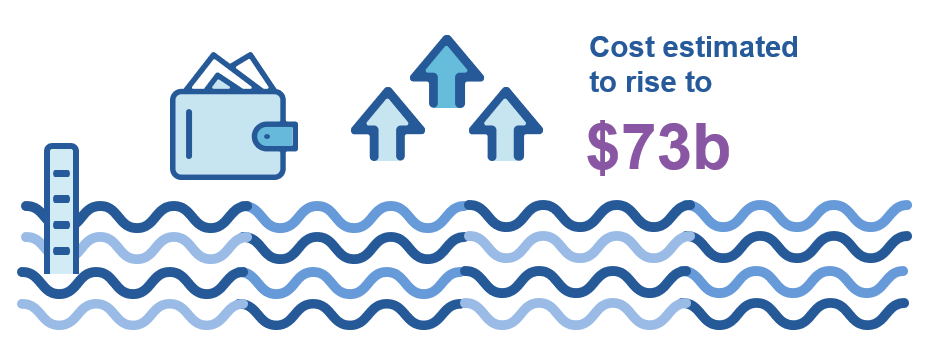
National disasters in Australia have significant social and financial impacts on people, businesses, communities and governments. The estimated total economic cost of natural disasters is forecast to increase from $11.8 billion in 2023-24 to $40.3 billion in 2049-50 (Colvin 2024). Based on this forecast, it is estimated the Commonwealth will have an associated disaster funding requirement of $8.8 billion in 2049-50 (Colvin 2024).
In Australia, floods are the second most significant natural disaster to cause human fatalities, after heatwaves (Australian Climate Service 2024). Floods are predicted to be the highest contributor to the estimated economic cost of disasters in 2060 (ABRT 2021).
While flooding can be a natural process with positive benefits, floods can also have negative impacts on the social, economic, natural and built environments (BoM 2024). Recovery from floods can be prolonged and costly, with social and economic costs that can deeply impact local communities (AIDR 2020).
Flood mitigation, prevention and preparedness measures
Flood studies
Flood studies are detailed technical examinations of flood behaviour that are essential for informing prevention, mitigation and preparedness efforts (AIDR 2017). Flood studies can provide information to inform the community and for emergency management planning. The Australian Flood Risk Information Portal is a central online location for flood risk information to be stored, including details of flood studies and flood maps to support people and organisations better prepare for, and mitigate against, flood risks (Geoscience Australia 2024).
Community awareness and household preparedness
Increasing community awareness of natural hazards helps to mitigate the effects of emergency events by assisting individuals and communities to prepare, respond and recover from natural hazards (AIDR 2020).
All state and territory governments undertake programs to increase community awareness of natural hazards and to support household preparedness. Examples include community awareness events, school programs providing information in community languages, providing tailored information for people living with impairment and mobile apps to provide current information about local emergencies.
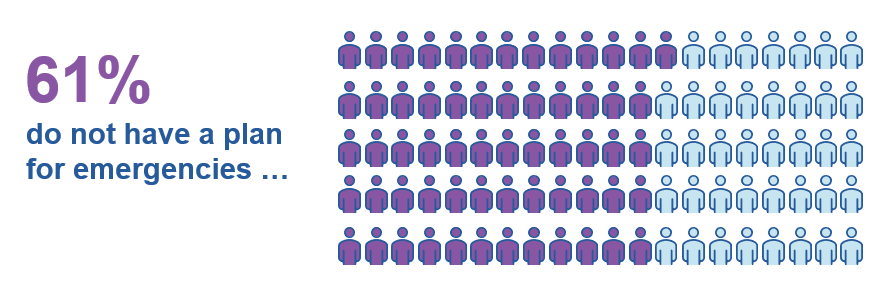
Online research of 3,500 people across New South Wales, Queensland, Australian Capital Territory, Western Australia and South Australia by NRMA Insurance found that 61% of people surveyed did not have an emergency plan for emergencies, with younger people (18–34 years) and people living in major metropolitan areas less likely to have an emergency plan (NRMA Insurance 2023). Creating household emergency plans is frequently an intended outcome of community awareness programs.
Flood warnings
Effective flood warnings alert communities and emergency services about approaching floods and encourage those at risk to take protective action. Flood warning infrastructure, such as rain and river gauges, monitor water height and rainfall levels in a catchment, and this data can be used to predict the expected scale and location of a potential flood. The Australian Government established the National Flood Infrastructure Program, which delivered $100 million in funding across 2020-21 and 2021-22 to state and territory governments for the construction or improvement of flood mitigation infrastructure (NEMA 2024).
A summary of the emergency services for fire and other events performance indicator results is presented. Detailed information is in the service-specific section.
- Response times to structure fires are shorter in major cities than in remote areas.
- Within major cities in 2024-25, 50% of first responding fire crews arrived within a range of 6.0 to 9.0 minutes including call taking time, while 90% arrived within a range of 9.3 to 13.2 minutes.
- Within remote areas in 2024-25, 50% of first responding fire crews arrived within a range of 7.1 to 17.5 minutes including call taking time, while 90% arrived within a range of 13.1 to 36.0 minutes.
- The rate of accidental residential structure fires has decreased since 2017-18.
In 2024-25:- there were 71.0 fires per 100,000 households, down from a 10-year high of 85.4 in 2017-18.
- Over the 30 years to 2024, death rates due to fires and exposure to forces of nature have fluctuated.
In 2024, the number of deaths per million people was:- 5.0 for fire deaths, compared to 12.4 in 2009
- 2.2 exposure to forces of nature deaths, compared to 3.9 in 2009.
- The value of insurance claims for fire and other events per person in the population has fluctuated over the 10 years to 2024-25.
In 2024-25, the value of claims per person was:- $30.71 for total fire events (excluding bushfire), down from a 10-year high of $43.41 in 2019-20
- $58.85 for non-fire weather events, down from a 10-year high of $147.43 in 2021-22.
References
ABRT (Australian Business Round Table) 2021, Special report: Update to the economic costs of natural disasters in Australia, https://australianbusinessroundtable.com.au/our-research (accessed 10 October 2025).
Australian Climate Service 2024, Floods, https://www.acs.gov.au/pages/6212cfadf42c4c44becef7182ead8bb6 (accessed 10 October 2025).
AIDR (Australian Institute for Disaster Resilience) 2023, Australian emergency management arrangements (third edition), https://knowledge.aidr.org.au/resources/handbook-australian-emergency-management-arrangements/ (accessed 10 October 2025).
—— 2020, Community Engagement for Disaster Resilience, https://knowledge.aidr.org.au/resources/handbook-community-engagement-for-disaster-resilience/(accessed 10 October 2025).
—— 2017, Managing the floodplain: a guide to best practice in flood risk management in Australia (Handbook 7), https://knowledge.aidr.org.au/resources/handbook-managing-the-floodplain/(accessed 10 October 2025).
BoM (Bureau of Meteorology) 2024, Understanding Floods, http://www.bom.gov.au/australia/flood/knowledge-centre/understanding.shtml (accessed 10 October 2025).
Colvin, A. 2024, Independent Review of Commonwealth Disaster Funding, https://www.nema.gov.au/about-us/governance-and-reporting/reviews/independent-review-of-commonwealth-disaster-funding (accessed 24 December 2025).
Commonwealth of Australia 2025, Australian Government Crisis Management Framework, https://www.pmc.gov.au/resources/australian-government-crisis-management-framework-agcmf (accessed 22 December 2025).
—— 2020, Royal Commission into National Natural Disaster Arrangements, https://www.royalcommission.gov.au/natural-disasters (accessed 10 October 2025).
—— 2018, National Disaster Risk Reduction Framework, https://www.nema.gov.au/about-us/governance-and-reporting/strategies-and-frameworks/disaster-risk-reduction (accessed 10 October 2025).
COAG (Council of Australian Governments) 2011, National strategy for disaster resilience, https://knowledge.aidr.org.au/resources/national-strategy-for-disaster-resilience/(accessed 10 October 2025).
Geoscience Australia 2024, Australian Flood Risk Information Portal, https://www.ga.gov.au/scientific-topics/community-safety/projects/afrip (accessed 10 October 2025).
NEMA (National Emergency Management Agency) 2024, National Flood Mitigation Infrastructure Program, https://www.nema.gov.au/our-work/resilience/national-flood-mitigation-infrastructure-program (accessed 10 October 2025).
NRMA Insurance 2023, NRMA Insurance Wild Weather Tracker Autumn 2023, https://articles.nrma.com.au/help-nation-wild-weather-tracker/(accessed 10 October 2025).
Productivity Commission 2015, Natural disaster funding arrangements, Inquiry report no. 74.
UNODRR (United Nations Office for Disaster Risk Reduction) 2015, Sendai Framework for Disaster Risk Reduction 2015‑2030 (first edition), https://www.undrr.org/publication/sendai-framework-disaster-risk-reduction-2015-2030 (accessed 10 October 2025).
We value your comments about this publication and encourage you to provide feedback.