Report on Government Services 2026
PART G: LATEST UPDATE 3 JUNE 2026
G Housing and homelessness

Data downloads
These data tables relate to the sector as a whole. Data specific to individual service areas is in the data tables under the relevant service area.
 Housing and Homelessness data tables (Excel - 97.9 KB)
 Housing and Homelessness dataset (CSV - 87.9 KB)
Refer to the sector overview text and corresponding table number in the data tables for detailed definitions, caveats, footnotes and data source(s).
Note: Data tables are referenced by table xA.1, xA.2, etc., with x referring to the sector or overview. For example, table GA.1 refers to data table one for this sector overview.
 Housing and Homelessness – sector overview and sections (PDF - 5 MB)
Main aims of services within the sector
The housing and homelessness sector provides services that support access to affordable, safe and sustainable housing for all Australians – a vital determinant of wellbeing that is associated with better outcomes in health, education and employment, as well as economic and social participation (Ong ViforJ et al, 2022). The main service outputs are:
- Provision of subsidised rental housing to assist people on low incomes who are unable to access suitable housing options in the private market
- Provision of direct assistance to people who are homeless or at risk of homelessness, to support them to obtain and sustain housing and economic participation.

Housing
Subsidised rental housing is provided by not-for-profit, non-government or government organisations.
- Total state and territory government net recurrent expenditure on social housing was $5.9 billion in 2024-25, an increase of $0.4 billion from 2023-24. This expenditure included $4.4 billion for public housing and $539.4 million for State owned and managed Indigenous housing (SOMIH).
- Nationally, at 30 June 2025, there were 450,607 social housing dwellings (tenancy rental units for community housing) and 429,567 households accessing social housing.

Homelessness services
Government specialist homelessness services provide direct assistance for people who are homeless or at risk of homelessness, including accommodation and other services such as health, counselling, education and employment services.
- Total government recurrent expenditure on specialist homelessness services was $1.8 billion in 2024-25, or $64.05 per person in the population.
- Nationally in 2021, 48.2 Australians per 10,000 in the population were homeless on Census night, a total of 122,494 people.
- The number of clients receiving support services in 2024-25 was 288,970, a 3.2% increase from 2023-24.
Detailed information on the equity, effectiveness and efficiency of service provision and the achievement of outcomes for the social housing and specialist homelessness services areas is contained in the service-specific sections.
Government expenditure in the sector
Total government funding for social housing and specialist homelessness services was around $7.7 billion in 2024‑25. For the 2023-24 financial year (the most recent financial year for which data is available across all sections), this represented around 1.7% of total government expenditure covered in this report.
Australian government funding of $1.9 billion was provided to state and territory governments through the National Agreement on Social Housing and Homelessness and related agreements in 2024-25.
Flows in the sector
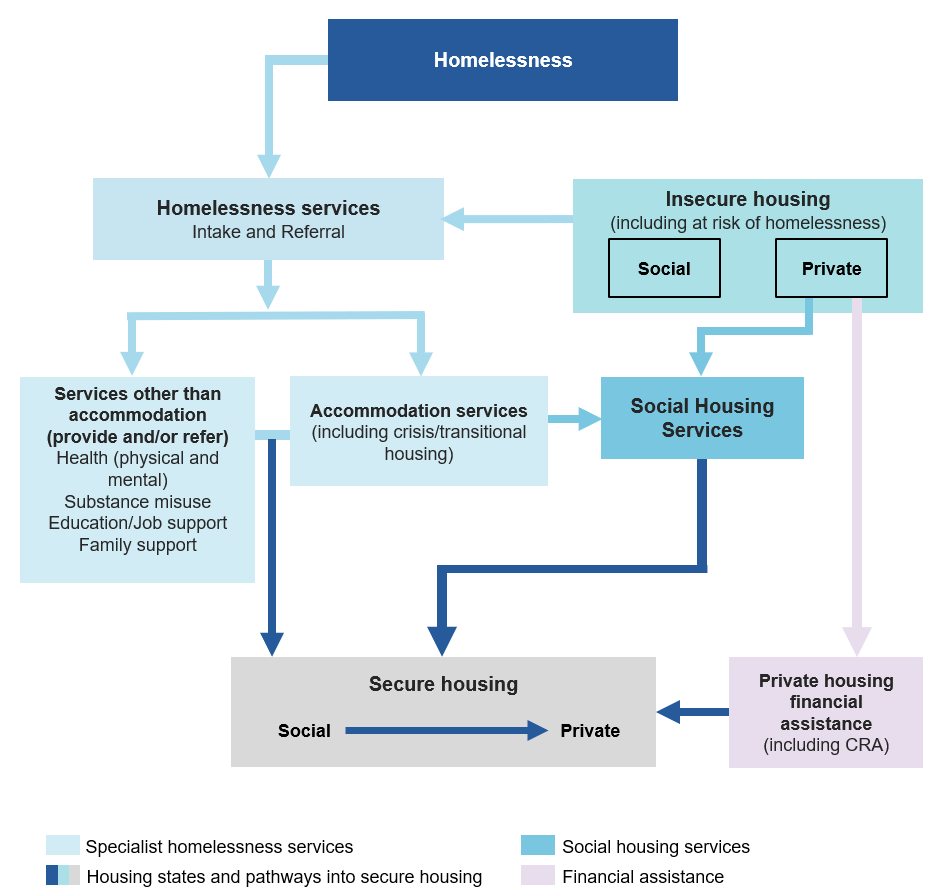
Paths into and through the housing and homelessness services sector vary widely (figure G.1). Drivers of housing instability include market factors affecting affordability and household factors such as adverse personal, social, and economic circumstances.
Figure G.1 Role of housing and homelessness sector services in pathways to secure housing
Commonwealth Rent Assistance (CRA)
Commonwealth Rent Assistance (CRA) helps individuals and families in receipt of social security payments with the cost of rent:
- Expenditure on the program in 2024-25 was $6.4 billion dollars (table GA.4)
- At end June 2025, 74.8% of low income households would have experienced rental stress without CRA, though 43.0% of low income households receiving CRA still experienced rental stress over the period (table GA.12).
Households with low incomes spending more than 30% of gross household income on rent are considered to be in 'rental stress', as rental costs may impact on the ability to afford other living costs such as food, clothing, transport and utilities. In 2019-20 52.5% of low income households renting in the private sector were paying more than 30% of gross household income on housing costs (table GA.2).
A summary of the social housing and specialist homelessness services performance indicator results is presented. Detailed information is in the service-specific sections.
- Nearly all housing across social housing types was occupied by low-income households at end June 2025
- 99.9% (public housing), 99.8% (SOMIH) and 99.6% (community housing). These figures have remained relatively stable over the past three years.
- Few public housing and SOMIH households were facing rental stress at end June 2025
- 0.2% of public housing, 0.3% of SOMIH and 3.7% of community housing households were in rental stress at end June 2025.
- In 2024-25 new social housing allocations were successfully targeted to those in greatest need1
- 84.6% (public housing), 85.1% (SOMIH) and 79.5% (community housing).
- The time waited for public housing in 2024-25 was similar to 2023-24
- 50% of newly allocated households in public housing were allocated a dwelling within nine months (as in 2023-24); 75% were allocated a dwelling within 36 months (up from 35 months in 2023-24). For SOMIH in 2024-25, 50% of newly allocated households were allocated a dwelling within nine months; 75% were allocated a dwelling within 50 months.
More information: section 18 Housing
- Greatest need households are defined as households that at the time of allocation are homeless, in housing inappropriate to their needs, in housing that is adversely affecting their health or placing their life and safety at risk or have very high rental housing costs.
- Most homelessness services clients needed assistance with accommodation in 2024-25
- Over half (54.3%) of clients with closed support periods needed accommodation or accommodation related assistance. Of these clients, 63.1% were directly provided with and/or referred for a service, down from 63.4% in 2023-24.
- Nationally, most clients at risk of homelessness avoided homelessness in 2024-25
- Of all clients at risk of homelessness, 81.3% avoided homelessness. For Aboriginal and Torres Strait Islander clients at risk of homelessness, 78.7% avoided homelessness.
- Some clients experienced a return to homelessness or persistent homelessness
- The proportion of clients who returned to homelessness after achieving housing was at a five year national low of 9.8% in 2024-25.
- Of all clients who experienced homelessness nationally in 2024-25, 27.4% experienced persistent homelessness (that is, were homeless for more than seven months over the 24 month reporting period).
More information: section 19 Homelessness services
References
Ong ViforJ, R, Singh, R, Baker, E, Bentley, R and Hewton, J 2022, Precarious housing and wellbeing: a multi-dimensional investigation, AHURI Final Report No. 373, Australian Housing and Urban Research Institute Limited, https://www.ahuri.edu.au/research/final-reports/373 (accessed 7 October 2025).
We value your comments about this publication and encourage you to provide feedback.